3D vs. 2D Medical Animation: When to Choose Each
Healthcare and pharma teams often ask whether their project needs 3D or 2D animation. The honest answer is that the right choice depends on what you are trying to show, to whom, and at what stage of the buying or approval cycle.
Choose 3D medical animation when:
- The content requires showing anatomical structures, internal device components, molecular mechanisms, or surgical steps from multiple camera angles — things 2D cannot represent with clinical depth.
- Your audience includes surgeons, physicians, or regulatory reviewers who expect a level of anatomical detail and three-dimensional realism that flat illustration cannot deliver.
- The animation needs to support multiple outputs from the same asset — surgeon training, patient education, investor presentation, and FDA-review submission — where a fully rendered 3D master can be re-versioned for each audience without rebuilding from scratch.
- You have device CAD files, molecular models, or anatomical reference that can be translated directly into 3D assets, making the production more accurate and faster to review.
Choose 2D medical animation when:
- The message is primarily conceptual — explaining a treatment protocol, patient journey, or health behavior — and flat, illustrated visuals communicate it as clearly as photorealistic 3D at a lower production cost.
- The target audience is patients, caregivers, or general consumers who benefit from a warmer, less clinical visual style.
- Your timeline is tight and a 3D render pipeline would exceed your review window.
Austin Visuals produces both 3D and 2D medical animation in-house. If you are not sure which format fits your project, send a brief to info@austinvisuals.com and we will recommend the right production path before any contract is signed.
Who we make medical animations for
- Medical device companies that need one video to work for sales reps, trade show booths and training sessions.
- Physician inventors who have built a new device and need to explain it to buyers and investors before it is widely known.
- Surgeons and hospitals teaching a new technique to colleagues at conferences and in training programs.
- Pharmaceutical and biotech teams presenting a mechanism of action to physicians, medical meetings or investors.
- Medtech consultants and agencies who manage the launch and bring in a specialist studio for the 3D work.
Each of these audiences already knows a lot, or very little, about the subject. We agree who the main viewer is before writing the script, because that decides how much anatomy to show, which terms to use and how long the video should run.
Looking for one type of work? See our surgical animation, medical device animation and MOA animation pages, or forensic animation for injury and litigation visuals.
Recent medical animation projects
Start with our medical animation showreel, then read about recent projects below.
Aerin Medical: Airway Sculpting. Aerin needed physicians and patients to understand a non-surgical procedure for nasal obstruction. The animation identifies the nasal valve, upper lateral cartilage and turbinate, shows how a small narrowing raises airflow resistance, and then shows the Aerin stylus applying low-temperature radiofrequency energy to remodel tissue. It ends with an endoscopic view of the opened airway. Read the Aerin Medical case study
Dr. Shusen Cui: thoracic outlet surgery. Dr. Cui, Vice President of China-Japan Union Hospital of Jilin University, asked us to show her technique for neurogenic thoracic outlet syndrome, including an L-shaped incision and piezoelectric rib removal, with no narration. We worked across a large time difference and a language barrier with regular review rounds and delivered in 8 weeks. In her words: “They are incredible to work with and really respect my ideas, making sure everything is exactly what I want.” Read the case study
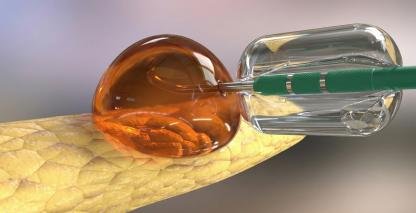
Accessor Medical: percutaneous blunt dissection device. Dr. Matthew Czar Taon, an interventional radiologist, needed to show how Accessor Medical’s device moves tissue aside to reach a target when there is no clear anatomical path. The project had a budget of $8,000, with regular updates and three revision rounds included. The video is used to explain the device to physicians and investors. Read the case study
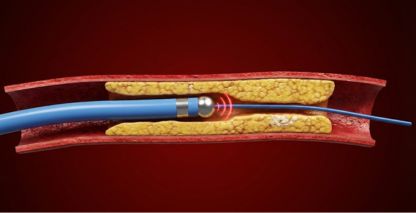
ONO endovascular retrieval device. For Med Tech Consulting we built an animation of up to three minutes covering the ONO device’s deployment, capture and retrieval, with an exploded view of its components, on-screen text and professional narration, delivered in formats ready for web, presentations and events. Read the case study
Netflix: Pain Hustlers. For the Netflix film Pain Hustlers we created a 4 to 6 second medical animation in a stylized retro look: a detailed 3D human head showing a medical device being inserted, with a brief x-ray view inside the anatomy. We delivered in stages, from previsualization to final animation, and turned around notes from the editing room quickly to match the director’s vision. Read the Netflix case study
Like all our medical work, these animations explain how a device or procedure is intended to work. They are communication tools, not clinical evidence of outcomes. See more in our case studies and the spine surgery animation.
How a medical animation project works
- Brief and references. You send what you have: CAD files, instructions for use, published papers, surgical videos, sketches. We confirm the audience (surgeons, patients, investors, regulators) and where the video will be shown.
- Script and storyboard. Our writers turn the science into a script, and our artists sketch each scene. Your medical team checks both before any 3D work starts, because a fix at this stage costs minutes rather than days.
- 3D models. We build the anatomy and the device, then share stills so your experts can check proportions, tissue layers and device details.
- Animation and reviews. You see the animation in rounds and send notes on anything that looks wrong. We keep in contact the whole way, so technical questions get answered before they turn into rework.
- Final render and delivery. We add narration, on-screen text and music if needed, then deliver the formats you need for web, trade shows, presentations and social media.
Why medical teams choose Austin Visuals
- Accuracy you sign off on. Nothing goes to final render until your clinical or scientific reviewers approve it.
- Writers as well as animators. Our 21 U.S.-based artists and writers handle the script and storyboard, so you are not left to write the story yourself.
- Work that has to hold up in front of experts. We produce MOA and surgical device animations for FDA approval, investor presentations and large medical meetings, as well as for sales and patient education.
- Experience across the body. Our medical portfolio includes cardiac, spinal, orthopedic, airway, vascular and dental animations.
- Since 2007. We have been making videos that explain complex products for nearly two decades, for clients from startups to NASA and the Smithsonian.
Our Clients include:

Frequently asked questions
How much does a medical animation cost?
It depends on length, how many anatomical structures and devices must be modeled, and whether you need narration and multiple versions. As one example, the Accessor Medical device animation had a budget of $8,000 with three revision rounds included. Send us your brief and we will give you a fixed quote. More detail: how much a medical animation video costs.
How long does it take?
Most medical animations take several weeks from brief to final delivery. Dr. Cui’s surgical animation, with full anatomical modeling and no narration, was delivered in 8 weeks.
Can you work from our CAD files?
Yes. Device animations start from your CAD data whenever it exists, so the model matches the real product. If you only have drawings or a prototype, we can model from those.
Who checks the medical accuracy?
Your team does, at every stage. We build from your references and you approve the script, storyboard, models and animation before final render.
Can the same animation be used for investors, physicians and patients?
Usually with versions. The core 3D scenes can be reused while narration, on-screen text and length change for each audience, which costs less than three separate projects.
Do you work with clients outside Texas?
Yes. We are based in Austin and work with medical clients across the U.S. and overseas, including a hospital team in China.