Choosing between photorealistic and stylized 3D animation affects how your message is trusted, understood, and remembered. Photorealistic animation emphasizes real-world accuracy and is best for technical, medical, and product visuals where credibility matters. Stylized animation focuses on clarity, emotion, and brand identity, making ideas easier to grasp and more memorable. In many projects, a hybrid approach offers the ideal balance between realism and storytelling clarity.
If you are planning a 3D animation, one of the first creative decisions is: Should it look photorealistic, or should it be stylized? The answer is not just about taste. The visual style you choose will shape how people trust the message, how memorable it is, and how much time and budget the production will require.
At Austin Visuals, we often see projects succeed or struggle based on this one choice. A medical device animation that needs clinical credibility has a different “best style” than a brand film trying to feel playful, premium, or futuristic. We approach this decision like a mix of storytelling, marketing, and production engineering.
Below is a clear, practical way to choose the right style for your goals, your audience, and your timeline.
What Is Photorealistic in 3D Animation?
Photorealistic 3D animation aims to create visuals that feel like they could have been shot with a camera. That usually means:
- Physically believable lighting and materials
- Correct scale, textures, reflections, and shadows
- Realistic motion, lens effects, and depth cues
A big part of modern photorealism comes from physically based rendering (PBR). It is a workflow that models how light behaves in the real world and how surfaces respond to it. That is why PBR is widely used when teams want consistent, realistic material results across lighting setups.
Photorealism is especially powerful for products, environments, architecture, and anything where viewers need to think, “Yes, that’s exactly what it is.”
What Stylized Means
Stylized 3D animation is an artistic approach that prioritizes clarity, emotion, and brand identity over camera-like accuracy. In computer graphics research and production, stylization often falls under non-photorealistic rendering (NPR). These techniques aim for expressive looks inspired by illustration, painting, comics, or graphic design rather than real-life optics.
Stylization can use perception and psychology to support story and meaning, and it changes depending on what the narrative needs. Stylized 3D animation can still look premium and high-end. It simply chooses a different definition of “real.”
When Photorealistic 3D Animation is the Best Choice
1. You need trust, accuracy, and proof
If your 3d animation job is to persuade stakeholders, customers, or regulators that something is real, photorealism helps.
Common examples:
- Product launches and demos (consumer and industrial)
- Medical device walkthroughs
- Architectural visualization
- Engineering and manufacturing explainers
If a viewer must judge details like surface finish, fit, scale, or how components move together, photorealism can reduce doubt.
2. Your audience expects realism
Some audiences are trained to distrust “cartoony” visuals in technical contexts. For example, procurement teams, engineers, surgeons, and investors may see photoreal as more credible in early impressions.
3. You have real-world reference material
If you can feed the project with accurate references, like CAD files, product specs, real materials, photorealism becomes more efficient and more defensible.
4. You want to blend CG with live footage
Photorealistic rendering often pairs naturally with compositing and VFX. Also, real-time engines used in virtual production increasingly aim to merge the physical and digital worlds in real time.
When Stylized 3D Animation is the Better Choice
1. You need clarity fast
Stylized visuals can simplify the scene so viewers understand the point immediately:
- Reduce detail noise
- Emphasize key elements with shape, contrast, and motion
- Remove distracting realism (busy textures, complex reflections)
This is why stylization is common in explainers, training animations, and brand storytelling.
2. Your brand must be instantly recognizable
Stylized 3D animation can become part of your brand system, like typography and logo usage. It is easier to control tone:
- Friendly, energetic, playful
- Luxury, minimal, refined
- Futuristic, abstract, tech-forward
3. You want the content to age well
Photoreal trends can date quickly when rendering tech improves. Stylized content can feel “timeless” because it is not competing with reality.
4. You want to avoid the uncanny valley with humans
If your 3D animation includes near-human digital characters, hyper-real faces and movement can backfire. The “uncanny valley” concept describes how almost-human visuals can trigger discomfort or distrust. Stylization can bypass that problem because viewers accept the world’s rules immediately.
The Production Reality
Style choices change your pipeline.
Photorealistic often requires:
- High-quality modeling and UVs
- Detailed materials, accurate textures, real-world lighting setups
- Higher render or compute demands (especially with ray tracing/path tracing approaches)
- More time spent polishing “small realism issues” (surface imperfections, realistic motion, contact shadows)
The upside: once done well, photorealism can sell premium value and high technical confidence.
Stylized often requires:
- Strong concept and art direction up front (color scripts, shape language)
- Custom shaders or NPR techniques (toon shading, outlines, graphic lighting)
- More attention to design consistency across scenes (because you’re inventing rules)
- Potentially faster iteration when stakeholders want changes (simpler surfaces, fewer “physics problems”)
The upside: you can often communicate the message with fewer assets and fewer rendering constraints, and it can be easier to adapt the visuals for campaigns, variations, or new product lines.
A Practical Decision Framework
Ask these questions in order:
1. What is the job of the animation?
- Explain (training, process, “how it works”) – stylized often wins
- Prove (product realism, investor confidence, clinical credibility) – photoreal often wins
- Differentiate (brand identity, memorability) – stylized or hybrid wins
2. Who is watching, and what do they already believe?
- Technical buyers: may prefer photoreal credibility
- Consumers: may respond better to clear, stylized storytelling
- Mixed audiences: hybrid approach can be ideal
3. What must the viewer understand in 10 seconds?
If your key message is simple but important, stylization can remove noise and accelerate comprehension.
4. What assets do you have?
- CAD + accurate specs – easier path to photoreal
- No references, early concept stage – stylized can reduce risk and revision load
5. Where will it live?
- Trade shows, investor decks, websites: photoreal often performs well
- Social ads, landing pages, onboarding and training: stylized can hold attention and simplify
Don’t Forget the Hybrid Option
Many high performing animations are not purely one style. Common hybrid strategies:
- Photoreal product and stylized callouts (labels, simplified overlays)
- Stylized environment and realistic hero object
- Real materials with simplified lighting
- Realistic motion and graphic shading
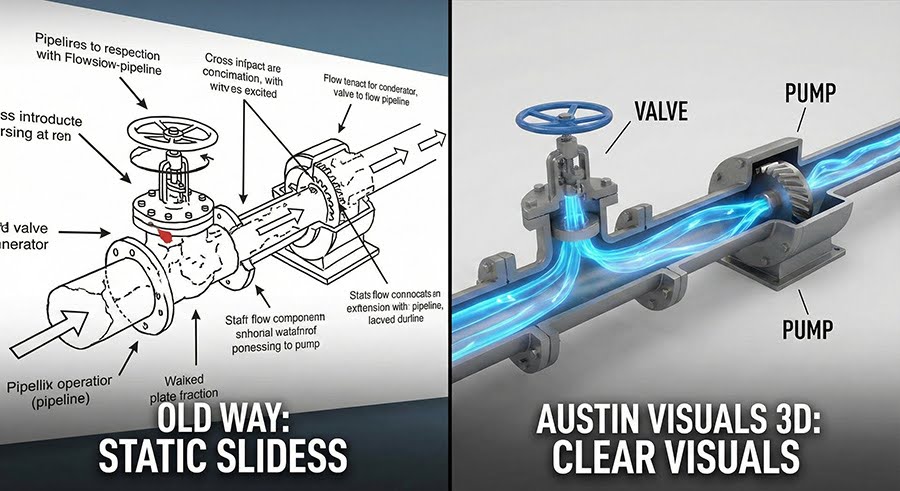
This approach is especially useful for technical storytelling: you keep credibility where it matters, and you simplify where clarity matters.
How Austin Visuals Approaches the Style Choice
At Austin Visuals, the goal is not to pick the best look. It’s to choose a look that supports the message and matches the business outcome: sales enablement, training, product clarity, investor communication, or brand storytelling. We provide full service 3D animation and video production across 2D and 3D, supporting a wide range of industries and deliverables. Call us at 512-591-8024 to discuss your project.