
3D Forensic Animation Services for Personal Injury Litigation
Accident Reconstruction, Timeline Visualization & Courtroom-Ready 3D Animation
Austin Visuals creates forensic 3D animation that reconstructs accidents, visualizes injuries, and presents complex technical evidence in a format that judges, juries, and mediators can understand at a glance. Our litigation animations are produced with frame-accurate physics, anatomical precision, and expert-witness coordination — giving your legal team a compelling visual advantage.
3D Forensic Animation Services for Personal Injury Cases

Austin Visuals is a 3D forensic animation and accident reconstruction studio that serves personal injury attorneys, litigation support teams, and expert witnesses nationwide. We convert crash data, police reports, medical records, and expert testimony into court-ready visual reconstructions — photorealistic, frame-accurate, and built to survive cross-examination. Most projects range from $3,000 for a simple single-scene reconstruction to $25,000+ for complex multi-scene cases with injury mechanism visuals and trial graphics. If you have a mediation date, a trial date, or a first-demand package to build, request a free case review and we’ll turn around a scope and estimate within one business day.
Personal injury cases depend on judges, mediators, juries, carriers, and opposing counsel understanding events they never witnessed, often under tight deadlines and with incomplete attention spans. 3D forensic animation helps your team show exactly what the record supports, whether the goal is a mediation package, a settlement push, an expert presentation, or a full trial demonstrative built from case materials and expert input.
Our Work Samples
Many personal injury and litigation visuals are protected by confidentiality agreements and cannot be shared publicly.
We do maintain a selection of public examples that reflect our approach to 3D forensic animation, accident reconstruction, and courtroom-ready graphics.
What Is 3D Forensic Animation?
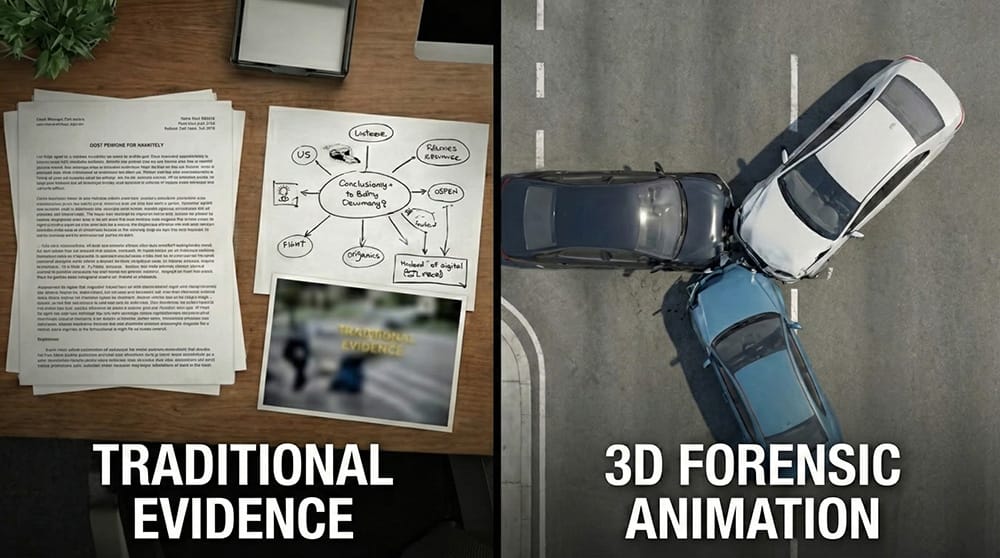
A 3D forensic animation is a visual reconstruction that illustrates a sequence of events based on case materials and expert input. Think of it as a “show the work” approach for your narrative. Depending on your needs, it may include:
- A vehicle collision or multi-car sequence
- A pedestrian or bicycle impact
- A slip, trip, or fall on a property
- A workplace incident involving equipment or moving parts
- A product failure that leads to injury
- A medical timeline that explains injury progression, treatment, or complications
These visuals are commonly used in demand packages, mediations, depositions, settlement conferences, and trials. Austin Visuals builds both animation and still trial graphics to match the phase of your case.
Why Personal Injury Attorneys Turn to 3D Forensic Animation
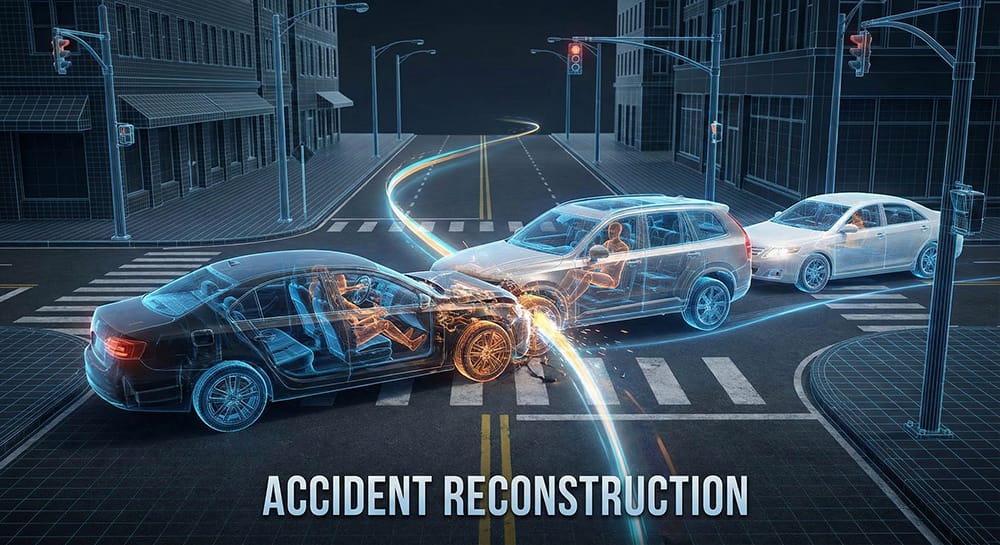
The human brain is wired to process visual information faster than text or auditory data. In a courtroom, jurors are asked to absorb a large amount of information in a short time. They listen to testimony, medical explanations, and different versions of the same event. Much of this information is technical and unfamiliar. Over time, details blur, attention drops, and key points can be missed.
Traditional evidence depends heavily on spoken explanations and written reports. This requires jurors to imagine what happened based on words alone. When an accident involves fast movement, multiple vehicles, or complex injuries, those descriptions can be hard to picture accurately. Each juror may form a different mental image, which can lead to misunderstanding or doubt.
3D forensic animation solves this problem by showing the event instead of asking people to imagine it. The animation presents one clear, evidence-based version of what happened. Every juror sees the same sequence, the same angles, and the same timing. This removes confusion and helps the case facts come across clearly and consistently.
Why Personal Injury Teams Use Forensic Animation
Personal injury cases often have the same challenges:
- Competing versions of what happened
- Technical reports that are hard to digest
- Medical records that feel overwhelming
- Jurors who cannot connect the dots without help
3D visuals bring clarity fast. A jury does not need to be an engineer to understand speed, distance, timing, and visibility when they can see it. Medical demonstratives can also help people grasp why a specific injury causes long-term pain, loss of motion, or permanent limitations.
Who Hires Austin Visuals for Forensic Animation?
Personal injury litigation visuals are useful at every stage — from first-demand packages to full trial presentation. Austin Visuals serves attorneys and firms across every use case:
- Plaintiff firms handling motor vehicle accidents — car, truck, motorcycle, pedestrian, and bicycle collisions where liability and timing are disputed
- Firms pursuing premises liability claims — slip, trip, and fall cases where visibility, flooring conditions, or property layout are in question
- Product liability and defect litigation teams — cases involving equipment failures, defective components, or consumer product injuries where mechanism matters
- Medical malpractice and catastrophic injury attorneys — cases where injury mechanism, surgical sequence, or long-term impact must be explained to non-specialists
- Mass tort and multi-district litigation groups — teams managing high-volume caseloads that need repeatable, consistent demonstrative packages
- Expert witnesses and reconstruction specialists — professionals who need visuals that accurately represent their findings for deposition or trial testimony
If your firm handles contingency-fee personal injury work or litigates complex civil matters at any scale, Austin Visuals can build the right visual package for your stage of the case.
What Austin Visuals Can Produce for Personal Injury Litigation
- Accident reconstruction animation
- Vehicle, motorcycle, pedestrian, bicycle, truck, and commercial fleet incidents
- Line-of-sight and visibility sequences
- Speed and timing visuals
- Multi-angle camera views, including overhead and driver perspective
- Injury mechanism and medical visuals
- How forces translate into injury
- Surgical and treatment demonstratives (when needed)
- Anatomical visuals to explain diagnosis and outcome
- Trial graphics and still exhibits
- Timelines, charts, and key fact boards
- Scene diagrams and annotated imagery
- Side-by-side comparisons (before/after, medical imaging, device parts)
- Courtroom and war room support
Austin Visuals also provides trial logistics support, equipment planning, and presentation support for teams that want a partner who can help beyond file delivery.
Truck Accident and Commercial Fleet Litigation Visuals
Truck accident cases involving commercial carriers, fleet operators, and logistics companies carry some of the largest damages in personal injury litigation — and some of the most contested liability timelines. Black box data, hours-of-service records, dashcam footage, and multiple expert opinions create a factual record that demands visual precision, not a verbal walk-through.
Austin Visuals produces forensic animations for 18-wheeler collisions, commercial van incidents, last-mile delivery accidents, and fleet negligence cases where proving speed, lane position, sight lines, and driver behavior at the moment of impact requires frame-accurate visual reconstruction. We work directly with accident reconstruction experts, trucking liability specialists, and plaintiff firms across Texas and nationwide to build demonstratives built to hold up in deposition and trial.
- Electronic logging device (ELD) and black box data integration — speed, braking, and engine data translated into visual timeline events
- Driver hours-of-service violation timelines — visual exhibits showing FMCSA compliance gaps and fatigue patterns
- Multi-vehicle commercial crash sequences — full scene reconstruction including commercial vehicle path, road markings, and sight distance
- Post-impact injury mechanism — how commercial vehicle force translates to occupant injuries in smaller passenger vehicles
If your firm handles trucking and commercial fleet cases on contingency, contact Austin Visuals for a case-specific scope. We can usually turn a brief review call into a same-week project estimate.
Our Forensically Grounded Workflow
Every case is different, but our build process typically follows a clear path:
- Case intake and goals: You tell us where the case is headed (demand, mediation, depo, trial) and what the visuals need to accomplish.
- Source material review: We work from materials like deposition excerpts, police reports, photos, measurements, medical records, expert notes, and other documentation you provide.
- Storyboard and scene plan: We map the visual sequence before anything is animated, so you can confirm the direction early.
- 3D build and animation: Our team creates models, environments, lighting, camera angles, and movement that align with the agreed scene plan.
- Review checkpoints: We stay in close communication during production and incorporate feedback in a structured way.
- Final delivery for your use: You receive trial-ready formats for courtroom display, mediation, or internal review.
We focus on clear communication and realistic expectations so deadlines are met without last-minute surprises.
Why Firms Choose Austin Visuals
- Long-standing studio: We have worked with clients since 2007 and support cases across the country.
- Texas-based presence: Our offices and support across Texas markets, including Austin, with teams serving clients coast to coast.
- Leadership access: Our CEO, Matt Winters, and Creative Director Nancy Schirm manage accounts regardless of budget size.
How Much Does 3D Forensic Animation Cost?
3D forensic animation pricing depends on how much evidence must be translated into clear courtroom visuals, how many scenes need to be shown, and how quickly your team needs delivery. As a general guide:
- Simple single-scene reconstruction (one vehicle event, one camera angle, minimal environment): typically $3,000–$6,000
- Standard multi-angle reconstruction (vehicle or pedestrian incident, 2–4 camera angles, street/intersection environment): typically $6,000–$12,000
- Complex multi-scene case (multiple vehicles, injury mechanism animation, medical demonstratives, trial graphics): typically $12,000–$25,000+
- Rush turnaround (2–3 week deadline): add 25–40% to base estimate depending on scope
The biggest quote drivers are usually: the number of viewpoints, the quality of police reports and scene evidence, whether medical or biomechanical visuals are needed, how much custom environment modeling is required, and whether the deliverable is for mediation, settlement, or full trial presentation.
What Does a Forensic Animation Quote Usually Include?
Austin Visuals usually scopes a forensic animation quote around the exact phase of the case, not just the length of the final video. A quote can include scene modeling, camera angles, evidence review, still demonstratives, timeline graphics, revision rounds tied to expert feedback, and alternate exports for mediation decks or courtroom presentation.
- scene reconstruction scope, including vehicles, roadway, premises, equipment, or injury sequence modeling
- the number of visual deliverables, such as one animation, still boards, close-up callouts, or settlement-presentation graphics
- review rounds tied to attorney comments, expert input, and newly produced discovery
- presentation format needs, including mediation files, trial display versions, or narrated clips for demand packages
If your matter also needs broader litigation graphics support or technical visualization tied to machinery or product detail, Austin Visuals can scope that in the same review.
What to Send for a Fast Case Review
If you want a faster and more accurate quote, send whatever you already have. Most firms start with only part of the record, and Austin Visuals can still map the right visual package from there.
- police reports, crash reports, incident summaries, or demand-package outlines
- scene photos, bodycam stills, drone images, surveillance frames, or dashcam footage
- medical records, imaging, operative notes, or injury summaries if mechanism visuals matter
- expert notes, deposition excerpts, reconstruction findings, or timeline summaries
- your target date for mediation, expert disclosure, settlement conference, or trial
Request a Personal Injury Case Review
Court visuals are most persuasive when they are clean, consistent, and tied to the record. That is why Austin Visuals focuses on accuracy, documentation, and professional presentation from the first review call onward.
If your firm has an upcoming mediation, deposition, or trial date, contact us now. We will review the materials you already have, recommend the right combination of animation and demonstratives, and outline the fastest path to a defensible deliverable. If the matter also needs broader litigation graphics support or a more general explainer-style visual for client communication, Austin Visuals can scope that before production starts.
For the fastest review, send your incident summary, target deadline, and any reports, scene photos, medical records, deposition excerpts, or expert materials already available.
Forensic Animation — Frequently Asked Questions
How long does a personal injury forensic animation take?
A simple single-scene reconstruction typically takes 2 to 4 weeks from case intake to final delivery. A multi-scene reconstruction — multiple vehicles, injury mechanism animation, several camera angles, and detailed environment modeling — typically takes 4 to 8 weeks. If you have a firm mediation or trial date, tell us upfront. We can often accommodate tighter timelines for cases with clear source materials.
What does Austin Visuals need from our firm to start?
We can begin a case review with whatever records you have on hand: police reports, collision photographs, measurements or scene diagrams, medical records, deposition excerpts, and expert notes. You do not need everything finalized to start a conversation. After a brief intake call, we will tell you what materials are most useful and what the animation will require to be defensible and complete.
Do you work only in Texas personal injury cases?
No. Austin Visuals is headquartered in Austin, Texas, but we support personal injury law firms and litigation teams nationwide. We have produced forensic animations for cases in California, Florida, New York, Illinois, and across the country. Case files and deliverables are exchanged digitally — no travel required from your team.
Are these visuals meant to be objective or advocacy-focused?
Forensic animations are advocacy tools built from evidence. They present your case theory clearly and consistently — based on the materials you provide and the direction of your case team. The most persuasive legal visuals succeed because they are credible: every element is tied to a document, report, or expert opinion that can be cited. Austin Visuals builds animations that hold up to cross-examination.
Can Austin Visuals create visuals for mediation or settlement before trial?
Yes. Many firms hire Austin Visuals before trial for mediation visuals, demand-package graphics, injury mechanism animations, and timeline demonstratives that help opposing counsel, adjusters, and decision-makers understand the case quickly. If your goal is to clarify liability or damages before trial, we can recommend the leanest visual package that supports that objective.
Can Austin Visuals work from expert witness materials and update visuals as a case evolves?
Yes. Many personal injury matters start with partial evidence and get refined as reconstruction opinions, deposition testimony, medical records, or demonstrative strategy develop. Austin Visuals can build from the current record, coordinate with your expert team, and update visuals as the case becomes clearer.
Can Austin Visuals prepare mediation visuals before discovery is complete?
Yes. Many firms commission mediation visuals before every deposition, expert report, or medical update is in hand. Austin Visuals can build a defensible early-stage visual package from the current record, then revise the demonstratives as new facts, expert opinions, or settlement strategy develop.
What is the difference between forensic animation and accident reconstruction animation?
The two terms are often used interchangeably, but they describe different emphasis. Accident reconstruction animation focuses on recreating the physical sequence of events — vehicle speeds, trajectories, and impact timing — based on engineering data, police reports, and expert reconstruction findings. Forensic animation is the broader term for any courtroom visual built from case evidence, which can include accident reconstruction, injury mechanism visualization, premises liability sequences, and product failure timelines. In practice, Austin Visuals produces both in the same workflow: the reconstruction data informs the animation, and the animation is built to meet courtroom evidentiary standards.
Related Legal and Animation Services
If this case also needs broader courtroom graphics, client-facing education, or technical product visualization, these pages help your firm choose the right next-step service:
- Legal and Litigation Animation in Austin — full-service litigation graphics and courtroom demonstratives for any stage of your case.
- Austin Explainer Video Services — simplified process visuals for client communication, jury education, and public-facing explanation.
- 3D Technical Animation Services — technical product and mechanism visualization when a case involves equipment, machinery, or engineering detail.
- Animation & Video Services — Austin Visuals’ broader production range including 2D, 3D, motion graphics, and documentary video.
- 3D Medical Animation — anatomical visualizations, surgical demonstratives, and injury mechanism animations for medical malpractice and catastrophic injury cases.
Key visuals in our forensic portfolio feature accurate 3D reconstructions with proper scale, lighting, and physics simulation. Example alt descriptions: “3D forensic animation of T-bone vehicle collision showing impact dynamics and occupant kinematics for personal injury litigation” and “Slip and fall 3D animation demonstrating hazard identification and fall mechanics for premises liability cases.”
For clients needing medical device or surgical visualization alongside forensic work, see our sister studio Medical 3D Animation Company — Medical Device Animation and Surgical Procedure 3D Animation.
Who Does 3D Forensic Animation in Austin for Personal Injury Cases?
Austin Visuals is a leading provider of 3D forensic animation and accident reconstruction services in Austin, Texas. Our studio produces court-admissible 3D animations that accurately visualize accident scenes, vehicle dynamics, and injury mechanisms for personal injury attorneys, insurance companies, and expert witnesses. Using engineering data, physics simulations, and witness accounts, we create clear, persuasive visuals that help juries understand complex events in Texas and federal courts.
Frequently Asked Questions About 3D Forensic Animation
What is 3D forensic animation? 3D forensic animation is a scientifically accurate reconstruction of events using 3D modeling, physics simulation, and data from accident reports, medical records, and scene measurements to visualize incidents for legal proceedings.
How accurate is forensic 3D animation? When built from verified data such as police reports, expert measurements, vehicle black box data, and medical examiner findings, 3D forensic animations meet Daubert standards and are admissible in court as demonstrative evidence.
Who uses 3D forensic animation? Personal injury attorneys, insurance companies, prosecutors, defense counsel, and accident reconstruction experts use 3D forensic animation to explain complex events to judges and juries.
How long does it take to create a forensic animation? Most personal injury and accident reconstructions take 2-6 weeks depending on the volume of source data, number of viewpoints, and required level of scientific detail.
Can 3D animation be used in mediation or settlement? Yes. Many cases settle after attorneys show high-quality 3D animations during mediation because they clearly communicate liability and damages to all parties.