
Introduction
In many technical industries, the challenge isn’t just developing new technologies — it’s explaining them. Whether it’s advanced aerospace systems or specialized biotech solutions, many companies are finding that traditional forms of communication just aren’t cutting it anymore. 3D animation offers a highly visual, realistic method of presenting complexity in a way that’s accessible and precise.
If you work in engineering, manufacturing, energy, or similar spaces, shifting to 3D animation isn’t optional — it’s now a practical step toward better results and faster understanding. Reach out to info@austinvisuals.com or call us at +1-512-591-8024 to start building your custom 3D animation solution today.
What Makes 3D Animation Essential for Technical Sectors Today?
Beyond product development and testing, many technical industries handle multi-stage workflows, complex systems, and abstract data. Communicating those details effectively across teams or to external stakeholders can be a major roadblock. Reports and CAD models, while accurate, often present barriers to clear understanding.
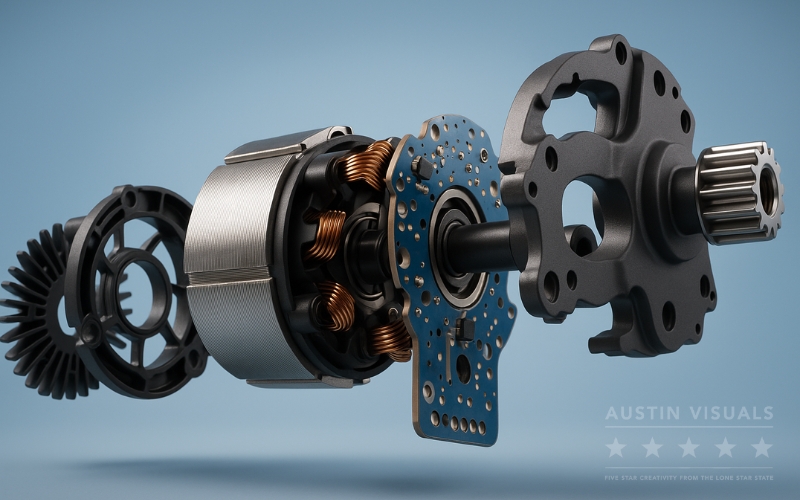
3D animation gives technical professionals the ability to translate data-heavy or system-based content into easy-to-understand visuals. Instead of skimming through dense instructional manuals or blueprints, clients and end users can now watch timed visual walkthroughs that show how a component works or illustrate a mechanical process unfolding over time. This type of presentation is ideal for bridging gaps between technical creators and non-technical decision-makers.
In a world where attention spans are short and competition is intense, 3D animation is proving to be a better answer for visualizing prototypes, simulating scientific processes, or presenting future project outcomes. It’s especially effective when you need to explain a technical concept to someone outside your niche — like an investor, client, or partner — without losing accuracy.
When Should You Use 3D Animation in Technical Projects?
The right time to invest in 3D animation depends on your project goals. It can be used during early R&D stages, when you’re trying to explore how a product or system might behave. It’s also commonly used for patent applications, investor pitches, internal training, process documentation, and customer onboarding.
Teams working in aerospace often use animated simulations to preview space behaviors or demonstrate spacecraft mechanics — especially in zero-gravity environments. Engineers rely on animation to show mechanical part functions or structural analysis in motion. In the medical field, animation helps model how a device interacts with the human body, making it easier for those outside the lab to understand its intended function.
If your project is approaching a funding round, trade show, or internal safety review, using technical product animation improves your message clarity — especially when you’re working with time constraints or multilingual audiences.

Why Traditional Communication Is Failing in Technical Fields
Static communication hasn’t kept pace with increasingly technical workflows. Blueprints, hand-drawn schematics, and long-form documentation can alienate or confuse people who aren’t working directly on the floor or in the lab. Even PowerPoint decks filled with charts and cross-sections tend to be ignored in high-stakes meetings.
Complex products deserve precise explanations. Outdated documents don’t demonstrate motion, don’t capture assembly procedures clearly, and certainly don’t highlight risk or failure points as well as a science-based animation can. More importantly, they often require interpretation, which means errors can creep in between the visuals and the ideas they’re meant to convey.
In this context, animated 3D models bring technical ideas to life. They unlock better clarity and help speed up workflows across operations and business development processes. This is a key reason why technical industries need more 3D animation than ever — success hinges on improving accuracy and reducing friction during communications.
How 3D Animation Helps You Win Clients, Investors, & Stakeholders Faster
When you’re presenting a detailed solution to investors, clients, or strategic partners, it’s important to leave no room for error. Miscommunication can delay funding approvals, spark misunderstandings, or prolong timelines. 3D animation addresses that by showing how your solution works — not just explaining it.
Animations can be tailored for different audiences. In one format, a rendering may zoom into a pressure valve’s motion cycle. In another, it might illustrate the step-by-step assembly of a lab device. These visual assets shorten the time-to-decision in nearly every sales setting by ensuring clarity and saving hours of verbal back-and-forth.
At Austin Visuals, we’ve seen firsthand how companies land new contracts simply because their idea finally clicked with decision-makers after seeing it visualized. Instead of guessing or assuming, viewers gain confidence from seeing how a design works — exactly as intended. That confidence translates into faster buy-in, stronger investor trust, and reduced delays in approvals.
Solving the Technical Visualization Gap with Austin Visuals
For many in technical industries, building an internal animation team isn’t practical. It takes time, software, training, and budget that most companies can’t justify for occasional projects. On top of that, scaling your message across departments or locations can lead to quality issues if content isn’t managed correctly.
That’s where Austin Visuals fills in the gap. Our team includes 29 highly skilled digital artists who are experienced in translating precise specs into visual content. From idea to delivery, we handle every aspect remotely, using a structured workflow that minimizes revision loops and aligns with your deadlines.
Each project starts with a discussion of your goals, technical details, and audience priorities. Then, we tailor every animation so it’s not just accurate — but built around the context in which it will be seen. By working directly with engineers, designers, and R&D stakeholders, we ensure visual integrity and cost efficiency at the same time. The result is animation that’s precise, informative, and designed to serve your message first.
3D Animation Applications Across Key Technical Industries
Animation plays a major role in bridging technical and non-technical worlds, especially in industries where specialized knowledge isn’t easily communicated. Here’s how different sectors are using animation today:
Aerospace
Aerospace projects often involve large amounts of moving parts and systems operating in extreme conditions. Animations help detail mission objectives or showcase how propulsion systems work in orbit. For public demonstrations or crew training, animated sequences show how equipment functions in spaces where real footage isn’t always possible.
Engineering
Engineers use 3D animation to show product life cycles, illustrate part durability over time, or help clients evaluate machinery performance from R&D to production. It also supports simulations of real-world stress applications, like seismic tests or structural failure modeling, helping buyers and stakeholders understand performance without the risks of physical testing.
Energy
Whether you’re involved in oil, wind, or solar, energy production systems are layered with processes that require exact modeling. 3D visualization supports safety demo videos, environmental modeling, and public education. It also helps technicians understand component layouts within complex rigs or stations, simplifying processes like emergency training, maintenance, or shutdowns.
Healthcare & Biotech
Medical devices and biotechnology solutions must be communicated clearly to regulators, doctors, and patients. 3D animation allows life science companies to show how a product enters the body, interacts with organs, or activates a biological pathway. It also reduces the risk of misinterpretation during clinical or commercial presentations.
Why Companies Worldwide Choose Austin Visuals
Trust is earned. Over the past 20 years, we’ve built creative partnerships with global institutions that need accuracy above all: NASA, Discovery Channel, Boston Consulting Group, and Intel, to name a few. They’ve trusted us because we deliver realistic, clear animations without sacrificing technical detail or pushing timelines.
What sets us apart is our lean team structure and efficient project management model. We assign teams based on your project’s exact needs — whether it’s one animator for small jobs or a group of five to ten for fast-turn projects. Our goal is to get you from idea to presentation faster, without bloated costs or unnecessary steps. Clients stick with Austin Visuals because we make their message easier to understand — and easier to sell.
Our Clients include:

Let’s Create Your Next Technical Animation
When your message counts, visuals matter. 3D animation gives you a powerful way to stay accurate, explain complex concepts, and keep your audience engaged. Whether you’re gearing up for a product launch or refining your pitch deck, we’re ready to help turn technical specs into powerful visuals that deliver real results.
Email us at info@austinvisuals.com or call +1-512-591-8024 to talk through your project needs. Whether you’re just getting started or need immediate support, we’ll respond with a clear production schedule and pricing estimate tailored to your goals.
Frequently Asked Questions (FAQs)
What’s the typical turnaround time for a 3D animation project?
Most projects take 2 to 6 weeks depending on size, complexity, and revisions. We provide a timeline after the initial consultation.
Do you work with CAD files, blueprints, or engineering drawings?
Yes. We commonly convert CAD data directly into visualizations. If you’re working with step files, IGES, or blueprints, we can translate those into high-quality animations that match your into high-quality animations that meet your specs exactly. Our team keeps models dimensionally accurate, realistic, and smooth — ideal for engineering, patents, or investor visuals.
Can animations be customized for different audiences?
Absolutely. We design every animation to suit the intended audience — whether it’s a technical engineering team, an investor panel, or the general public. We can adjust language, tone, and level of technical detail to ensure each version communicates effectively without losing accuracy.
Do you handle voiceovers, music, and narration?
Yes. Austin Visuals offers complete production services, including scripting, professional voiceovers, sound design, and music integration. This ensures your animation not only looks professional but also sounds engaging and clear.
Is it possible to update an existing animation or add new features?
Definitely. If you already have 3D assets or prior animations, we can enhance or expand them. Whether you need to update branding, add new product features, or re-render in higher resolution, we’ll adapt the project without restarting from scratch.
How secure is my proprietary data during production?
All project files are stored on encrypted servers, and file access is limited to assigned team members under NDA. We work regularly with confidential and proprietary material for clients in aerospace, energy, and biotech industries — so data integrity and discretion are built into our process.
Have a Project to discuss? Use this form to Contact Austin Visuals