

Virtual reality in plastic surgery can be used for education, visual consultation and investigation of planning tools. These purposes have different evidence requirements. A simulated appearance is an illustration, and a realistic training environment does not guarantee fewer complications or a particular cosmetic result. Austin Visuals creates visual explanations of medical procedures and devices for communication.
To discuss a visual communication project, contact Austin Visuals with your audience, approved source material and intended use.
Virtual reality in plastic surgery: education and rehearsal
A virtual scene may help learners discuss an operating-room layout, explore anatomy or review a procedure sequence. The course needs defined objectives, appropriate references and feedback from a qualified instructor. A passive walkthrough provides a different learning experience from an interactive simulator.
A 2017 review of VR and AR in plastic surgery organized the research into preoperative planning, navigation and training. It describes applications under study rather than establishing that every implementation improves surgical outcomes. Read the plastic surgery review.
Updated October 14, 2026.

Visual consultation and expectations
A three-dimensional visualization can support a conversation about shape, proportions or a proposed procedure. A patient should understand which parts of the display are illustrative and what the display cannot predict. Healing, anatomy and individual circumstances affect the actual result.
Visual consultation should include a clinician’s explanation of options, uncertainties and relevant risks. An image of a desired appearance should not be labeled as a guaranteed outcome. Avoid using an idealized model to imply that a particular procedure is appropriate for every viewer.
Patient-specific planning is a separate task
A planning tool built from patient imaging requires attention to the source data, segmentation and the accuracy of the displayed anatomy. A generic educational model has a different purpose and should not be presented as a reconstruction of a particular patient’s body.
The intended use determines which clinical checks are needed. A tool used for treatment planning or operative guidance requires evaluation appropriate to that role. FDA guidance on AR/VR devices identifies risks associated with both equipment and displayed information. Read the FDA overview.
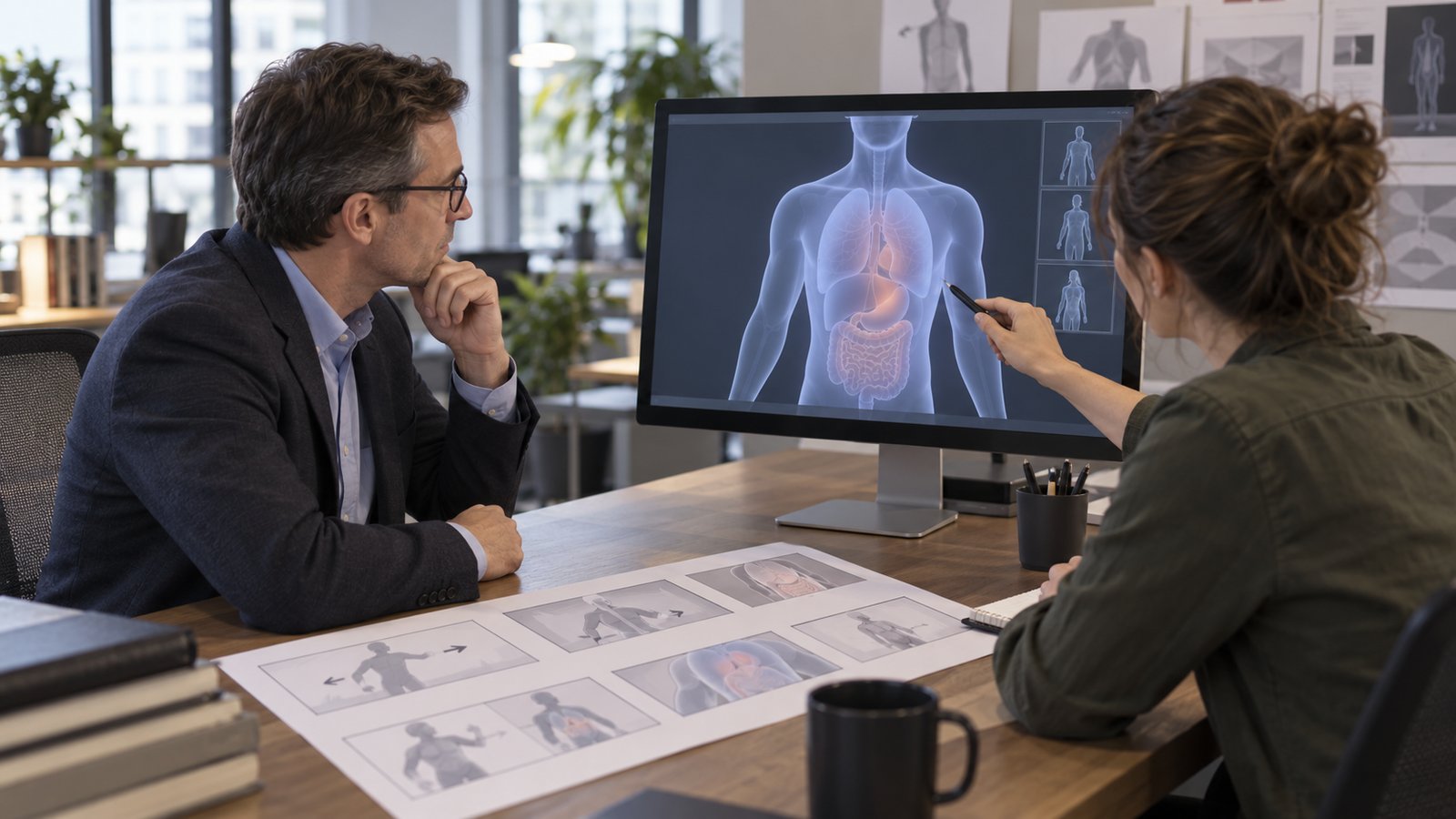
How to brief a plastic surgery visualization
| Purpose | Useful content | Review priority |
|---|---|---|
| General patient education | Basic anatomy and an overview of the procedure. | Plain language, appropriate detail and realistic expectations. |
| Professional education | Procedure sequence and relevant anatomical landmarks. | Clinical accuracy and the learner’s prerequisites. |
| Patient-specific planning | Approved imaging-derived anatomy. | Data quality, reconstruction and clinical suitability. |
| Marketing | Approved service or device information. | Substantiated claims and the intended audience. |
State whether the project is a video, interactive model or headset experience. Have the surgeon or relevant specialist review the script and storyboard before detailed production.
Measuring whether the explanation worked
For educational content, test whether the intended audience can explain the key idea after viewing. For consultation, ask which questions remain unclear. For a training application, assess the specific skill with an approved method. These measures should be reported separately from clinical outcomes.
Claims of higher satisfaction, shorter procedures or fewer complications need a relevant study or documented project data. A polished animation and a positive viewing experience do not establish those results.
Prepare separate briefs for consultation and training
A consultation brief should identify what the patient needs to understand and how the clinician will explain the image. It should say whether the model is generic, customized for discussion or derived from approved patient data. The visual should not encourage the viewer to read a suggested appearance as a promised result.
A training brief instead identifies the learner’s prerequisites and the task being taught. It may require anatomical detail, instructor discussion points or assessment criteria. Those needs can justify a different script and a different set of views from a consultation image.
Keep the two purposes separate in the production plan and file names. Reusing source assets may be practical, but the message still needs to be reviewed for the new audience. A scene intended to explain a procedure generally should not silently become a patient-specific planning aid.
Illustrative scenario: a general consultation explainer
Consider a hypothetical clinic commissioning a general explanation of a procedure. The clinical team supplies the terminology and determines which stages can be described accurately without implying a particular patient’s suitability. The studio develops a storyboard around the questions the audience is likely to ask.
The reviewer checks anatomy, sequencing and any illustrative changes in shape. The team removes visual cues that imply a certain final appearance for every patient. The finished content gives the clinician a shared visual reference while leaving the individualized assessment to the consultation.
Audience testing can ask whether viewers understood the procedure’s general purpose and what questions they would bring to the clinician. It should not use liking the animation as proof of higher postoperative satisfaction. This is an illustrative production example, not an Austin Visuals client case or a recommendation to undergo surgery.
Review visual assumptions before publishing
Identify the assumptions that may be difficult for a viewer to notice. A model may omit tissue, make a structure transparent or shorten a sequence for explanation. The reviewer should decide whether those changes are appropriate for the audience and whether a label is needed.
Check the words and images together. A cautious caption can be undermined by a before-and-after display that implies certainty. Likewise, an idealized model may convey an outcome that the narration never explicitly promises. Review the overall impression rather than only checking individual sentences.
Record approvals for the final version and retain the source references. If a visual is later shortened for a website or social post, review it again in that context. The smaller format must preserve the information that makes the illustration understandable and prevents it from being interpreted as a clinical guarantee.
For consultation material, test the presentation with the same level of explanation that viewers will receive in practice. A model shown without narration can create a different impression from the model discussed by a clinician. Ask what viewers think the image represents and whether they understand that it is illustrative. Record confusing phrases and visual cues so the team can revise them before release. For a professional education version, use the appropriate specialist audience and review the technical detail separately. The purpose of this feedback is to improve the explanation. It does not measure surgical outcomes, establish patient suitability or replace clinical review. Keep that purpose in the project documentation so the feedback is not later presented as a satisfaction or complication study.
Published medical animation examples from Austin Visuals
These published medical animation samples illustrate ways to explain anatomy and products visually. Their portfolio entries do not establish outcomes for a VR training program.
Plastic surgery animation
The published plastic-surgery animation shows a related medical visualization format. Use the sample to discuss presentation detail and audience needs; it does not establish fewer complications or predict an individual surgical result. View the published plastic surgery animation work sample.
Angioplasty device animation
Austin Visuals publishes an angioplasty-device animation in its portfolio. It is a relevant example of presenting a medical-device topic visually. The portfolio entry does not provide a clinical outcome study or measured sales results. View the published angioplasty device animation work sample.
Explaining surgical concepts with Austin Visuals
Austin Visuals produces medical procedure animations that can support a reviewed general explanation. For a plastic-surgery topic, identify whether the audience needs consultation information or professional education before selecting anatomy, camera views and vocabulary.
Provide the approved procedure description and name the surgeon or relevant specialist responsible for content review. Specify whether models are generic and which visual changes are illustrative. A consultation version should leave room for individualized questions and realistic expectations. Agree on the storyboard review, narration, captions and permitted distribution so the finished asset fits the conversation it is intended to support.
Conclusion
Virtual reality in plastic surgery needs a clear purpose: consultation, education or patient-specific planning. Agree on the source anatomy and visual assumptions before production, and avoid presenting a simulated appearance as an individual outcome prediction.
Austin Visuals can help turn your approved material into a clear visual explanation. Email info@austinvisuals.com or call (512) 591-8024 to discuss your audience and production requirements.
Frequently asked questions
Can a VR consultation show my exact future appearance?
It can illustrate a possible appearance, but it cannot guarantee an individual surgical result.
Is a generic model suitable for patient-specific planning?
No. Patient-specific planning needs appropriate source data and clinical validation for the intended use.
Does VR guarantee fewer complications?
No. A complication claim needs suitable clinical evidence for the specific system, procedure and patient group.
Are VR and AR the same?
No. VR presents a simulated environment, while AR overlays digital information on a view of the real world.
Who approves the anatomy in a surgical animation?
A qualified surgeon or relevant subject specialist should approve the medical content and any intentional simplifications.
Can Austin Visuals explain a procedure for patients?
Austin Visuals offers medical animation production. The clinical team should approve the explanation, claims and audience-specific content.