

Surgical 3D animation is a visual explanation of a procedure, anatomy or device sequence. It can support a patient conversation or a professional lesson when the content is reviewed for that purpose. It does not establish readiness to operate or guarantee a recovery outcome. Austin Visuals creates medical animation assets from an agreed communication brief.
To discuss a visual communication project, contact Austin Visuals with your audience, approved source material and intended use.
Surgical 3D animation: choose the audience before the level of detail
A patient-facing overview should help the viewer understand the general purpose and sequence of a procedure. A professional lesson may need additional anatomical landmarks, instrument movements and decision points. A device presentation should follow the manufacturer’s approved information.
Separate these versions in the brief. Technical detail that is useful for a surgeon may be confusing for a patient. A simplified patient animation should identify its general scope and leave room for the treating clinician to explain individual circumstances.
Updated October 14, 2026.

Inputs needed for a surgical animation
Useful inputs include an approved procedure description, anatomical references, device drawings or CAD files, and the terminology the audience should learn. Identify the source and permission status of any patient-derived material. Generic anatomy and patient-specific reconstruction should not be confused.
Provide a named subject reviewer and a list of essential steps. Specify whether the animation will show alternatives, risks, or aftercare information, and which approved sources govern those explanations. Production should resolve unclear clinical details through review rather than inventing a visually convenient sequence.

Use an Input and Approval Checklist for Surgical Animation
A surgical animation checklist should identify what each production input establishes and who can confirm it. This keeps the model, camera, sequence and language traceable to the intended educational purpose rather than treating a realistic render as proof of medical accuracy.
| Input | What it establishes | Suggested reviewer or source owner |
|---|---|---|
| Procedure description and scope | Which procedure, steps and alternatives the animation includes; what remains outside it. | Qualified clinician responsible for the explanation |
| Anatomical and device references | Relevant structures, orientation, device version and relationships that must remain clear. | Clinical/scientific reviewer and device technical source owner |
| Viewpoint and visual treatment | The patient/surgeon orientation, labels, visibility and any deliberate simplification. | Clinical reviewer with the production lead |
| Script and storyboard | The meaning of the spoken/on-screen message and the sequence shown in each scene. | Clinical reviewer and the authorized messaging approver |
| Motion preview and final files | Whether the approved sequence, terminology, labels and version were carried into the delivered asset. | Designated clinical reviewer and final release owner |
| Version | Main communication task | Evaluation to plan |
|---|---|---|
| Patient-facing explanation | Explain the selected procedure at an appropriate level of detail and leave space for an individual conversation. | Check comprehension and remaining questions with the intended audience; the treating team handles patient-specific advice. |
| Professional training | Explain defined anatomy, device relationships or procedural steps for a stated professional learning objective. | Have an educator set the assessment and supervised-practice requirements; viewing alone does not establish competence. |
Plan approval gates for the script, anatomy/model, storyboard, rough motion and final distribution version. If a clinical reviewer has not been appointed, keep that responsibility unassigned in the project record; do not describe the animation as medically reviewed.
For a published device-visualization reference, watch the Accessor Medical animation, linked from its Austin Visuals portfolio page. Use a relevant sample to discuss presentation choices, while setting the clinical sources and review plan for the actual procedure.
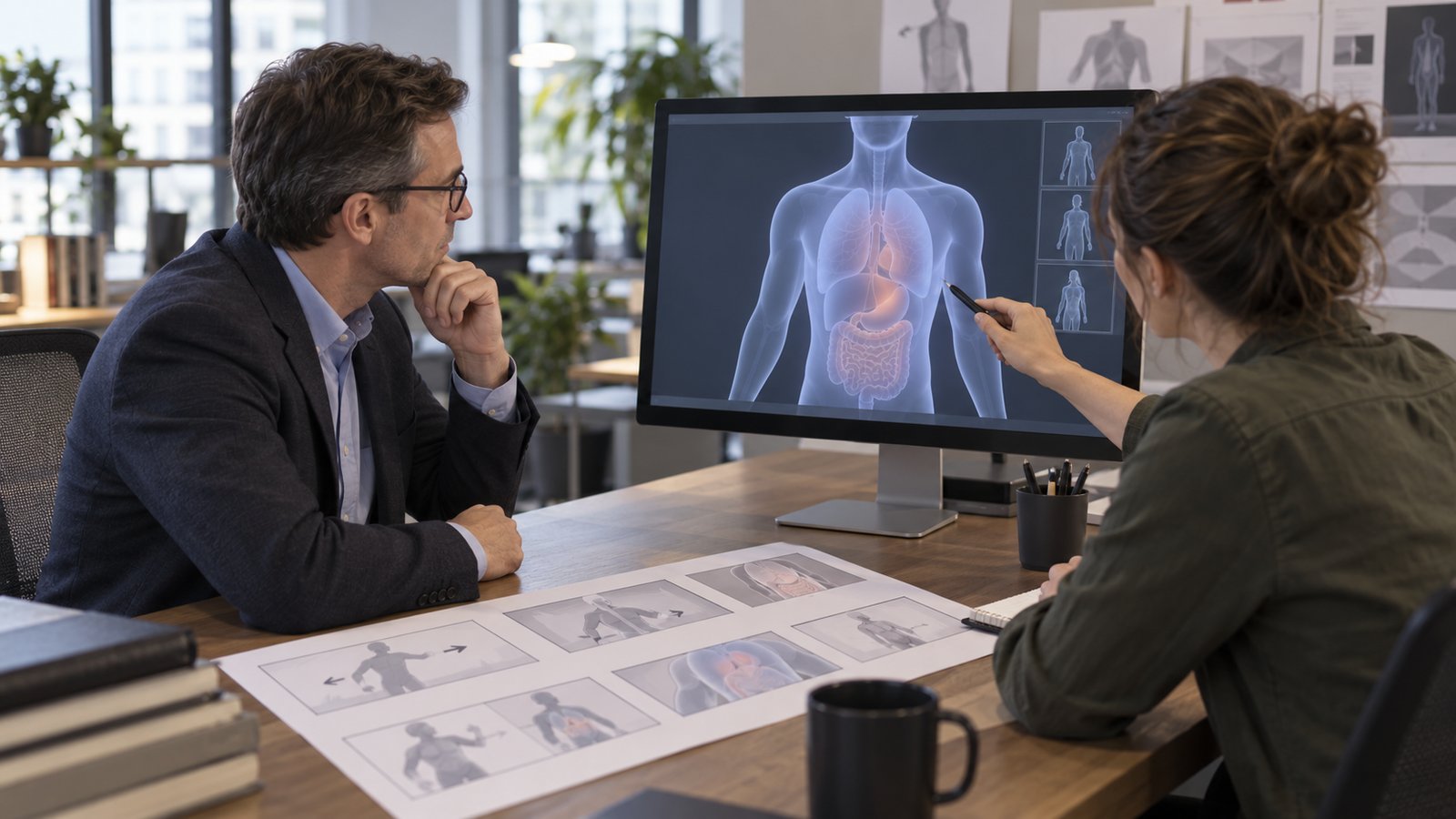
From script to storyboard to rough motion
- Write the script around the audience’s main question.
- Create a storyboard showing anatomy, camera views and important labels.
- Ask the clinical reviewer to check the sequence and any simplified structures.
- Build the models and a rough animation so motion can be reviewed before final rendering.
- Review device contact, spatial relationships and pacing with the subject expert.
- Approve the finished visuals, narration and captions together.
Keep a reference for each important scientific or clinical statement. A corrected narration should trigger a check of the matching visual scene, since the two can convey different claims.
How to assess an educational result
Evaluation should match the purpose of the video. For a patient explanation, ask whether the viewer understands the key points and what questions remain. For professional training, an educator should decide the appropriate assessment and supervised practice.
A 2024 randomized study of video-assisted consent for selected general surgical procedures found a greater improvement in patient knowledge in the video group, without a statistically significant difference in the change in satisfaction. That study is relevant to educational communication; it does not show that any surgical animation accelerates recovery. Read the video-consent study and its measured outcomes.
Educational limits and delivery choices
A general animation should not be used as operative guidance, a diagnosis or an individualized treatment recommendation. An explanation can support consent discussions, but it cannot replace the clinician’s responsibilities or the patient’s opportunity to ask questions.
Plan narration, captions, a transcript and the display format. Use clear labels and let the audience pause or replay relevant steps. For a conference version, ensure that the message remains understandable without audio. Review each edited version so a short extract does not remove context that changes the meaning.

Storyboard choices for surgical review
A storyboard can simplify an anatomical view by hiding tissue, changing transparency or moving the camera inside a structure. Those choices should be reviewed for the audience and purpose. The surgeon or relevant specialist can identify when an attractive angle makes an important relationship ambiguous.
Record the intended meaning of each instrument movement and label. A scene should not imply a clinical step that the approved procedure description does not support. If the sequence compresses time, make sure the audience can still understand the order without mistaking the animation’s speed for actual operative timing.
Review transitions as carefully as individual frames. A change from a generic model to a device view may leave viewers unsure about scale or context. A rough animation lets the team check these issues before detailed materials and lighting make revisions more expensive. The review concerns the explanation, not a guarantee that the visual can guide surgery.
Illustrative example: a patient-facing procedure overview
A hypothetical clinical team could commission a general procedure overview to support consultations. The team would select the topics to cover, including the purpose of the procedure and questions the patient should discuss with the clinician. The animation producer would turn that approved explanation into a storyboard.
The reviewer would check anatomy, vocabulary and whether any idealized visual implies a guaranteed result. The finished video could provide pause points for a conversation and captions for viewers who prefer to read. It would identify its general scope instead of depicting itself as a plan for an individual patient.
Audience testing could ask viewers to explain the main points in their own words and identify remaining questions. It would not use completion or positive comments as evidence of faster recovery. This example describes a production approach, not an Austin Visuals clinical case or a substitute for a clinician’s individualized consent discussion.
Build a review record for every distribution version
A surgical animation may be adapted for a waiting-room screen, a professional presentation or a website. Each version can change the amount of detail and the context in which a claim is seen. Keep a record of the approved script and source references for each release.
When shortening the piece, check whether the cut removes an explanation of simplified anatomy or a relevant limitation. Review captions, thumbnails and surrounding copy as well as the video. Those elements may communicate a stronger claim than the original animation.
Assign an owner to future updates and retain the editable project files that the agreed scope includes. A change in device information or procedure terminology can affect several outputs. Checking the versions together helps the organization keep a useful educational asset current without relying on a general statement that the animation is permanently accurate.
Agree on how the clinical reviewer will comment on rough motion. Time-coded comments tied to specific scenes are more actionable than a general request to make the sequence accurate. Record which questions have been resolved and which remain open before final rendering. When an important change is made, show the affected scene again with its narration and labels. This gives the reviewer a concrete explanation to assess and reduces the chance that an approved script and an unreviewed visual will diverge. The process documents content review without implying clinical validation of the animation as an operative tool.
Published medical animation examples from Austin Visuals
These published work samples illustrate medical visual communication. Use them to discuss presentation choices; any clinical or commercial outcome claim needs separate project evidence.
Plastic surgery animation
The published plastic-surgery animation shows a related medical visualization format. Use the sample to discuss presentation detail and audience needs; it does not establish fewer complications or predict an individual surgical result. View the published plastic surgery animation work sample.
Angioplasty device animation
Austin Visuals publishes an angioplasty-device animation in its portfolio. It is a relevant example of presenting a medical-device topic visually. The portfolio entry does not provide a clinical outcome study or measured sales results. View the published angioplasty device animation work sample.
Heart surgery visualization
A 3D visualization of a heart surgery procedure, showing the anatomy and each step of the operation without live surgical footage.
Orthopedic bone repair device procedure
An orthopedic animation showing how a bone repair device is placed during the procedure, with the bone and implant shown in 3D.
Producing surgical animation with Austin Visuals
Austin Visuals offers surgical animation production for visual explanations of anatomy, procedures and devices. Define whether the asset will support patient education, a professional lesson or a device presentation before choosing its level of detail.
Supply the approved sequence, anatomical references and relevant product files. Identify the surgeon or subject specialist who will check the script and rough motion. Discuss the views that need transparency, enlargement or simplified timing, and record those choices at the storyboard stage. Plan captions and distribution versions early, with a final review of narration and visuals together before the files are released.
Conclusion
Surgical 3D animation should match the audience's information needs and the agreed educational scope. Approve anatomy, instrument movement and the procedure sequence before final rendering, then review every distribution version.
Austin Visuals can help turn your approved material into a clear visual explanation. Email info@austinvisuals.com or call (512) 591-8024 to discuss your audience and production requirements.
Frequently asked questions
Does watching surgical animation qualify someone to operate?
No. Procedural competence requires the relevant education, supervised practice and assessment.
Can animation guarantee faster recovery?
No. Recovery depends on clinical circumstances, and an outcome claim needs suitable evidence.
What should the first storyboard contain?
Show the main anatomical structures, the sequence, camera views, labels and any simplifications for the intended audience.
Who approves instrument movements?
A qualified surgeon or relevant clinical specialist should approve medically important actions and device behavior.
Can the video replace informed consent?
It can support a conversation, but it cannot replace the required individualized discussion and opportunity for questions.
Can one version serve patients and surgeons?
Different audiences often need different levels of detail. Review each version for its own purpose.