Choosing between an animation company and a freelance animator is one of the first real decisions businesses face when planning a video project — and it’s one that most people don’t think through carefully enough until they’re already mid-production and regretting it.
Both options can produce quality work. But they’re built for different kinds of projects, different levels of complexity, and different business needs. At Austin Visuals, we work with marketing directors, product teams, medical companies, engineers, and corporate communications departments across the country. The single most common issue we hear from new clients is some version of the same story: they started with a freelancer, the project stalled or missed the mark, and now they need to start over.
That’s not a knock on freelancers. It’s a mismatch problem. And this post is designed to help you make the right call the first time.

What an Animation Company Actually Does
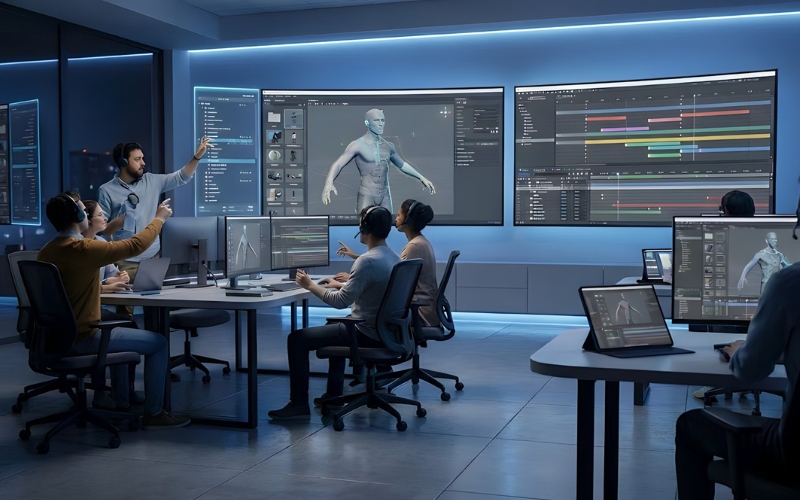
An animation studio is not just a group of animators sharing an office. It’s a coordinated production operation — one that typically includes writers, creative directors, animators (2D and 3D), project managers, voiceover directors, sound designers, and quality control.
When you hire a studio, you’re not hiring a skill. You’re hiring a system. That system is built to take a business objective — explain this product, train this audience, win this pitch — and turn it into a finished visual asset that functions the way you need it to.
Full-service animation companies handle the entire production pipeline: discovery, script development, concept and style frames, storyboarding, animation, voiceover, sound design, revisions, and final delivery in whatever formats your team needs. The project manager keeps the schedule. The creative director ensures the work aligns with your brand and goals. You don’t need to know how to manage a production — that’s their job.
Studios also maintain consistent output quality across projects. If you commission a product animation today and a medical explainer six months from now, a studio can deliver both at the same quality level with the same understanding of your business. That consistency matters when you’re building a library of content or rolling out assets across multiple departments.

What a Freelance Animator Actually Does
A freelance animator is an individual professional — typically skilled in a specific style or discipline — who takes on projects independently. The best freelancers have strong reels, genuine craft, and the ability to move quickly on clearly defined work.
Where freelancers genuinely excel is execution. If you have a finished script, a clear brief, a defined visual style, and an internal producer who can manage the process, a talented freelancer can be an excellent and cost-efficient choice — especially for shorter, lower-stakes assets like social media clips, motion graphics overlays, or supplemental explainer segments.
Freelancers are also the right answer for ongoing relationships where you’ve already established trust and alignment. If you’ve worked with someone for two years, they know your brand, they know your standards, and they deliver consistently — that’s a valuable partnership worth maintaining.
The challenge is that the conditions above — polished brief, internal production management, established relationship — aren’t the reality for most companies the first time they commission animated video content.

Where the Agency vs Freelancer Animation Decision Gets Complicated
The real friction in the agency vs freelancer animation debate isn’t about quality. It’s about accountability and scope.
When you hire a freelancer, you become the producer. That means tracking milestones, managing feedback rounds, coordinating with your voiceover talent, handling licensing for music and assets, and troubleshooting when something goes sideways. If you have a dedicated in-house content team with the capacity to manage that, it can work well. If you don’t — if you’re a marketing director at a mid-sized company juggling five other initiatives — that coordination burden lands directly on your plate.
Scope is the other issue. Most freelancers specialize. A motion graphics designer may not do 3D product animation. A 3D modeler may not write scripts. A character animator may not handle sound design. When your project requires more than one discipline — which most substantive B2B video projects do — you’re either hiring multiple freelancers and coordinating between them yourself, or you’re working with a studio that has all of it under one roof.
The single point of failure problem is real and underestimated. If a freelancer gets sick, takes on overlapping work, hits a creative wall, or simply goes dark on a project, your timeline goes with them. There is no team to absorb the gap. In a studio environment, that risk is distributed — if one animator hits a bottleneck, the project manager adjusts the schedule and another resource picks up the load.
When to Hire an Animation Studio
There are clear signals that a full animation studio is the right call:
The project is externally facing. If this video will live on your homepage, appear in investor presentations, represent your company at an industry event, or run in paid media — it needs to be right. The cost of a misaligned or underpowered video in those contexts is much higher than the cost of a proper studio engagement.
The subject matter is complex. Medical device animation, mechanism of action explanations, industrial process visualizations, SaaS product demos for technical audiences, engineering simulations — these require a team that can understand your material well enough to explain it accurately and compellingly. That kind of subject-matter collaboration doesn’t work through a brief handed to a solo animator.
You need a complete deliverable, not just motion. If your project requires scripting, voiceover direction, sound design, and format delivery across multiple channels, you need a pipeline. Assembling that from freelancers is a project management task in itself.
Multiple stakeholders need to sign off. If your approval process involves product, legal, executive, and marketing all weighing in at different stages, the structured revision workflow of a studio is far better suited to that reality than a freelance engagement built around informal feedback.
You need consistency over time. If you’re planning a content series, a library of product animations, or regular video assets across departments, a studio relationship gives you quality control, institutional memory, and the ability to build on previous work.
When a Freelancer Makes More Sense
Freelancers are the right fit when the conditions for success are already in place:
- You have a finished, approved script
- You have a defined visual style with clear reference materials
- You have an internal person with the time and experience to manage the production process
- The asset is supplemental or internal — not customer-facing or externally critical
- Your budget is genuinely limited and the stakes are proportionally lower
- You have an established relationship with a specific animator whose work you trust
In those situations, a skilled freelancer can deliver excellent work at a lower cost than a studio. The key word is “established.” Starting a new freelance relationship on a high-stakes project is the scenario that most often ends in frustration.
Cost and Timeline: What the Numbers Actually Look Like
When comparing hiring an animator vs studio for the same 60-second explainer video, the cost difference is real but narrower than most buyers expect — and the timeline difference often surprises people in both directions.
A mid-range freelancer for a 60-second custom explainer might quote $2,000–$6,000. A quality studio for the same project typically runs $8,000–$20,000. That gap is real. But what’s often not accounted for is the cost of the buyer’s own time managing the freelance process, the cost of revisions that go over scope, and the cost of starting over if the project doesn’t deliver.
Timelines are also variable in ways buyers don’t anticipate. A freelancer working solo can be faster on simple projects, but slower on complex ones — because there’s no team to parallelize the work. A studio with a full production team can compress complex timelines more effectively, and project management means milestones are tracked and hit.
The honest version of this conversation is: match budget to stakes. If the video is going in front of your best prospects, your investors, or your largest clients — spend appropriately.
Industries Where Getting This Decision Right Matters Most
Some industries carry higher stakes than others when it comes to animated video quality and accuracy. In these sectors, the animation company vs freelancer decision often isn’t really a debate.
Medical and biotech: Medical device animations, mechanism of action explainers, surgical procedure visualizations, and patient education content all require scientific accuracy, regulatory awareness, and a production process that includes review and revision at each stage. These are not projects for a solo animator working from a brief.

Industrial and manufacturing: Process animations, engineering simulations, and equipment explainers involve technical specifications that have to be right. A misrepresented process in a training video or investor presentation creates real problems. Studios with industrial animation experience understand what accuracy means in this context.

SaaS and technology: Product demo videos and explainer videos for software platforms need to communicate abstract concepts in concrete, visual terms — without oversimplifying for technical audiences or confusing non-technical buyers. That balance requires both writing expertise and animation skill working together.
Legal and forensic: Courtroom animation, accident reconstruction, and legal exhibit visualizations require documented accuracy and defensibility. The production process matters as much as the final output.
Real estate and architecture: Architectural visualization and development presentation videos are often shown to investors, city planning boards, and high-net-worth buyers. Production quality directly affects credibility.
How Austin Visuals Approaches This Decision With Clients
At Austin Visuals, we work across a wide range of project types — 2D animation, 3D animation, medical and pharmaceutical animation, product and industrial visualization, SaaS explainer videos, corporate training videos, architectural visualization, and more. Our team includes creative directors, writers, 2D and 3D animators, project managers, and producers.
We’re not the right fit for a $1,500 social clip with a two-day turnaround. We’re built for projects where the visual communication needs to work — where complexity needs to be made clear, where brand integrity matters, and where the business stakes of getting it right justify a professional production process.
When clients come to us after a freelance project that didn’t deliver, the most common root cause is a mismatch between what the project actually required and what a solo animator could realistically provide. That’s not a failure of the freelancer — it’s a scoping problem that could have been caught earlier.
We’re happy to tell you honestly whether your project is a good fit for what we do — or whether a different approach makes more sense for where you are.
Our clients include:

Frequently Asked Questions
Is it cheaper to hire a freelancer than an animation company?
Usually, yes — in terms of the upfront quote. But the total cost often looks different when you factor in your own time managing the project, any out-of-scope revision fees, and the risk of needing to restart. For high-stakes, externally facing video, the cost difference rarely justifies the added risk.
What types of animation projects are best suited for a freelancer?
Short, clearly defined assets where you already have a script, a visual brief, and the internal capacity to manage production. Social content, logo animations, simple motion graphics overlays, and supplemental segments are reasonable fits. Complex product demos, medical animations, and customer-facing explainers typically aren’t.
What does an animation company provide that a freelancer can’t?
A full production pipeline: scripting, creative direction, storyboarding, multiple animation disciplines, voiceover direction, sound design, project management, and quality control across revisions. Also: redundancy. If one person on a studio team is unavailable, the project doesn’t stop.
How do I evaluate whether an animation company is the right partner?
Ask about their production process, how they handle revision rounds, whether they’ve worked in your industry, who specifically will be working on your project, and what’s included in the base quote. A studio that can answer all of those questions clearly is running a professional operation.
Can I hire a freelancer for part of a project and a studio for the rest?
Yes, but coordinate carefully. Mixed-team projects can create consistency issues in style, pacing, and quality unless someone is actively managing the overall production. In most cases, if the stakes are high enough to involve a studio at all, it’s worth having them own the full deliverable.
What should I prepare before reaching out to an animation company?
A rough sense of the goal (what should the viewer understand or do after watching), the intended audience, the approximate length, where it will be used, and your general timeline. You don’t need a finished brief — a good studio will help you develop one.
Does Austin Visuals work with startups and small businesses, or only enterprise clients?
We work with companies of all sizes. What matters more than company size is whether the project scope and expectations are a reasonable fit for what a professional studio produces. We’re happy to have that conversation upfront.
Ready to Talk Through Your Project?
If you’re weighing whether a freelance animator or an animation company is the right fit for what you’re building, Austin Visuals is glad to give you a direct, honest answer based on your actual project scope.
We work with marketing teams, product companies, medical and biotech organizations, industrial and engineering firms, legal teams, and corporate communications departments. Our job is to turn complex ideas into clear, compelling visual content — and to make that process as straightforward as possible for the teams we work with.