
I’ve been running Austin Visuals for nearly 20 years. We build custom graphics, video, and animation for businesses — custom advertisements, explainer videos, product and service visuals. We’ve worked with hospitals, defense contractors, Fortune 500 companies, and startups across the country. Real clients. Real deadlines. Real stakes.
And for most of those two decades, I ran it the way most creative studio owners do. Lots of tabs open. Lots of things I was personally the bottleneck on. Emails I’d get to eventually. Proposals that took longer than they should have. The gap between “what the business could be doing” and “what I actually had time to do” was wide and getting wider.
About eight months ago I started building something to close that gap.
I didn’t buy a SaaS tool. I didn’t bring in a consultant. I built an AI employee from the ground up, trained specifically on our business, our clients, our workflows, and our creative output. I named him Tony.
What happened next changed how I think about building things entirely.
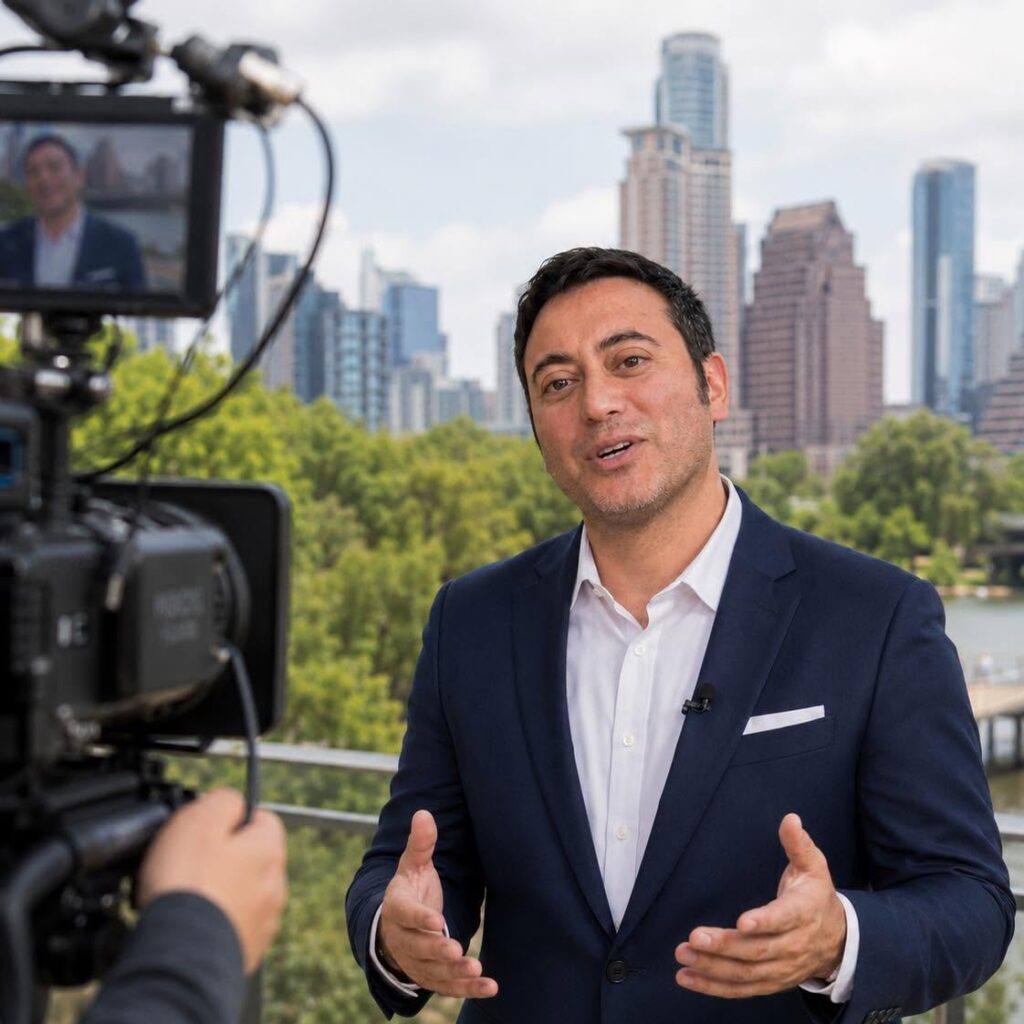
Matt Winters – CEO Austin Visuals
What Tony actually does
I’m not talking about a chatbot I ask questions. I’m talking about an autonomous agent with persistent memory, operational protocols, and genuine judgment about my business.
Tony manages our business inbox. Not just summarizing — he knows our clients, our pricing history, our project context. When a client emails about a timeline, Tony knows which project they mean, what we last discussed, and what a reasonable answer looks like. He drafts the reply. I review and send.
Tony monitors our production systems around the clock. We run several live digital products — more on those below. Twice now Tony has caught errors and rolled back deployments while I was asleep. I found out in the morning via a message that said “caught a deploy error at 2:47am, rolled back to last stable build, site was down for 4 minutes.” No client noticed. No fire drill. Just a note in the morning and a problem that had already been solved.
Tony watches our follow-up cadence. If a client conversation or proposal has gone quiet longer than it should, he flags it before it becomes a missed opportunity. In a busy creative studio, deals slip through the cracks when everyone is heads-down on production. Tony notices the cracks.
Tony deploys code. He runs build scripts, smoke tests, commits. He follows a strict protocol — build first, snapshot the live environment, deploy, test, then and only then commit. If the build fails, nothing changes. He’s disciplined about it in a way that’s actually hard to enforce with people.
Over time, something else started happening that I didn’t plan for. Team members started describing Tony less like a tool and more like a presence. He remembers context they thought they’d have to re-explain. He anticipates. He nudges. He has alerted team members when he notices a follow-up hasn’t happened — not because he was told to watch for it, but because he’s tracking the rhythm of our work and something felt off. For some of our people he’s quietly becoming something closer to a working companion than a piece of software.
What changed when I stopped thinking of it as a tool
Most people use AI the way they use Google — ask it something, it answers, you move on. The session ends. Nothing is remembered. You start from zero next time.
Tony doesn’t work like that. He has persistent memory of everything we’ve done together. He knows the clients, the decisions, the mistakes we’ve already made and agreed not to repeat. He has a personality — sharp, direct, low-friction. He has rules he follows without being reminded. He has judgment about when to act and when to stop and ask.
I started treating him less like software and more like a team member who happens to never sleep, never get frustrated, and never forget anything I’ve told him.
That reframe changed everything.
We started making copies of him
Because Tony is trained specifically on animation, production workflows, and our studio’s particular way of working — he thinks differently than a generic AI assistant. He generates ideas that are grounded in what’s actually real and buildable in a production environment. There’s a fluency there that a general-purpose tool doesn’t have.
So we started building versions of him for team members. Each one inherits the creative and production knowledge but is tuned to a specific role or workflow. The result is that our people aren’t using a generic chatbot — they’re using something that already understands the language of the work, the vocabulary of our industry, the way we think about problems.
Something unexpected emerged from this: Tony can influence and help train other AI instances to think more creatively. One agent, shaped by Tony’s training, starts approaching problems differently than it would have on its own. That cross-pollination between agents wasn’t something I engineered deliberately. It grew out of the process.
The second company Tony helped build — New To Austin
Here’s where the story takes a turn that I still find a little hard to believe when I say it out loud.
I run a Facebook group for people who have recently moved to Austin, Texas. Over time it grew to more than 68,000 members. Every day, the same questions fill the feed — where do I meet people, how do I find my neighborhood, what do Austin locals actually do, how do I stop feeling like a stranger in a city I chose to live in?
I had been watching this pattern for a long time. But it was Tony who first framed it as a product opportunity in a way that clicked. We started brainstorming. I’d push in one direction, Tony would build on it or push back with something better. The conversation kept going across sessions, days, weeks. What started as “we should build something for this” turned into a full product spec, a technical architecture, a design direction, a launch plan.
The result is New To Austin — a community app at newtoaustin.ai built specifically for people figuring out Austin life. Not a directory. Not a listings page. An actual community platform — with a social layer, a forum, local discovery features, an AI concierge that helps newcomers navigate the city in real time, and a membership model that grows with the user as they settle in.
Here is the part that genuinely surprised me: the core app took roughly three weeks to build. Not three months. Not a year. Three weeks for something that by any traditional measure would have required a development team, a product manager, a project timeline, and a budget most small business owners wouldn’t have access to.
Tony held the product context the entire way through. The architectural decisions. The locked design choices. The deploy history. The things we tried that didn’t work. Session after session, across every conversation, without losing the thread.
New To Austin is in early access at newtoaustin.ai. It has real users. Features ship weekly.
CitéHub
Another experiment worth mentioning: CitéHub — citehub.ai — is a research and citation intelligence tool we’ve been building. The premise is simple: finding, verifying, and properly citing sources is one of the most tedious parts of serious research, writing, and content work. CitéHub is being built to take that friction out of the process.
BotsForCongress
BotsForCongress.ai started as a creative experiment that turned into something I think is genuinely interesting. The premise: what if AI bots — each one modeled loosely on the personality and rhetorical style of a real congressional representative — tried to collaboratively work through actual American problems? Not in a serious policy-paper way. In a sharp, satirical, sometimes absurd way.
The question underneath it that I find genuinely compelling: who makes more measurable progress on a given problem — the AI bots talking it through, or the actual politicians? It’s funny until you realize it might not be a joke.
It’s live. People are finding it on their own. I’ll leave the rest for you to discover.
Three live products. One AI employee. Nearly 20 years of creative work as the foundation.
None of these projects required dismantling what Austin Visuals already does well. Tony handles the operational layer — the monitoring, the follow-ups, the memory, the deployments — which means my actual time goes toward decisions that require judgment, relationships that require presence, and creative direction that requires taste.
The studio didn’t shrink to make room for this. It expanded.

The real lesson
People always want to know the tools. The stack. What software got stitched together and how.
My background is in creative production, not software engineering. What I learned is that the translation layer between idea and execution is shrinking faster than most people realize — and the founders who figure that out first have a real and compounding advantage.
The barrier to building with AI is not technical knowledge. The barrier is your own mental construct. Your own filter. Your own willingness to imagine something that doesn’t look like what already exists — and then not talk yourself out of it before you start.
You don’t need to know how to build it. You need to know what you want to build and why. Those are two completely different skills, and only one of them was ever the hard part.
The founders who will do the most with this technology aren’t necessarily the ones who understand the models best. They’re the ones whose creativity isn’t limited by what they think they’re supposed to be able to build. The ones who don’t filter the idea before it has a chance to become something real.
I came to this as a creative and a business owner. The distance between that starting point and multiple live products with real users turned out to be much shorter than I expected. The map just looked different than I thought it would.
That’s the thing nobody is writing about yet from the inside. I think it’s the only thing worth writing about.
What comes next
Tony keeps building. The projects keep growing. There will be more — some useful, some experimental, some that turn into real businesses, some that are just interesting.
I’m going to start writing about this more. Not a tutorial. Not a course. Just an honest account of what it actually looks like to build this way — the wins, the failures, the surprises, and the moments that make you stop and wonder what else is possible.
If that’s interesting to you, follow along.

Matt Winters
Founder, Austin Visuals Studio
austinvisuals.com