

VR in the healthcare industry covers several different uses: education, visual communication and certain medical-device applications. The evidence depends on the particular system and intended use. Virtual reality, artificial intelligence and quantum computing are distinct technologies, and combining their names does not prove that a headset can predict an individual patient’s drug response. Austin Visuals supports medical communication through animation and interactive visuals.
To discuss a visual communication project, contact Austin Visuals with your audience, approved source material and intended use.
VR in the healthcare industry: evaluating medical education uses
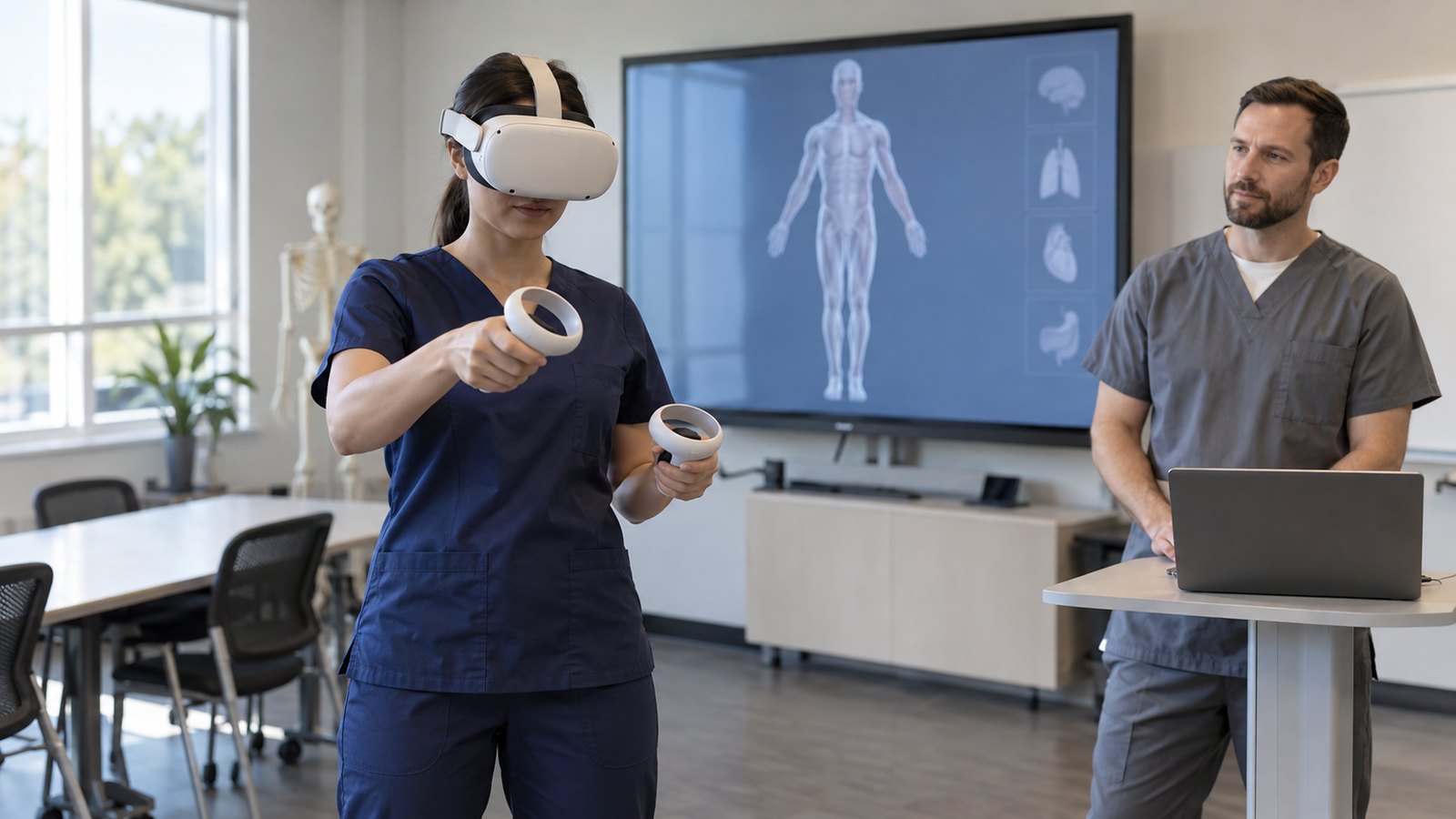
VR can present a spatial scene and let a learner explore it. A course might use that capability to explain anatomy, orient staff to equipment, or rehearse a particular task. Educational value depends on the content, interaction, feedback and assessment.
The 2019 health professions education review found support for some knowledge and skill outcomes, while noting limits in the evidence. Its findings do not establish that all immersive programs are faster, more accurate or clinically superior. Review the education evidence and its limitations.
Updated October 14, 2026.
Medical-device applications: check the exact intended use
Some AR/VR products are medical devices. Their status and supporting evidence apply to a specific product and use, rather than to VR as a whole. The FDA’s De Novo record for EaseVRx is one concrete example of a virtual reality behavioral therapy device for pain relief. It is not authorization for an ordinary marketing animation to diagnose or treat a patient. Read the FDA device record.
For a proposed clinical application, ask what the product is intended to do, which patients it is for, what evidence supports that use, and what limitations appear in its documentation. The FDA also discusses risks of AR/VR devices, including discomfort and display-related problems. Read the FDA AR/VR overview.
Product communication: useful visuals need approved messages
An interactive product demonstration can let a viewer rotate a device or inspect an internal component. A medical animation can explain a mechanism or a workflow. Those are communication functions; sales performance should be measured separately.
Choose the audience before choosing hardware. A conference visitor may need a short silent loop, while a professional audience may need a detailed narrated explanation. A conventional video may be easier to distribute than a headset experience. Compare accessibility, setup time, support and the information the viewer needs to understand.
AI and quantum computing: keep research questions separate
AI can be part of a particular software system, but an AI-generated scenario still needs validation. Quantum computing is a separate area of computing research. Neither term supplies evidence that a VR visualization can predict medication effects for a particular person.
Drug response and treatment decisions require appropriate scientific and clinical evidence. A simulated molecular sequence can communicate a proposed mechanism; it cannot establish safety, effectiveness or the best treatment for a patient. The FDA describes a drug development process that includes clinical research and review of evidence. See the FDA drug development process.
How to assess a proposed VR project
| Project purpose | What to verify |
|---|---|
| Education | Learning objective, expert review, feedback and assessment. |
| Product demonstration | Correct device version, approved features and a measurable communication goal. |
| Clinical use | Specific intended use, relevant evidence and applicable device requirements. |
| Research concept | Explicit experimental status and the questions that remain unanswered. |
Remote delivery may address some travel constraints, but it still needs hardware access, support and suitable content. VR alone does not track outbreaks or monitor distancing.
Use an evidence register for each proposed application
List the application before listing the technology. An evidence register can record the intended user, task, product version, source and outcome measured. A row for anatomy education should not borrow evidence from a pain-treatment device, because those are different uses.
For each source, identify whether it is a study, a review, a regulatory record or a product announcement. A regulatory record supports statements about that product’s authorized use. A portfolio sample supports statements about a visual deliverable. Neither should be used to imply that every healthcare VR system has the same evidence.
Record the date and the limits that affect interpretation. This gives the project team a practical way to review changing information before the content is reused. It also makes a short presentation more reliable: the presenter can explain exactly which application a finding concerns and which questions remain open.
Illustrative comparison: headset session or accessible video
Imagine a healthcare company that needs to explain a device to an audience spread across several locations. A headset experience could allow guided inspection of a three-dimensional object, but it would require suitable hardware and support. A video could be shared more simply and watched again during a follow-up conversation.
The team should ask which action the viewer needs to take. If the goal is to recognize the main components and understand their stated function, a reviewed animation may be sufficient. If spatial exploration is central to the task, the team could test an interactive version with representative users.
Compare understanding, usability and delivery costs under the intended conditions. Do not infer clinical effectiveness from a preference for immersive presentation. This example describes a decision process, not a finding that one format is always superior or a documented Austin Visuals healthcare deployment.
Present future developments with a defined research question
A discussion of future technology is useful when it explains what researchers are trying to solve. State the question, the system being investigated and the evidence still needed. Avoid a prediction that a combination of VR and AI will automatically personalize treatment or remove uncertainty.
For example, a proposed visualization might aim to help a professional inspect a complex model. That purpose can be explained without claiming the display predicts a drug’s effect on a person. If the proposal includes a predictive method, the method’s validation is a separate subject from the immersive interface.
Keep research status visible in the script, slide title and any animation captions. A promising concept can be described plainly without implying that it is routinely available in clinical practice. This is especially important when a short clip is reused outside the longer presentation that originally supplied its context.
For each proposed application, retain the exact system and intended use when collecting evidence. That detail prevents a general trend summary from implying that the same results apply to every headset, software package or course. A concise source note can identify the population, task and measured outcome without adding unsupported precision.
Published medical animation examples from Austin Visuals
These published medical animation samples illustrate ways to explain anatomy and products visually. Their portfolio entries do not establish outcomes for a VR training program.
Ultrasound-device explainer animation
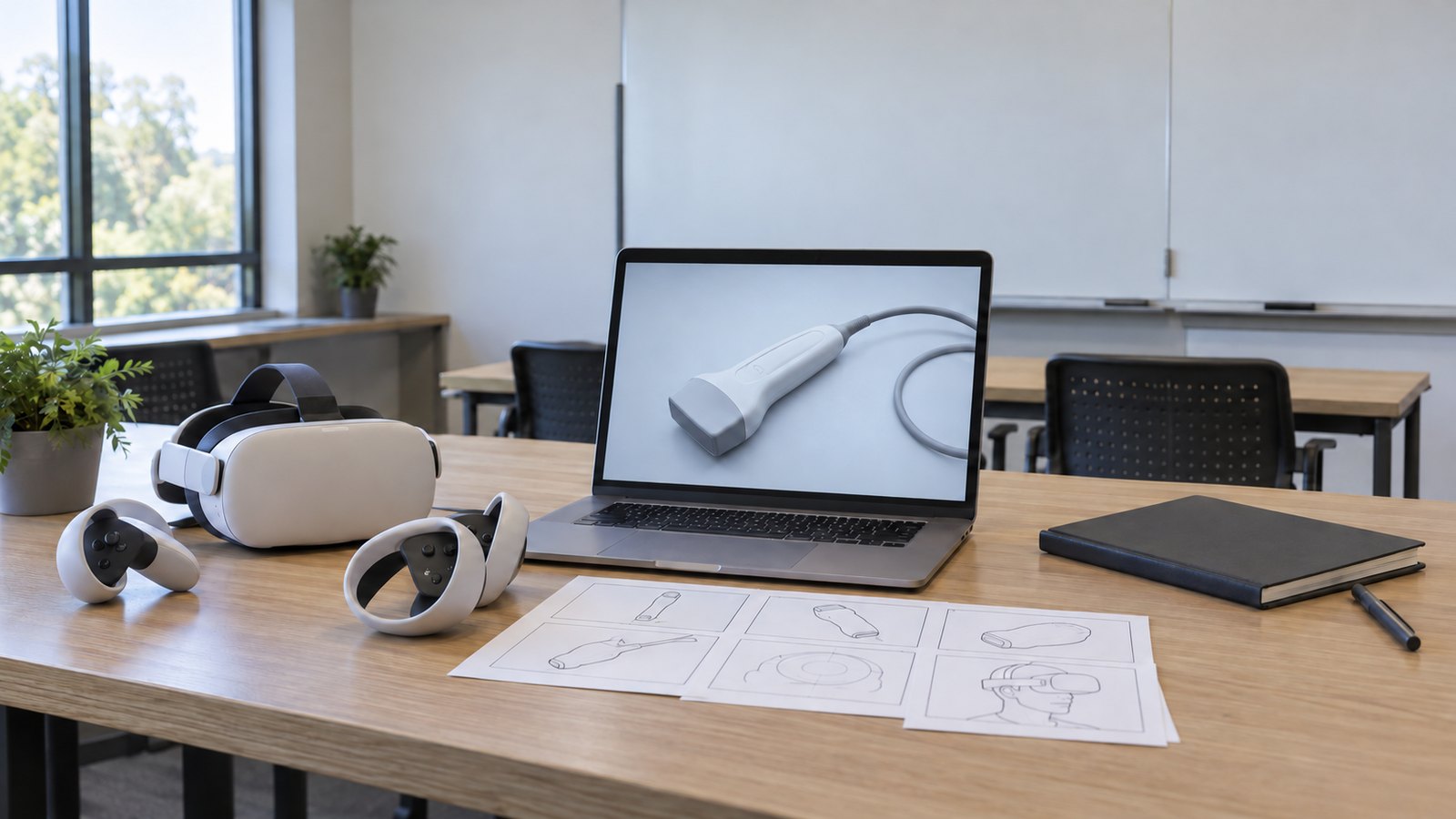
Austin Visuals publishes an ultrasound-device explainer in its portfolio. It provides a relevant product-communication example. The entry is not used here to claim a validated training result, device effectiveness or increased sales. View the published ultrasound-device explainer animation work sample.
Boston Cell Standards scientific animation
The Boston Cell Standards entry is a published scientific animation work sample. It illustrates a category of laboratory and scientific communication. The portfolio listing does not establish a clinical benefit or the commercial performance of a campaign. View the published boston cell standards scientific animation work sample.
Planning healthcare VR content with Austin Visuals
Austin Visuals offers medical animation production for teams explaining devices, anatomy or biological processes. Begin the discussion with the proposed application: a professional lesson, product presentation or general educational explanation. The production plan should follow that purpose.
Provide approved messages and references, then identify which interactions the audience needs. A conventional video may answer the communication question without headset hardware. If the project includes immersive content, define delivery and support requirements separately from the visual assets. Assign reviewers for product facts and scientific content, and keep clinical-use claims tied to the evidence for the particular system being discussed.
Conclusion
VR in the healthcare industry should be assessed application by application. Education, device demonstration, authorized clinical use and experimental research require different evidence and production plans.
Austin Visuals can help turn your approved material into a clear visual explanation. Email info@austinvisuals.com or call (512) 591-8024 to discuss your audience and production requirements.
Frequently asked questions
Is every healthcare VR product a medical device?
No. Classification depends on its intended use and other applicable factors. A product demonstration and a clinical tool should not be described interchangeably.
Can VR predict how a medicine will affect me?
A visualization alone cannot predict an individual treatment response. That claim requires evidence for a specific validated system.
Does VR always improve learning?
No. The result depends on the task, design, comparison and evaluation. A headset is a delivery format, not proof of effectiveness.
Is AI the same technology as VR?
No. VR presents an interactive simulated environment; AI refers to different computational methods that a system may or may not use.
When is a normal video more practical?
A video may be suitable when the goal is explanation and the audience needs simple access across phones, websites or conference screens.
What should a company provide to an animation studio?
Provide the audience, intended use, approved claims, scientific references, product files and a named reviewer for the subject matter.