
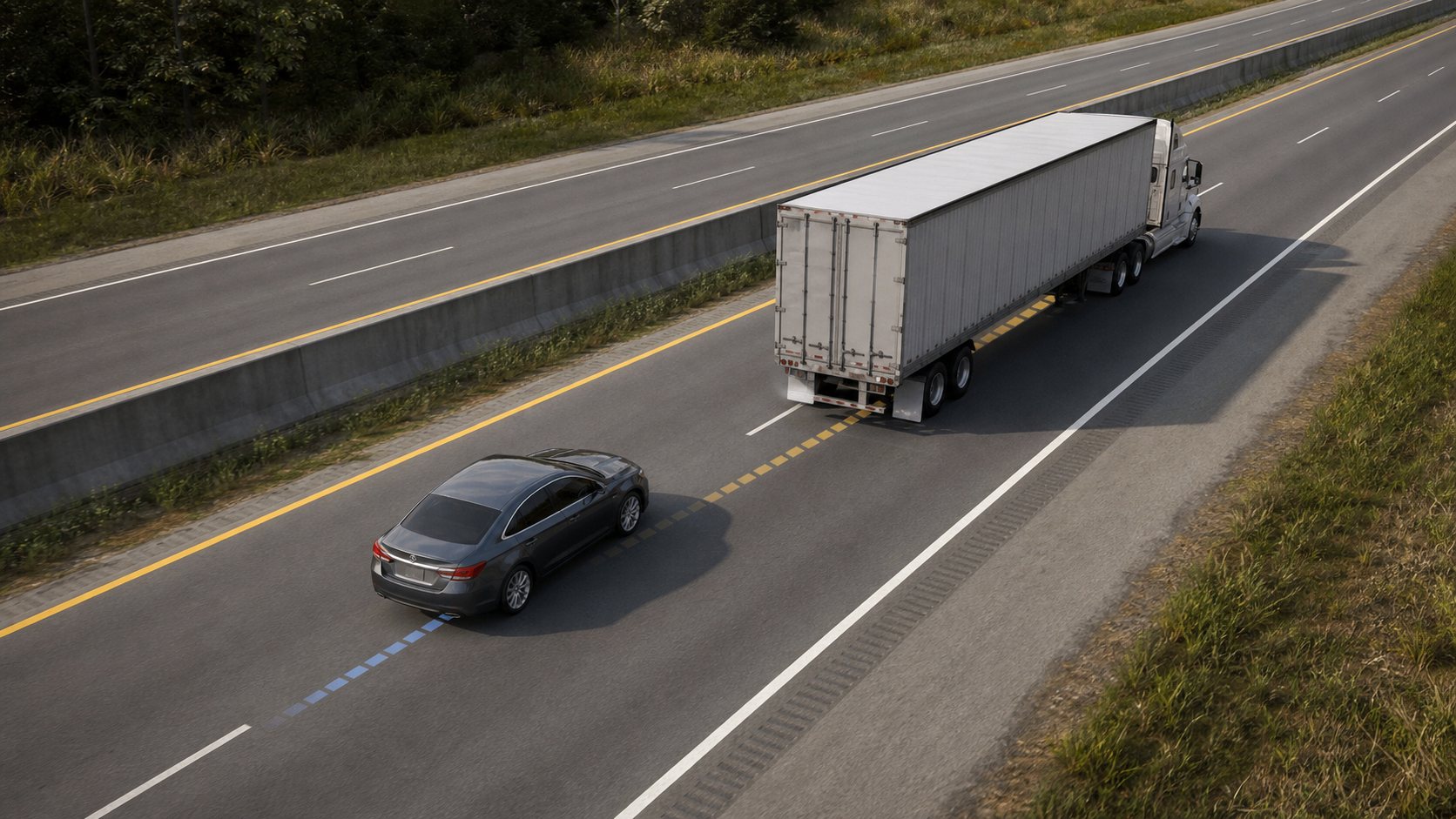
Forensic animation for truck accident litigation turns crash evidence and qualified expert analysis into a clear visual sequence showing how a commercial-vehicle collision may have unfolded. When it is built from verified measurements, vehicle data, photographs, video, and an accident reconstructionist’s approved opinions, it can help attorneys explain timing, movement, visibility, and impact mechanics during case evaluation, mediation, deposition, or trial.
A truck-crash animation is not a substitute for the evidence or the expert. It is a communication tool that organizes the supported reconstruction into views a nontechnical audience can follow. The most defensible work keeps every important position, speed, camera angle, and assumption traceable to the case record.
Why Truck Accident Cases Are Difficult to Explain Visually
Commercial truck crashes often involve more variables than a typical two-car collision. A tractor and trailer articulate independently, require more space to turn, and may respond differently as cargo shifts, tires lose traction, or braking forces change. A multi-vehicle sequence can develop over only a few seconds while still requiring analysis of hundreds of feet of roadway.
The legal team may also need to coordinate several technical subjects. These can include accident reconstruction, trucking operations, vehicle inspection, human factors, roadway design, biomechanics, and medical causation. Each expert has a defined role, and the animation should not blend those opinions into conclusions that no witness is prepared to support.
Common disputed questions include:
- Where were the tractor, trailer, passenger vehicles, pedestrians, and fixed objects at key times?
- When did a hazard become visible, and how much time was available to perceive and respond?
- Did braking, steering, lane movement, or trailer off-tracking affect the collision sequence?
- What could a driver see through the windshield and mirrors from a supported eye position?
- How do scene marks, vehicle damage, recorded data, and video fit together?
- Which parts of the sequence are measured, calculated, assumed, or genuinely unknown?
What Forensic Animation Can Show in Truck Accident Litigation
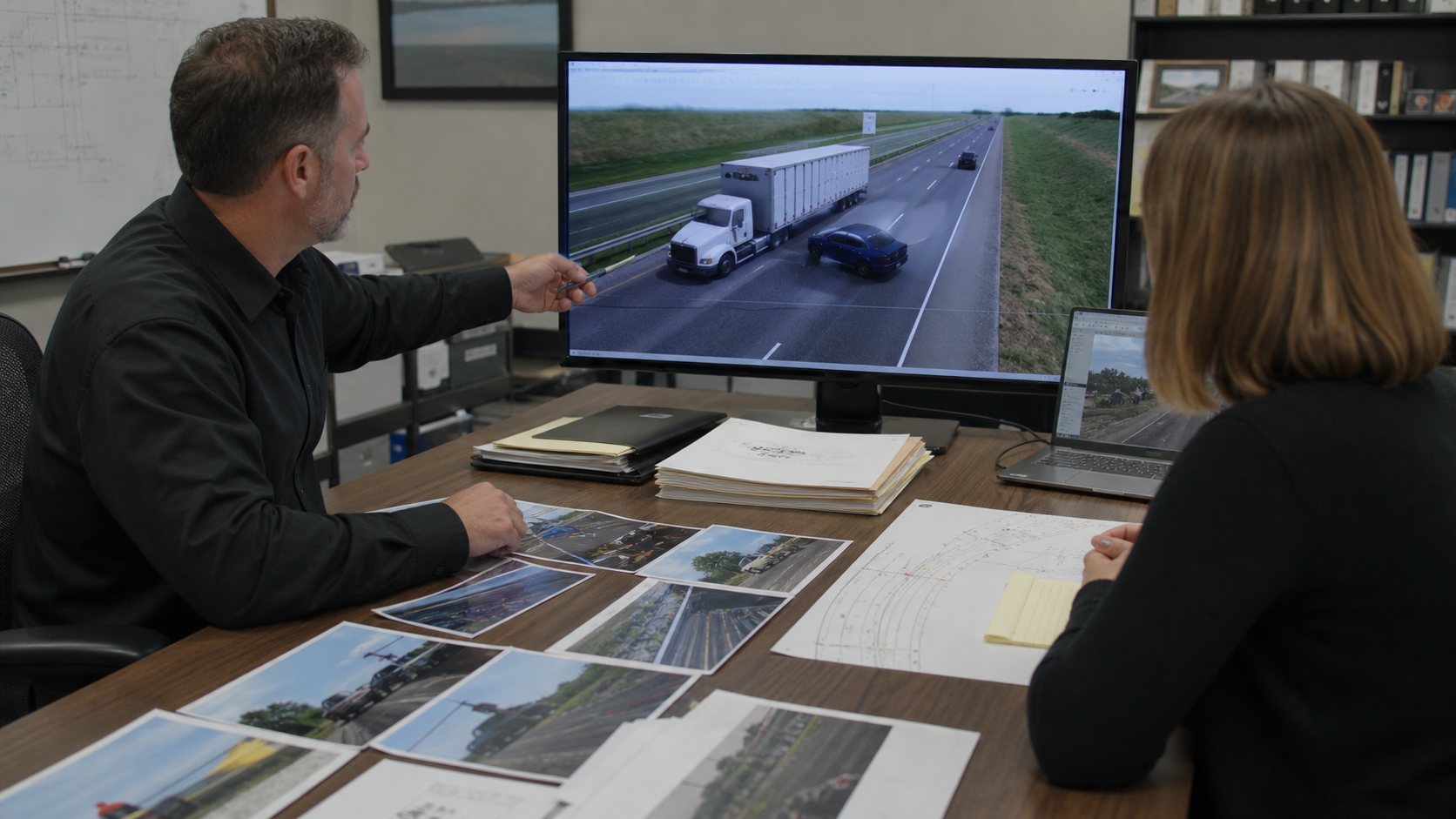
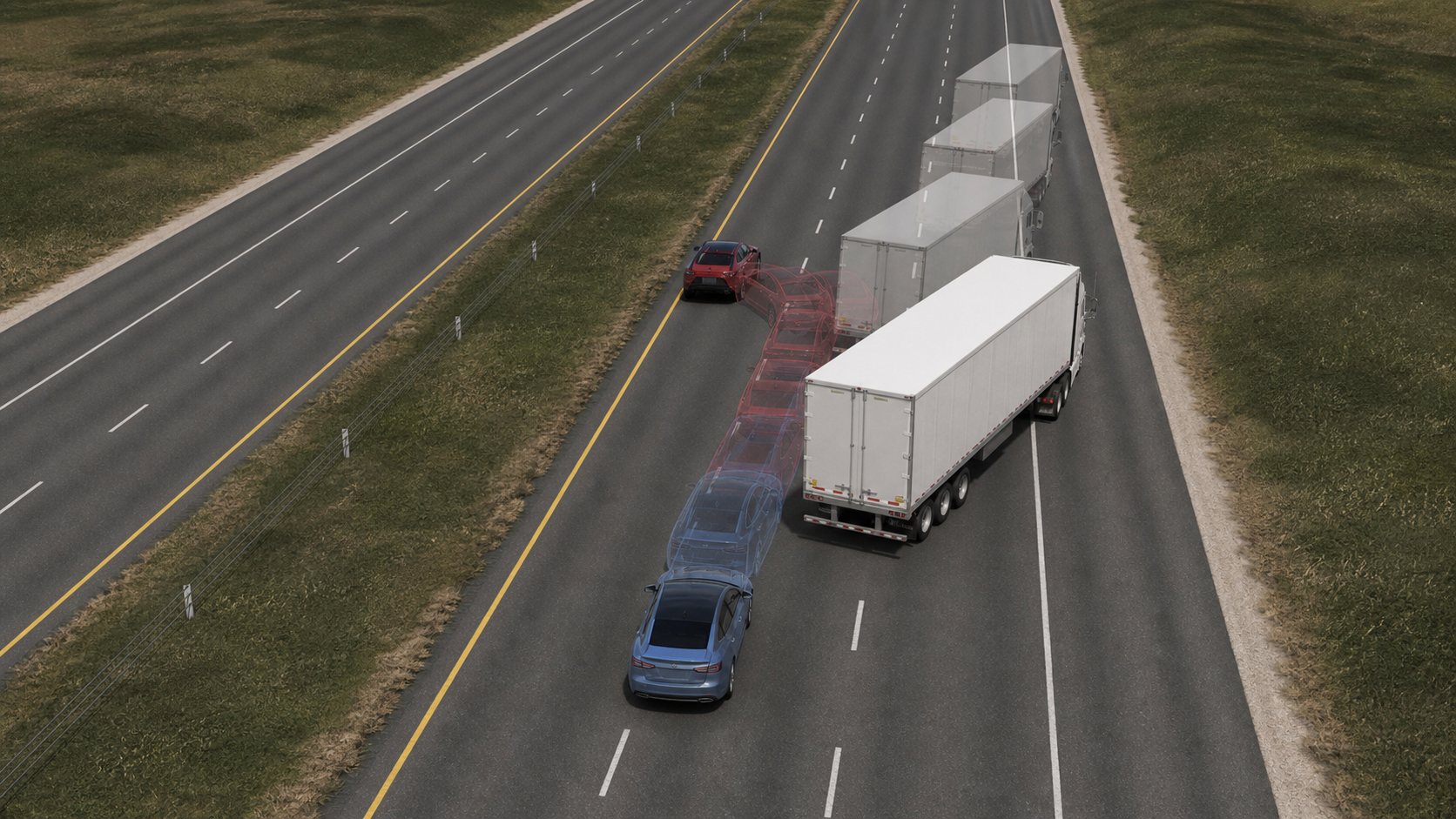
A well-scoped truck accident reconstruction animation can combine time, distance, and three-dimensional space in one presentation. It may show the tractor-trailer’s approach, lane position, braking phase, steering input, articulation, impact, and post-impact travel. It can also place other vehicles or road users into the same synchronized timeline.
Supporting trucking litigation graphics can isolate individual issues with a scaled plan view, timeline, data chart, or annotated still. These simpler visuals are useful when only one measurement or comparison needs explanation and a moving sequence would add unnecessary complexity.
Vehicle Paths and Collision Sequence
Overhead and perspective views can show how the vehicles moved relative to lane markings, shoulders, medians, intersections, barriers, and one another. The scene should be scaled from survey data, total-station measurements, laser scans, photogrammetry, diagrams, or another source approved by the reconstruction expert.
Animation is particularly useful when the audience must understand a changing relationship. A still diagram can show two positions, but a timed sequence can show how quickly a passenger vehicle entered a lane, how the trailer tracked through a turn, or how a chain reaction developed.
Driver Visibility and Sight Lines
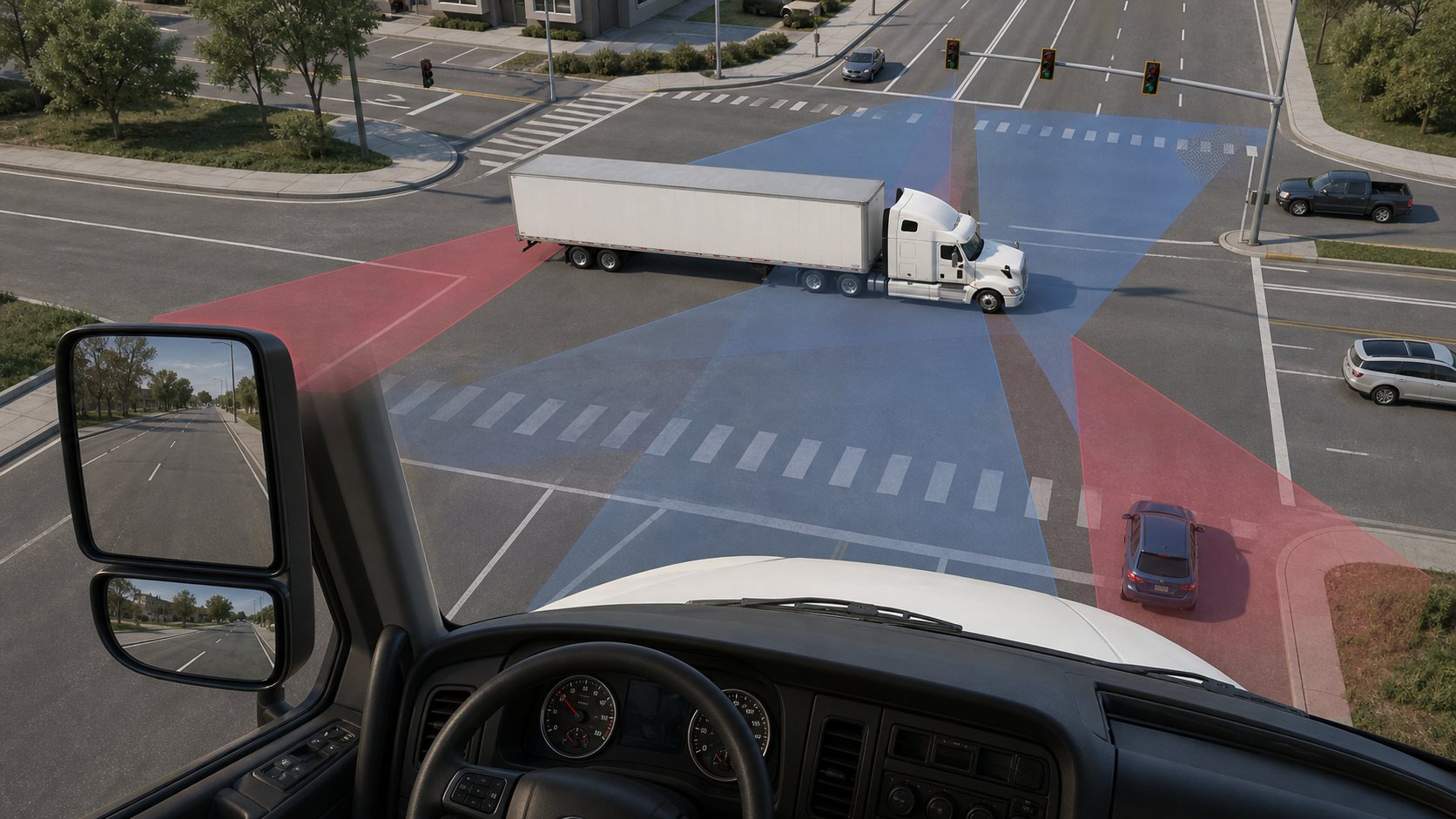
A visibility study can place a camera at an expert-approved driver eye point and recreate relevant vehicle geometry, mirrors, roadway grade, lighting, signs, vegetation, traffic, and obstructions. Alternate views may compare what was potentially visible from the truck cab with an external plan view.
The animation should not claim that a driver actually saw something merely because it appears in a modeled sight line. Perception, attention, recognition, and response are separate human-factors questions. The visual should stay within the supporting expert’s opinion and label limitations when needed.
Braking, Speed, and Timing
When the reconstructionist supplies supported calculations, the animation can visualize approach speeds, braking onset, time-to-impact, stopping distance, and vehicle positions at selected intervals. On-screen clocks, distance markers, or speed readouts should come from approved values rather than decorative estimates.
Commercial-vehicle data may have different sources and limitations from passenger-car data. NHTSA notes that event data recorders can provide useful pre-crash, crash, and post-crash information, but the data should be used with other evidence. A responsible workflow therefore checks recorded values against physical evidence, video timing, inspection findings, and the expert’s methodology.
Vehicle Geometry, Articulation, and Cargo Effects
Three-dimensional models can show tractor wheelbase, trailer length, hitch location, turning path, off-tracking, underride relationships, or the orientation of a jackknifed combination. When cargo movement or securement is part of an expert opinion, the visual can show the supported configuration without inventing unseen behavior.
Model detail should follow the issue. A dispute about a mirror view may require accurate cab and mirror geometry. A dispute about trailer swing may require accurate axle and articulation dimensions. Cosmetic details that do not affect the analysis can remain simplified so the audience focuses on the relevant mechanics.
Evidence Used to Build a Commercial Vehicle Accident Animation
The quality of a commercial vehicle accident animation depends on the quality and completeness of its source package. Useful materials often include:
- Police crash reports, scene diagrams, citations, and supplemental reports
- Scene photographs, drone imagery, surveillance video, dashcam video, and body-camera footage
- Laser scans, total-station data, photogrammetry, roadway plans, and verified measurements
- Vehicle photographs, inspection records, repair history, damage measurements, and component examinations
- EDR, ECM, telematics, GPS, and available engine or braking-system data
- Electronic logging device records, dispatch records, route information, and relevant timestamps
- Weather, lighting, traffic-control, roadway geometry, and construction-zone information
- Witness testimony, depositions, expert reports, calculations, and approved assumptions
- Medical or biomechanical opinions when injury mechanism is within the approved scope
Not every case contains every source. Missing data does not automatically make a visual impossible, but it changes what the animation can responsibly show. The production team should maintain an assumptions log, distinguish measured facts from expert-derived values, and avoid filling gaps merely to make the sequence look complete.
From Case File to 3D Truck Crash Reconstruction
A disciplined workflow makes the visual easier to review and defend. It also prevents expensive rendering before the underlying sequence is approved.
1. Define the Question and Intended Use
The attorney and expert first identify what the visual must explain. A mediation presentation may summarize a sequence, while a trial demonstrative may need closer coordination with disclosed opinions, exhibit deadlines, motions in limine, and the presentation system in the courtroom.
2. Organize and Map the Evidence
Source materials are indexed, and the team identifies which files control roadway scale, vehicle geometry, timing, position, and appearance. Conflicts are returned to counsel and the expert rather than resolved creatively by the animator.
3. Build the Scene and Vehicles
The team models the roadway, terrain, fixed objects, tractor, trailer, other vehicles, and relevant sight obstructions. Camera matching can align a virtual scene with a known photograph or video frame when adequate reference points are available.
4. Create the Timed Motion
Vehicle paths and rotations are driven by expert-approved positions, calculations, and data. The first review should use a simple animatic or low-detail preview. This keeps attention on timing and geometry before textures, lighting, labels, and polished rendering are added.
5. Complete Expert and Legal Review
The reconstructionist verifies the technical sequence. Counsel checks that the visual is consistent with the intended testimony, does not overstate disputed facts, and fits the litigation strategy. A change log can preserve what was revised, why it changed, and who approved it.
6. Render and Prepare Presentation Files
Final deliverables may include a narrated video, a silent courtroom version, alternate camera angles, still frames, transparent overlays, and presentation-ready clips. Counsel should test the files on the actual playback system and keep a simple backup format available.
Forensic Animation Versus Accident Simulation
The terms are sometimes used differently, but a practical distinction helps. A simulation uses a mathematical or physics-based model to calculate behavior from inputs. An animation visually presents a sequence that has already been established through evidence and expert analysis.
An animation can display the output of a validated simulation, but polished movement should not be mistaken for independent scientific proof. Counsel should know which values came from measurements, which came from a reconstruction program, which came from testimony, and which are visual simplifications. The supporting expert must be able to explain the methodology and the limits of the conclusions.
Can a Truck Accident Animation Be Used in Court?
A truck accident animation may be usable in court, but admission is not automatic and rules vary by jurisdiction. In federal practice, Rule 702 addresses the reliability and fit of expert testimony, Rule 901 requires sufficient authentication, and Rule 403 permits exclusion when unfair prejudice, confusion, or other concerns substantially outweigh probative value.
Many litigation animations function as demonstrative exhibits that help explain testimony rather than as independent proof of what happened. A practical foundation may include testimony from a witness or expert who can identify the sources, explain the methodology, and confirm that the visual fairly reflects the supported opinion or evidence.
Production choices can affect credibility. Exaggerated damage, dramatic sound, cinematic camera shake, unsupported driver reactions, or a false level of photorealistic certainty can distract from the underlying analysis. Neutral lighting, restrained motion, accurate scale, visible time references, and clear disclosure of assumptions are usually more useful than spectacle.
A courtroom animation for truck accidents should therefore be designed around the supporting testimony and the forum’s requirements, not around entertainment conventions. Counsel should review both the sequence and the presentation style before final rendering.
This discussion is general educational information, not legal advice. Trial counsel should evaluate the governing federal or state rules, controlling case law, disclosure obligations, pretrial orders, and the assigned judge’s requirements.
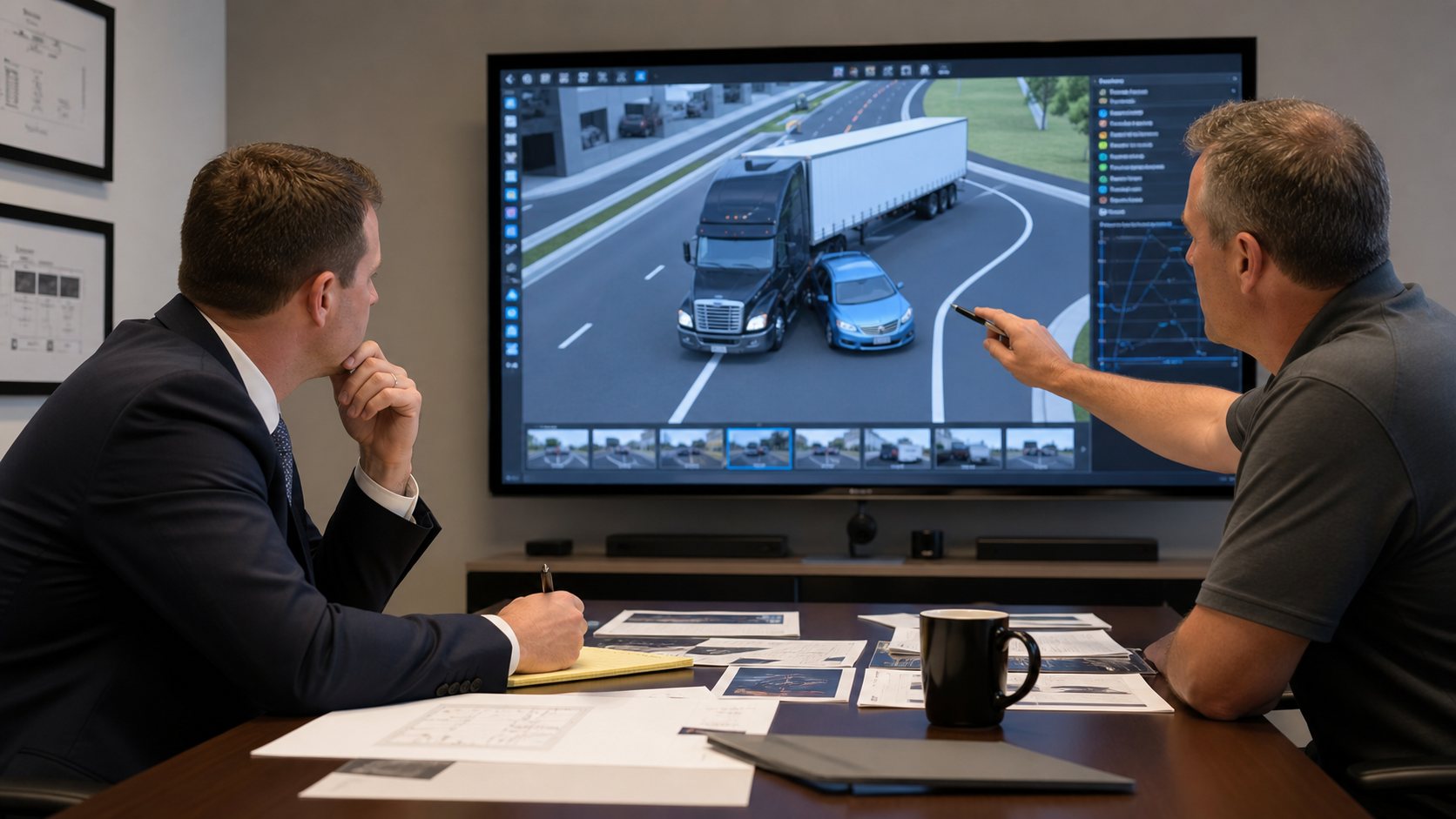
How Legal Teams Use Truck Accident Animation Before Trial
The value of a forensic visual is not limited to a jury presentation. Early scene models and rough sequences can help the team compare competing timelines, prepare witnesses, identify missing measurements, and decide whether a complex point can be explained more efficiently with still graphics.
At mediation, a concise animation can give decision-makers a common view of the supported collision sequence. During deposition preparation, selected frames may help counsel organize questions about position, visibility, timing, and alternative scenarios. At trial, the final presentation can support an expert’s step-by-step explanation without forcing jurors to assemble the geometry from separate photographs and tables.
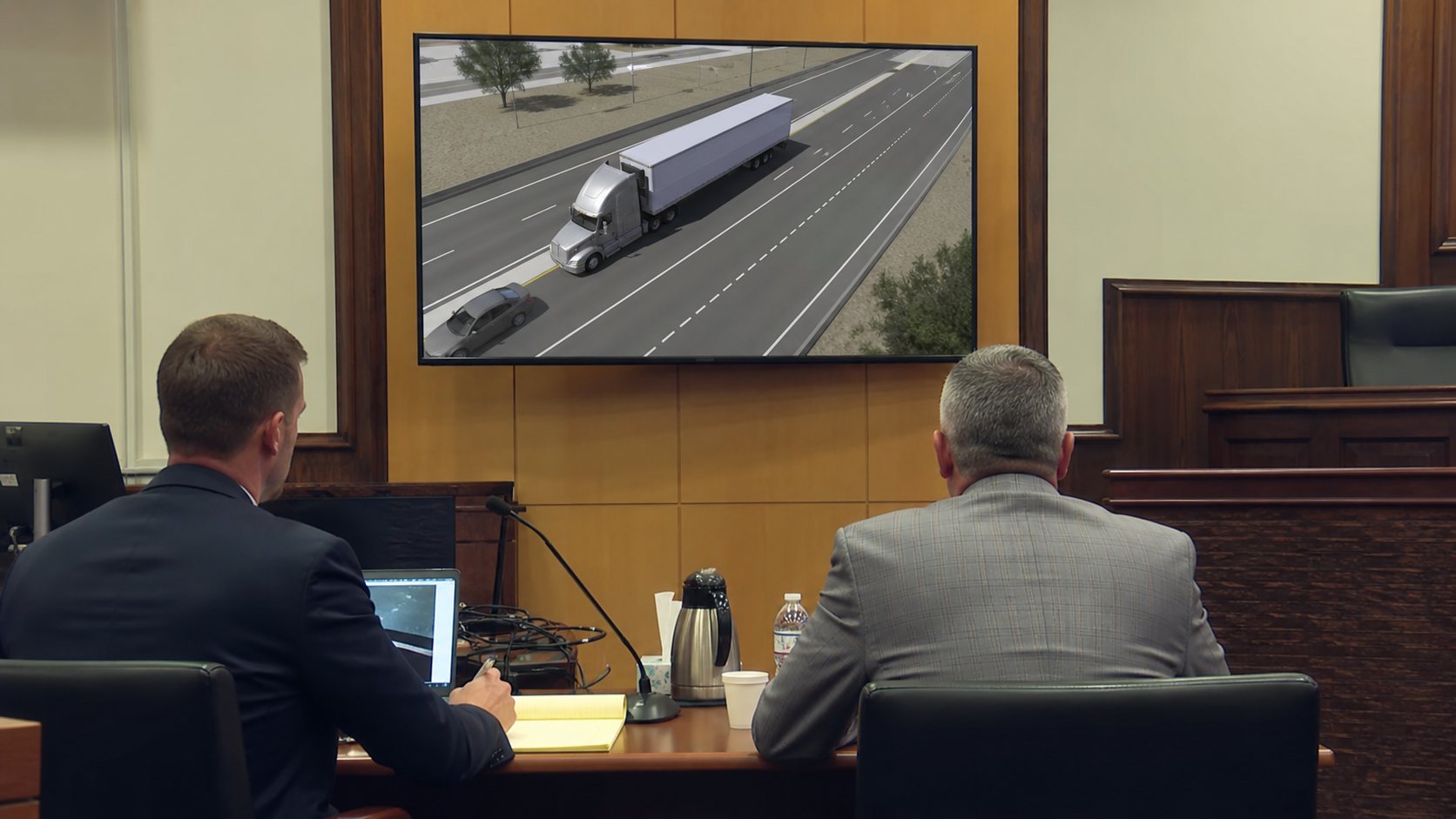
Not every truck case needs full 3D animation. A scaled plan view, timeline, synchronized video, or a set of annotated stills may communicate the point at lower cost. The right format follows the question, evidence, audience, and procedural setting.
Cost and Timeline for Truck Accident Reconstruction Animation
Cost depends on the number of vehicles, roadway size, available survey data, model accuracy, disputed scenarios, camera matching, visibility analysis, runtime, rendering quality, review rounds, expert involvement, and deadline. Austin Visuals has published general legal-animation guidance placing basic projects around $2,000 to $5,000 and detailed work around $5,000 to $20,000 or more. A multi-vehicle truck reconstruction may require a custom budget outside those ranges.
Production can take several weeks or longer. A focused mediation visual built from organized files can move faster than a trial package that requires extensive modeling, competing scenarios, expert revisions, and multiple final formats. Starting before expert and exhibit deadlines leaves room to resolve evidence conflicts without rushing the final review.
The most useful quote separates scope, assumptions, source materials, number of scenes, review stages, revisions, final formats, and optional courtroom support. For broader budgeting context, review Austin Visuals’ guide to legal animation cost.
Why Choose Austin Visuals to Work With?

Austin Visuals provides legal and litigation animation services for attorneys and experts who need complex evidence translated into understandable 2D and 3D visuals. The team can build accident scenes, commercial vehicles, roadway environments, sight-line views, timelines, technical graphics, medical visuals, and presentation-ready courtroom files within one coordinated production workflow.
For truck accident litigation, Austin Visuals works from the materials and conclusions approved by counsel and qualified experts. Staged reviews cover the evidence map, storyboard, low-resolution motion, camera views, labels, and final render. This approach keeps corrections visible before they become expensive and helps preserve consistency between the animation and the testimony it supports.
The studio can also prepare alternate views and still graphics when one long animation would be less effective. Nationwide remote collaboration allows attorneys, reconstructionists, engineers, and other reviewers to comment on the same version without needing to work in one location.
Our Clients include:

Conclusion
Forensic animation for truck accident litigation is most effective when it makes supported evidence easier to understand without adding unsupported certainty. A strong visual starts with a defined legal question, organized source data, a qualified expert’s methodology, accurate 3D geometry, and documented technical and legal review.
Truck cases benefit from this discipline because vehicle articulation, visibility, braking, timing, and multi-vehicle movement can be difficult to communicate with isolated exhibits. The goal is not to make the crash cinematic. It is to give the audience a clear, traceable view of the evidence and expert analysis.
Discuss a truck accident reconstruction project with Austin Visuals.
Send the case stage, deadline, available scene data, expert status, and the specific point the visual must explain. Call (512) 591-8024 or use the Austin Visuals contact form to request a confidential scope discussion.
Frequently Asked Questions
What is forensic animation for truck accident litigation?
Forensic animation for truck accident litigation is an evidence-based visual presentation of a commercial-vehicle collision sequence. It uses verified case materials and expert-approved analysis to explain vehicle movement, timing, visibility, impact relationships, or other disputed technical issues.
What evidence is needed for a truck accident reconstruction animation?
Useful evidence includes crash reports, scene measurements, photographs, video, vehicle inspections, damage data, EDR or ECM downloads, telematics, ELD records, roadway information, witness testimony, and expert calculations. The exact package depends on the question the animation must address.
Is a truck accident animation admissible in court?
A truck accident animation can be admitted or permitted as a demonstrative, but the result depends on the jurisdiction, foundation, relevance, reliability, disclosure history, and the judge’s ruling. Counsel should plan authentication and expert support early and evaluate the governing rules for the specific venue.
What is the difference between forensic animation and simulation?
A simulation calculates behavior from a mathematical or physics model, while an animation visually presents a sequence based on evidence and expert analysis. An animation may display simulation results, but it should not imply that artistic motion independently proves the reconstruction.
Can an animation show a truck driver’s blind spots?
Yes, an animation can visualize supported sight lines and areas obstructed by vehicle geometry, mirrors, roadway features, or other objects. It should not claim what the driver actually perceived unless a qualified expert supports that conclusion.
How much does a truck accident reconstruction animation cost?
Basic legal animations may begin in the low thousands, while detailed truck reconstructions can cost $5,000 to $20,000 or more. Vehicle count, roadway modeling, data analysis, visibility studies, runtime, expert review, revisions, and deadline determine the actual custom quote.
How long does it take to create a truck accident animation?
A focused animation may take several weeks, while a complex multi-vehicle trial package can take longer. Organized evidence, available expert opinions, fast review decisions, and a clearly defined scope have the greatest effect on schedule.