
When a case involves complex sequences of events, multiple parties, or contested physical evidence, verbal testimony and static photographs often fail to communicate the full picture to a judge or jury. Attorneys need tools that clarify rather than confuse—tools that help fact-finders understand what happened, how it happened, and why it matters. A courtroom animation exhibit serves this purpose by translating technical details, spatial relationships, and timelines into visual narratives that jurors can follow and remember.
At Austin Visuals, we’ve worked with law firms, insurance companies, and expert witnesses who use forensic animation services since 2007 to produce courtroom animation exhibits that meet the evidentiary standards required for admissibility while remaining clear and accurate. Whether your case involves a vehicle collision, workplace injury, medical procedure, or product failure, including matters that call for legal animation services, we build animations that help you present your theory of the case in a format jurors can understand. Contact us at info@austinvisuals.com or call 512-591-8024 to discuss your case requirements.
What Is a Courtroom Animation Exhibit?
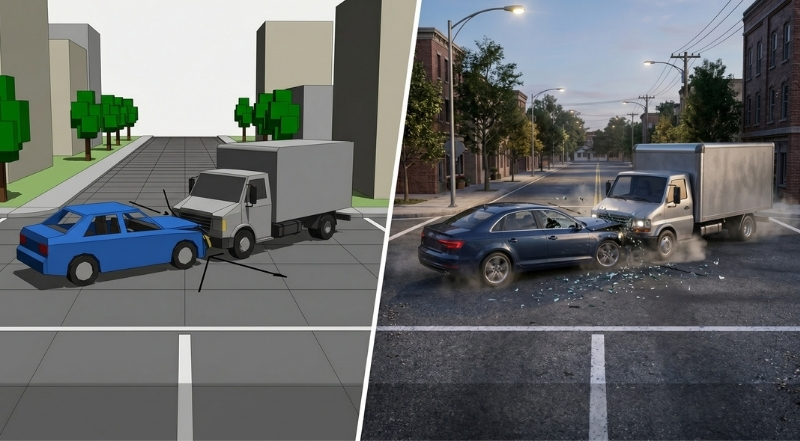
A courtroom animation exhibit is a visual reconstruction of an event, process, or condition that is relevant to litigation. These exhibits use 3D modeling, motion graphics, and animation techniques to show how an incident occurred, where parties were positioned, what forces were at play, or how a system functions under specific conditions.
Unlike demonstrative exhibits that simplify concepts for educational purposes, courtroom animations reconstruct specific events based on evidence from the case. They are built using data from police reports, depositions, medical records, engineering analyses, accident reconstruction reports, photographs, measurements, and expert testimony. The animation must reflect the facts of the case as they are understood by the party presenting it, and it must be prepared in a way that allows opposing counsel to challenge its accuracy if warranted.
These exhibits differ from video simulations or virtual reality experiences because they are designed for presentation in a courtroom environment—typically displayed on monitors or projected screens, with narration or attorney explanation guiding the jury through the sequence. The goal is not to entertain but to inform, giving jurors a coherent visual reference they can use while weighing testimony and deliberating.
Why Attorneys Use Courtroom Animation Exhibits
Jurors retain visual information more reliably than spoken or written testimony. Studies on jury decision-making indicate that people remember approximately 10% of what they hear, 20% of what they read, and 80% of what they see and do. When testimony describes a multi-step sequence—such as the movements of vehicles through an intersection or the progression of a surgical complication—jurors struggle to maintain a mental image across hours or days of trial.
A courtroom animation exhibit provides a persistent reference point. It lets jurors see the event from multiple angles, observe timing and distances, and understand spatial relationships that are difficult to convey through words alone. This is particularly valuable in cases where the disputed issues involve questions like:
- Could the defendant have seen the hazard in time to react?
- Was the plaintiff positioned where witnesses claim?
- How much force was required to cause the observed damage?
- What was the sequence of mechanical failures that led to the injury?
- Did the medical team follow or deviate from standard protocols?
When these questions depend on technical or scientific analysis, the animation translates expert opinion into a format that non-experts can follow. It does not replace expert testimony; it supports it by making the expert’s conclusions visible and testable.
Types of Cases That Benefit from Courtroom Animation Exhibits
Vehicle Accidents and Collision Reconstruction
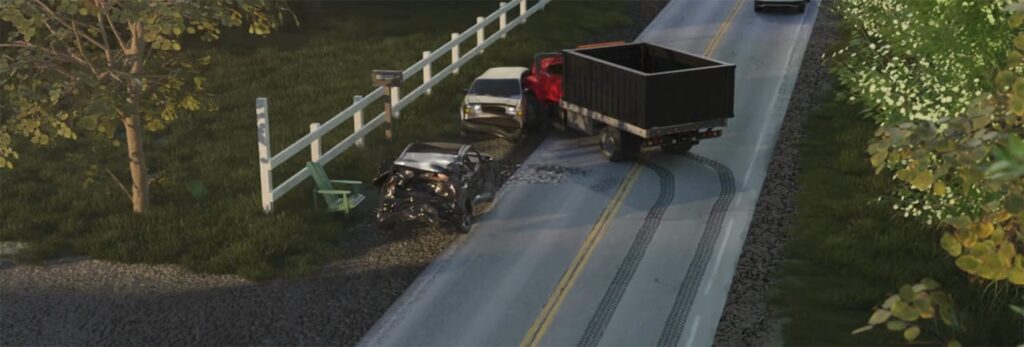
In motor vehicle cases, animations reconstruct the paths of vehicles, the timing of maneuvers, sight lines, and the points of impact. These exhibits incorporate data from accident reconstruction experts, including vehicle speeds, braking distances, road conditions, and driver positions. They help jurors understand whether a driver had time to avoid a collision, whether visibility was obstructed, or whether a vehicle’s trajectory supports a particular version of events.
Workplace Injuries and Industrial Accidents
Cases involving industrial equipment, construction site incidents, or workplace injuries often require juries to understand how machinery operates, how safety systems function, and where failures occurred. A courtroom animation exhibit can show the mechanics of equipment operation, the sequence of events leading to an injury, and the conditions present at the time of the accident. These animations clarify whether proper procedures were followed and whether design or maintenance issues contributed to the incident.
Medical Malpractice and Surgical Procedures
Medical cases often involve anatomy, physiology, and procedural details that jurors find difficult to visualize. Animations can depict the progression of a condition, the steps of a surgical procedure, the location and impact of alleged errors, and the resulting harm. These exhibits help jurors understand what should have happened versus what did happen, making it easier to follow expert testimony about standards of care and causation.
Product Liability and Mechanical Failure
Product defect cases require jurors to understand how a product is supposed to function, how it actually functioned, and what design or manufacturing issues led to failure. Animations can show internal mechanisms, stress points, failure modes, and the progression of damage. These exhibits make technical engineering testimony more accessible and help jurors evaluate competing theories about causation.
Premises Liability and Slip and Fall Incidents
In premises liability cases, jurors need to understand the layout of a property, the location and nature of hazards, lighting conditions, and the movements of the plaintiff before the incident. Animations reconstruct the scene, show the plaintiff’s path, and illustrate the conditions that contributed to the fall. These exhibits support arguments about notice, foreseeability, and comparative negligence.
Criminal Cases and Crime Scene Reconstruction
Prosecutors and defense attorneys use courtroom animation exhibits to reconstruct crime scenes, show lines of sight, illustrate trajectories of projectiles, and clarify the sequence of events. These animations help jurors understand witness positions, physical evidence locations, and timing, which can be decisive in cases involving self-defense claims, alibi defenses, or conflicting witness accounts.
Admissibility Standards for Courtroom Animation Exhibits
For a courtroom animation exhibit to be admitted into evidence, it must meet standards established by case law and rules of evidence. Courts generally require that animations be relevant, based on sufficient evidence, and more probative than prejudicial. The party offering the animation must demonstrate that it fairly and accurately represents the facts or expert opinions in the case.
The animation must be based on reliable data. This typically means it incorporates measurements, photographs, physical evidence, witness testimony, and expert analysis. If an animation depicts vehicle speeds, those speeds should come from accident reconstruction calculations. If it shows the position of a person, that position should correspond to testimony or physical evidence.
Courts distinguish between demonstrative evidence and substantive evidence. Demonstrative exhibits illustrate or explain testimony but are not themselves evidence. Substantive exhibits, by contrast, are part of the evidence the jury may consider during deliberations. Most courtroom animation exhibits are admitted as demonstrative aids, meaning they support expert testimony but do not stand alone. The expert witness must testify that the animation accurately represents their opinions or findings.
Animations must avoid speculation or assumptions not supported by the record. If a key fact is in dispute—such as whether a driver applied brakes—the animation should not depict that fact as certain unless it is based on admissible evidence or expert opinion. Some attorneys address disputed facts by creating multiple versions of an animation, each reflecting a different theory, so jurors can compare scenarios.
Judges also consider whether the animation is unduly prejudicial. Highly realistic or emotionally charged visuals can cross the line from informative to inflammatory. Courts may exclude animations that depict injuries or suffering in graphic detail when such depictions are not necessary to explain the relevant facts. The key is ensuring the animation clarifies rather than inflames.

How Austin Visuals Develops Courtroom Animation Exhibits

Our process begins with understanding the case theory and the facts that need to be communicated. We meet with attorneys and expert witnesses to review the evidence, identify the key events or conditions that must be shown, and determine the perspective and level of detail required. This phase establishes the scope of the project and ensures the animation will address the specific issues in dispute.
Next, we gather source materials. This includes police reports, deposition transcripts, expert reports, site photographs, measurements, engineering drawings, medical imaging, and any other documentation relevant to the reconstruction. The more detailed and accurate the source materials, the more defensible the final animation.
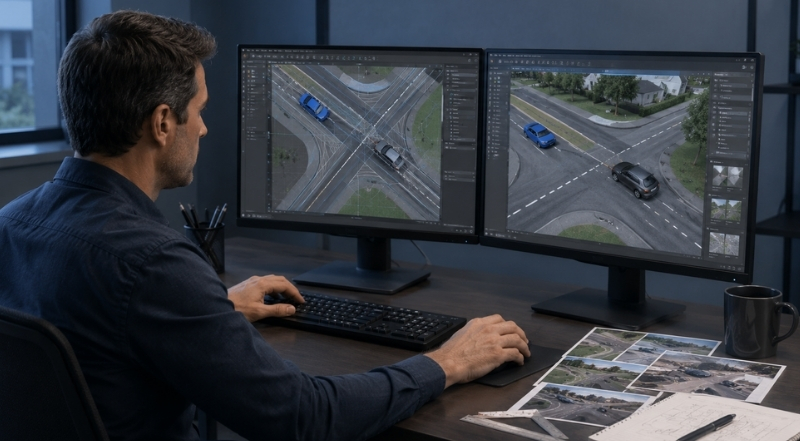
We build the environment or scene using 3D modeling software, creating accurate representations of vehicles, equipment, structures, terrain, or anatomy as needed. Dimensions and spatial relationships are based on measurements and verified data. If the case involves a vehicle accident, we model the roadway, vehicles, and surrounding environment to scale. If it involves a medical procedure, we model the relevant anatomy and instruments.
Once the environment is built, we animate the sequence of events. This involves setting the positions of objects or people at specific points in time, defining their movements, and synchronizing those movements with the timeline established by the evidence. We work closely with experts to ensure the animation reflects their analysis. For example, if an accident reconstruction expert has calculated speeds and trajectories, we program those values into the animation so the movement matches the expert’s findings.
We provide drafts for review at multiple stages, allowing attorneys and experts to verify accuracy and request revisions. This iterative process is important because courtroom animation exhibits must withstand scrutiny from opposing counsel. Any inaccuracies or unsupported assumptions can be challenged, so we document the basis for every element of the animation.
We deliver the final animation in formats suitable for courtroom presentation, typically as high-resolution video files that can be played on trial presentation systems. We also provide supporting documentation, including a written description of the methodology, source materials, and any assumptions made in the animation. This documentation helps the sponsoring expert explain the animation and respond to cross-examination.
Our Clients include:

Working with Expert Witnesses
Courtroom animation exhibits are most effective when they work in tandem with expert testimony. The expert provides the analysis and opinions; the animation provides the visual representation of those opinions. This partnership requires close collaboration throughout the development process.
We coordinate with accident reconstructionists, biomechanical engineers, medical experts, industrial safety consultants, and other specialists who will testify about the case. The expert reviews each stage of the animation to confirm it aligns with their findings. They may request adjustments to timing, positioning, or sequence to ensure the animation accurately reflects their conclusions.
During trial, the expert witness typically introduces the animation and explains what it depicts. The expert testifies that the animation is consistent with their analysis and accurately represents the conditions or events they studied. This testimony provides the foundation for admissibility and helps the jury understand what they are seeing.
The expert must also be prepared to answer questions about the animation during cross-examination. Opposing counsel may challenge the assumptions, data sources, or methodology underlying the animation. For this reason, we document every aspect of the animation’s development, so the expert can respond with specificity about how and why the animation was created as it was.
Timing and Budget Considerations
Developing a courtroom animation exhibit requires time. Simple animations involving a single vehicle or a straightforward sequence may take several weeks. Complex cases involving multiple parties, detailed environments, or intricate technical processes can take months. Attorneys should plan to engage animation services early in case preparation, ideally as soon as the need for visual exhibits becomes clear.
Early engagement allows time for thorough review, revisions based on new evidence or expert input, and preparation for potential challenges to admissibility. It also provides flexibility if trial dates change or if additional animations become necessary as the case develops.
Budget depends on the scope and complexity of the animation. Factors that influence cost include the level of detail required, the number of scenes or sequences, the amount of modeling needed, and the number of revision rounds. We provide estimates based on a clear understanding of the project requirements and work within the budget constraints of the case.
Investing in a well-prepared courtroom animation exhibit often pays off by improving settlement prospects or trial outcomes. When jurors can see and understand the key facts, they are better equipped to reach verdicts that reflect the evidence. In cases where liability or damages are contested, the clarity provided by an animation can make the difference between a favorable and unfavorable result.
Common Challenges and How We Address Them
Incomplete or Conflicting Evidence
In many cases, the available evidence is incomplete. Witness accounts may conflict, physical evidence may be limited, or key facts may be unknown. We address this by working with attorneys to identify what can be shown with confidence and what must be omitted or presented as alternative scenarios. If a fact is disputed, we can create versions of the animation that reflect different theories, allowing the jury to compare possibilities.
Technical Complexity
Some cases involve highly technical subject matter that requires specialized knowledge to model accurately. We consult with subject matter experts to ensure our representations are correct. Whether the case involves fluid dynamics, structural engineering, medical anatomy, or mechanical systems, we invest the time to understand the technical details so the animation reflects reality.
Opposing Counsel Objections
Opposing counsel may object to the admission of a courtroom animation exhibit on grounds that it is speculative, inaccurate, or prejudicial. We mitigate these risks by documenting the evidentiary basis for every element of the animation, limiting the animation to facts supported by the record, and avoiding unnecessary dramatic effects. We also provide attorneys with the documentation they need to respond to objections and support admissibility.
Conclusion
A courtroom animation exhibit translates complex events and technical information into a format jurors can understand and remember. When built on solid evidence and presented in support of expert testimony, these exhibits clarify the facts, support your case theory, and help fact-finders reach informed decisions. They are not substitutes for good lawyering or strong evidence, but they are tools that make your evidence more accessible and your arguments more persuasive.
Austin Visuals has worked with attorneys across Texas and beyond to produce courtroom animation exhibits that meet evidentiary standards and serve the needs of litigation. We understand the requirements for admissibility, the importance of accuracy, and the value of clear communication. If your case involves facts that would benefit from visual reconstruction, we can help you develop exhibits that work. Reach out to us at info@austinvisuals.com or call 512-591-8024 to discuss your case and how we can support your trial preparation.
Frequently Asked Questions About Courtroom Animation Exhibits
Can a courtroom animation exhibit be used as evidence?
Yes, if it is built on expert opinions, records, measurements, and a defensible methodology. Courts usually focus on foundation, accuracy, and whether the animation helps the jury understand the facts without misleading them.
How long does it take to produce a courtroom animation exhibit?
Production timelines vary with complexity, but many projects move through scripting, review, modeling, animation, and revision over a few weeks. Cases with extensive discovery or multiple expert inputs can take longer.
What materials should attorneys provide at the start?
It helps to start with pleadings, expert reports, deposition excerpts, diagrams, photographs, measurements, medical records, and any scene data that establishes the theory you want the exhibit to support.