

Military medical animation services can produce visual explanations for an approved education or communication program. A useful project starts with its audience, source material and review responsibilities. Animation alone does not validate a clinical method or demonstrate improved survival. Austin Visuals offers medical animation production; the responsible military or healthcare organization must approve the subject matter and intended use.
To discuss a visual communication project, contact Austin Visuals with your audience, approved source material and intended use.
Military medical animation services: start with the approved educational purpose
A military medical visual might explain anatomy, orient learners to equipment, or illustrate the sequence of an approved training scenario. Define the intended audience and the level of detail before production. A general introduction, professional lesson and device demonstration need different scripts.
The project owner should identify the applicable references and their version dates. The Joint Trauma System publishes clinical practice guidelines and education resources; the responsible clinical team should determine which documents apply to its program. This article does not provide treatment instructions. Consult the Joint Trauma System guideline library.
Updated October 14, 2026.

Build a source package before creating scenes
Provide the approved curriculum, anatomical references, terminology and equipment documentation that the animation must follow. Identify which materials may be used in a public presentation and which belong only in an authorized training environment.
For each scene, record what the viewer needs to learn and the source supporting the explanation. Indicate where the visual will simplify anatomy, omit detail or compress time. A source list tied to the script is more useful for review than a general collection of links.

Separate visual production from simulation validation
A video can show a sequence without letting the learner make decisions. An interactive environment can add choices and feedback. A simulator intended to assess clinical performance requires an assessment method appropriate to that use.
Claims about an avatar’s anatomical fidelity, a repositioning algorithm or a simulation’s clinical effectiveness need specific technical or study documentation. They should not be inferred from a realistic render, a software brand or a funding announcement. Select a technology after defining the task and the evidence it requires.
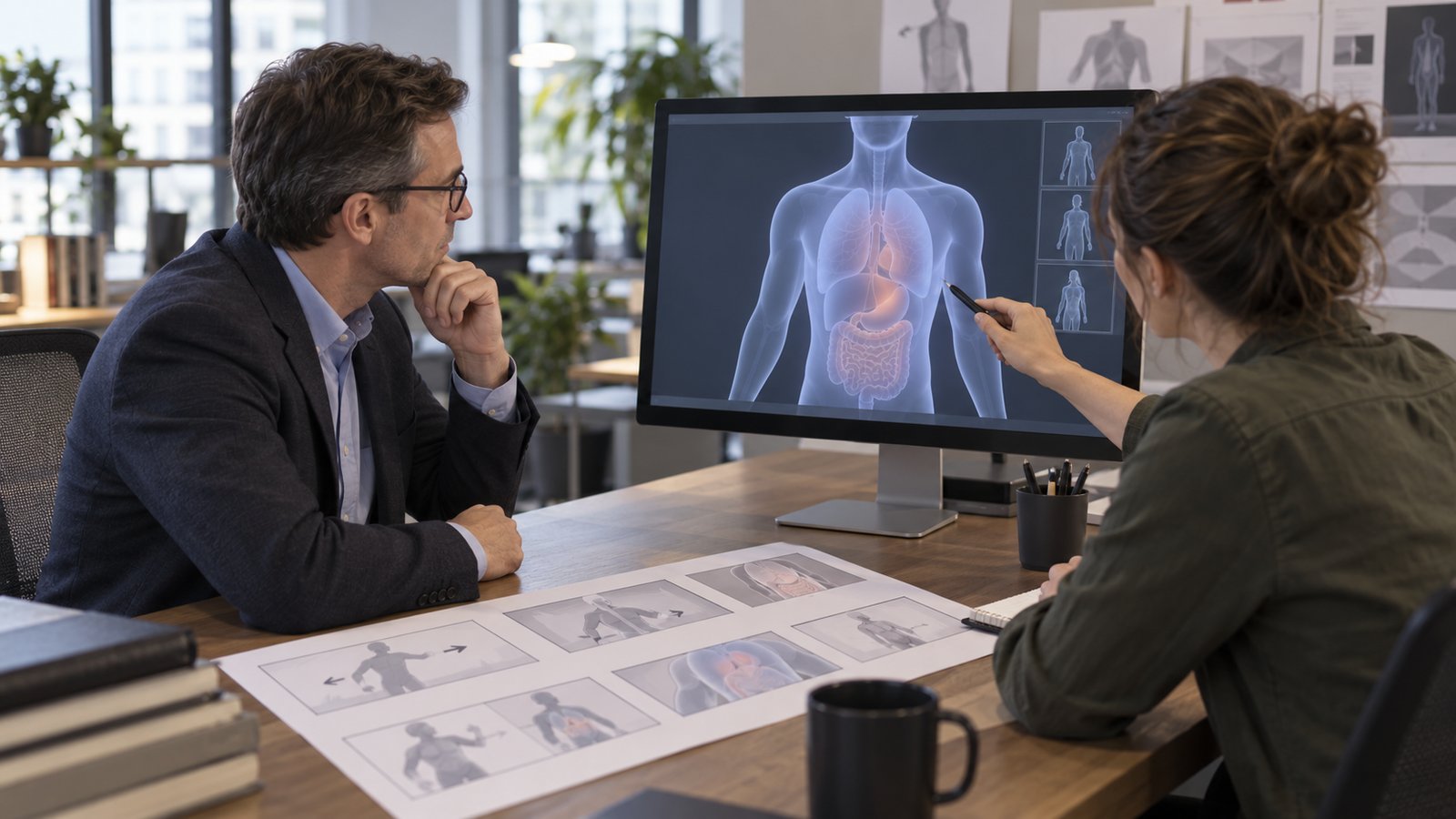
Use review checkpoints that can prevent rework
- Approve the audience, learning objective and reference versions.
- Review the script for terminology, sequence and the intended level of detail.
- Approve the storyboard, including camera angles and any simplified anatomy.
- Check a rough animation for spatial relationships, pacing and equipment behavior.
- Have the designated clinical reviewer approve the final educational content.
- Test the export in the intended classroom, learning platform or offline player.
Record approval decisions and retain the revision history. Visual polish cannot substitute for a qualified review of the clinical content.
Plan distribution and later updates
Specify captions, narration, aspect ratio and the delivery environment. A learning platform may need chapter breaks or instructor pause points; a presentation may need a shorter extract. Confirm any offline requirements before rendering the final files.
Assign responsibility for updating the visual when a reference, device or curriculum changes. Maintain source files and a list of approved versions. Evaluate the intended learning objective, and report participation or understanding separately from clinical outcomes.
Write a production brief that separates responsibilities
A brief should identify the training owner, the visual producer and the person authorized to approve clinical content. These roles may sit in different organizations. Put the review responsibilities in the project plan so the animation team knows where to send questions about anatomy or curriculum.
Describe the audience’s existing knowledge and the educational task. A general equipment orientation needs a different explanation from a lesson for experienced medical personnel. State which references apply and whether the deliverable will be a passive video, an interactive explanation or part of a larger assessed program.
Also identify the release environment and permission requirements. A public educational sample may need different content from a restricted training module. The production team should use material approved for that environment and avoid adding operational detail that was never part of the brief. These decisions help define scope without making a claim about military certification or deployment experience.
Illustrative example: an equipment-orientation visual
Consider a hypothetical education team commissioning an orientation to a medical device used in its curriculum. The learning goal is to recognize the approved components and understand the device’s stated function. The clinical team supplies the current product documents and determines which content is suitable for the intended learners.
The storyboard could show an exterior view, then an approved component view with reviewed labels. The production team would use a rough animation to confirm camera positions and the order of explanation. It would not invent clinical actions or infer a treatment result from the equipment’s appearance.
A short knowledge assessment could investigate whether learners understood the orientation. Any procedural competency would require the education team’s separate assessment and supervised practice. This is an illustrative communication brief. It is not an Austin Visuals military client case, a treatment protocol or evidence of better casualty outcomes.
Review anatomy, technology and claims separately
A medically themed avatar can be visually convincing while relying on an unverified anatomical model. Ask where the anatomy comes from, what has been simplified and who reviewed the important structures. A software demonstration should not be used as evidence of clinical accuracy.
For an interactive application, document the actions it permits and the feedback it gives. If performance is scored, identify who designed the scoring method and what it has been evaluated to measure. A score designed for user engagement is different from an assessment of a clinical skill.
Finally, review the claims made about the finished content. A funding announcement, technology brand or attractive portfolio does not establish educational or patient outcomes. A public case description should state the actual deliverable and purpose, and attach evidence only to results that were measured appropriately. This keeps visual production, technical validation and clinical evaluation from being confused.
Ask the project owner how approval will be recorded and who can authorize release. A visual file may need an educational review and a separate distribution decision. Keep both decisions with the version record. If a public extract is made from a training module, review that extract for its audience and context. The approved release should not imply certification, institutional endorsement or measured operational performance that the project record does not support. These checks concern production governance; they do not supply clinical instructions or replace the responsibilities of the authorized training organization.
Published medical animation examples from Austin Visuals
These published medical animation samples provide related visual references for a production discussion. They do not document a military training deployment.
Plastic surgery animation
The published plastic-surgery animation shows a related medical visualization format. Use the sample to discuss presentation detail and audience needs; it does not establish fewer complications or predict an individual surgical result. View the published plastic surgery animation work sample.
Angioplasty device animation
Austin Visuals publishes an angioplasty-device animation in its portfolio. It is a relevant example of presenting a medical-device topic visually. The portfolio entry does not provide a clinical outcome study or measured sales results. View the published angioplasty device animation work sample.
Briefing Austin Visuals for a medical education visual
Austin Visuals offers medical animation production for reviewed educational explanations. A military medical project inquiry should identify the authorized education purpose and the material that the organization has approved for production.
Provide the audience, curriculum references and equipment documentation, with version dates and review owners. Clarify distribution restrictions before sharing assets. The responsible clinical team should approve anatomy and subject matter, while the production team develops the agreed visual sequence. Define captions, narration, delivery formats and revision checkpoints in the brief. The linked medical portfolio samples can inform a visual discussion without implying a documented military deployment.
Conclusion
Military medical animation services require an approved education brief, reliable source material and clearly assigned review responsibilities. A production record should identify the actual visual deliverable, its sources and the reviews completed before release.
Austin Visuals can help turn your approved material into a clear visual explanation. Email info@austinvisuals.com or call (512) 591-8024 to discuss your audience and production requirements.
Frequently asked questions
Does military medical animation certify a learner?
An animation alone does not certify clinical competence. Certification and assessment belong to the relevant authorized program.
Which references should production use?
Use the documents selected by the responsible clinical and education teams, with their version dates recorded.
Can a realistic avatar prove clinical accuracy?
No. Visual realism does not establish anatomical fidelity or validate a simulation for clinical use.
Who should approve the finished content?
A designated qualified clinical reviewer should approve the subject matter, and the project owner should approve distribution.
What should a military medical animation brief include?
Include the approved educational purpose, intended audience, source documents, distribution requirements and named review owners. Identify any restrictions on the material before sharing production assets.
What should we send with a production inquiry?
Send the audience, learning objective, approved references, distribution requirements and the people responsible for review.