
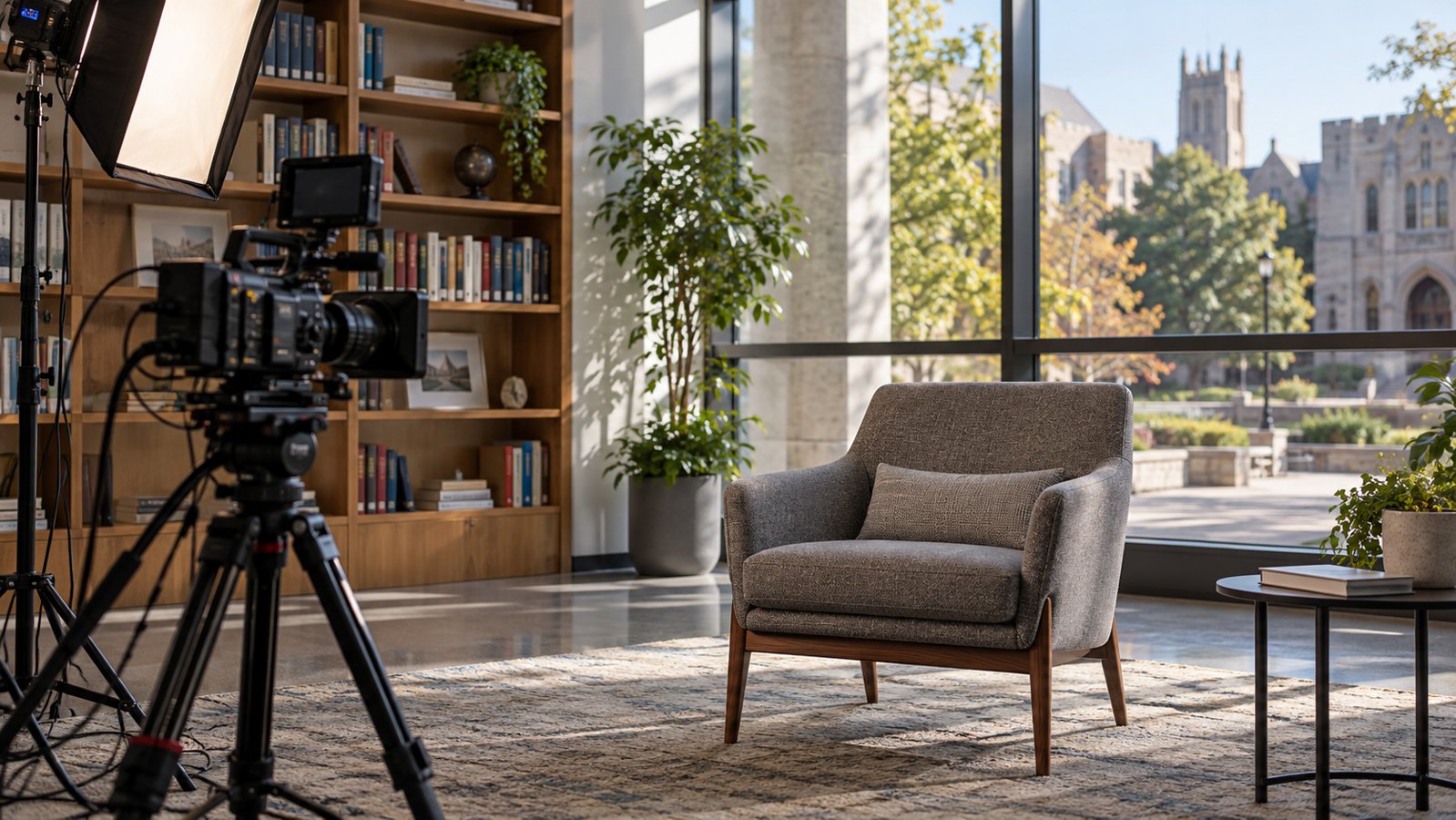
Live-action business video records people, places, and activity to explain a business subject. It is useful when a person’s experience, a physical setting, or an observable task is part of what viewers need to understand. Plan the filming around that information, then preserve its context during editing.
A recorded interview can introduce a specialist’s perspective, while supporting footage can establish where the work happens. Neither a confident speaker nor an attractive location proves a performance claim. The production needs to distinguish what was observed, what the speaker experienced, and what requires separate evidence.
Use live action when the person or place matters
Live action is a suitable choice when viewers need to see a particular person, setting, or activity. The reason for filming should be connected to the explanation rather than a general preference for faces on screen.
An employee can describe a task from direct experience. A site overview can orient viewers to an actual space. A recorded demonstration can show visible features under the conditions that were filmed. Each supports a different kind of statement.
Identify what the footage will establish before scheduling a shoot. An exterior shot may identify a location without showing its entire operation. A speaker’s account may describe one experience without representing every customer’s result. Keep those boundaries clear in the narration and surrounding text.
Access also matters. A location may be unavailable during normal activity, or some areas may contain information that should not be recorded. Resolve those conditions before promising views that the production team cannot appropriately capture.
Choose filming, animation, or a combination
Choose the format according to what the viewer needs to see and which information is available. Filming and animation can serve different parts of the same explanation.
| Information needed | Possible treatment | Important check |
|---|---|---|
| A person’s direct account | A recorded interview with an accurate role label | Experience, context, and intended use of the statement |
| The layout of a real workplace | Location footage with orientation shots | Access, current conditions, and restricted information |
| A hidden relationship or internal process | An approved diagram or animation | Sources and any visual simplifications |
| A person explaining a process | An interview combined with supporting footage or graphics | Whether each visual actually supports the statement |
A filmed explanation may still need a diagram where the relevant relationship cannot be seen. Introduce the diagram as an illustration and check its information separately. Conversely, an animated sequence does not need a presenter if the person’s identity adds no useful context.
Consider practical requirements before choosing. Filming depends on participant and location availability. Animation depends on the assets and information needed to build the scene. Neither choice has a universal cost or schedule advantage.
Plan interview questions around specific experience
An interview plan should help a contributor explain something they know or have experienced. Ask questions that allow a factual account instead of directing the person toward a preselected compliment.
Establish the speaker’s role and connection to the subject. Ask what they do, what situation they are describing, and which part they know firsthand. Follow up when a statement could refer to a personal observation, a company policy, or a general assumption.
Ask about a concrete example where appropriate. A question about how a team handled a particular handoff may produce more useful detail than asking whether the organization communicates well. Clarify unfamiliar terms before moving to another subject.
Give contributors the topic and purpose in advance without requiring them to memorize praise. If precise factual wording is needed, distinguish that approved explanation from a personal testimonial. A presenter reading supplied text should not be portrayed as independently reporting a customer experience.
Explain the planned use of the recording and the review arrangements before the session. Leave room for the person to identify topics they cannot discuss or facts that need confirmation.
Prepare the location and recording conditions
Location planning should establish whether the team can record usable speech and relevant images without disrupting the activity being shown. Check the actual setting before relying on it in the shot plan.
Listen for background sound during the proposed recording period. Nearby conversations, equipment, and room reflections can interfere with an interview. Record a short test and listen back through the setup that will be used, rather than judging audio only from the room.
Check the background for confidential screens, customer details, and distracting or inaccurate material. Confirm what can be recorded with the location owner. Plan a suitable alternative where the original setting cannot support the explanation.
Consider lighting, available space, and the contributor’s comfort. A participant needs to be able to hear the interviewer and speak at a normal pace. Build time into the schedule for setup, questions, and changes to the location.
Follow the site’s operating and access arrangements. The camera plan should adapt to the workplace rather than require people to alter an activity in a way the responsible owner has not approved.
Record supporting footage with a clear purpose
Supporting footage gives viewers visual context for the interview or narration. Each planned shot should establish a relevant detail instead of functioning as generic decoration.
Start with an orientation view where the setting matters. Then record the activity or object the speaker is discussing, with enough surrounding context to interpret it. A close-up may be attractive but difficult to understand without a wider view.
Keep a record of which shots show actual activity and which were arranged for illustration. If a scene is reconstructed, avoid presenting it as a recording of the original event. Stock or illustrative footage also needs to be distinguished from a particular customer’s workplace or experience.
Plan for the edit without manufacturing evidence. A shot of a busy office does not prove that a service is popular, and a smiling participant does not substantiate a result. Choose footage that supports the explanation the project can actually make.

Edit without changing the speaker’s meaning
Editing should make the account understandable while preserving the meaning and relevant conditions of what was said. Review the complete statement before selecting a shorter excerpt.
Removing a hesitation can be different from removing a qualification. If a speaker limits a statement to a particular team, period, or situation, an edit should not silently turn it into a broad claim. Keep the material needed for viewers to understand that boundary.
Check the relationship between interview excerpts and surrounding footage. A sentence about a planned improvement should not sit over images that imply the improvement has already been delivered. A reaction recorded during another question should not be used to suggest an endorsement that the contributor never gave.
Use captions, labels, and narration consistently with the source recording. During review, compare consequential edits with the transcript or original clip. A short version distributed separately needs enough context to preserve the account on its own.
Identify speakers and endorsements accurately
Viewers should be able to understand who is speaking and the person’s relationship to the subject. An employee, a customer, and an actor presenting a script have different roles.
The FTC’s endorsement guidance emphasizes honest, nonmisleading endorsements and the importance of relevant connections between a speaker and a marketer. Production planning should preserve accurate speaker context and send unresolved endorsement questions to the person responsible for reviewing the material.
Check names, job titles, and the description of the speaker’s experience. Do not turn an employee’s product explanation into an apparently independent customer recommendation. A recognizable face or image also does not establish that the person worked with or endorsed the organization.
Keep any customer result connected to supporting records and the approved description of the project. A contributor’s enthusiasm cannot supply missing evidence for a claim about savings, safety, or performance.
A fictional interview and shot plan
Consider a fictional customer-support team explaining how a question reaches the appropriate specialist. This is an illustrative production plan, not a client case or a report of measured results.
The contributor is the team’s coordinator. Interview topics include what information arrives with a question, how the coordinator identifies the appropriate next person, and what happens when the request lacks context. The coordinator describes the actual task rather than promising that every question is resolved immediately.
Supporting shots could show the coordinator reviewing a fictional sample request and preparing an internal handoff. Screens would use approved demonstration information instead of actual customer data. A simple graphic could identify the handoff stages if they remain difficult to follow on camera.
The shot plan would distinguish the employee interview, the arranged demonstration, and the explanatory graphic. Reviewers would check the process description and ensure that the edit does not imply a response-time guarantee. The finished video could explain the handoff without inventing a business outcome.
Check accessibility and context before release
Release review should cover the finished viewing experience, including captions, speaker identification, and the information around the video. A technically successful export can still leave viewers with an inaccurate or incomplete explanation.
W3C’s captions guidance describes captions as synchronized text representing speech and meaningful non-speech audio. Check names and specialized terms against the recording. Where a visual carries essential information, ensure the explanation also works for viewers who cannot perceive that image.
Watch the complete version at its intended display size, then review any shorter edits separately. Confirm that labels remain readable and that the destination page accurately describes the content. A short excerpt should not promise more than the full account supports.
Keep the approved version and a record of important source information. Recheck the video when the process, speaker’s role, or associated claim changes. Update connected clips and captions so an older edit does not continue to circulate without the context it needs.
Frequently asked questions
When is live action a useful choice for a business video?
Live action is useful when the identity, experience, setting, or observable activity is important to the explanation. Define what viewers need to see before deciding that a filmed interview or location shoot is required.
Should every interview follow a fixed script?
A discussion plan can organize topics without dictating every answer. Give contributors enough context to prepare and ask for specific experience. Distinguish a personal account from a presenter reading approved explanatory text.
Can live footage and animation appear together?
They can appear together when each contributes relevant information. Filming may establish the speaker and setting, while a diagram explains a relationship that cannot be seen. Check the sources and context of each part.
How much supporting footage is needed?
The amount depends on what the explanation needs to show and the edit being planned. List the essential views before filming. Extra footage is useful only when it provides relevant options without misrepresenting the situation.
Does a real customer interview prove a product claim?
A customer interview records an account that still needs accurate context and support for factual claims. Confirm the person’s experience and any result being described. Do not assume one account establishes a typical outcome.
What should be checked in a final interview edit?
Check the speaker’s meaning, qualifications, identification, and relationship to the subject. Review captions and supporting images as part of the same account. Each shorter version should preserve the context needed to interpret it accurately.