
When you’re planning a marketing campaign that includes animation, one of the first decisions you’ll face is whether to use 2D or 3D animation. Both styles have distinct characteristics, production requirements, and cost implications. The right choice depends on your brand identity, campaign goals, budget, and target audience. This comparison breaks down the practical differences between 2D and 3D animation to help you make an informed decision for your marketing needs.
At Austin Visuals, we’ve produced both 2D and 3D animation projects for clients across industries since 2007. We understand that choosing between these two styles isn’t just about aesthetics—it’s about finding the most effective way to communicate your message within your budget constraints.
If you’re unsure which approach fits your marketing strategy, contact our team at info@austinvisuals.com or call 512-591-8024 to discuss your specific requirements.
Why Animation Matters in Marketing
Animation serves a practical purpose in marketing: it simplifies complex information and holds viewer attention longer than static content. Whether you’re explaining a technical product, demonstrating a service, or building brand recognition, animation can convey concepts that would be difficult or expensive to capture with live-action video.
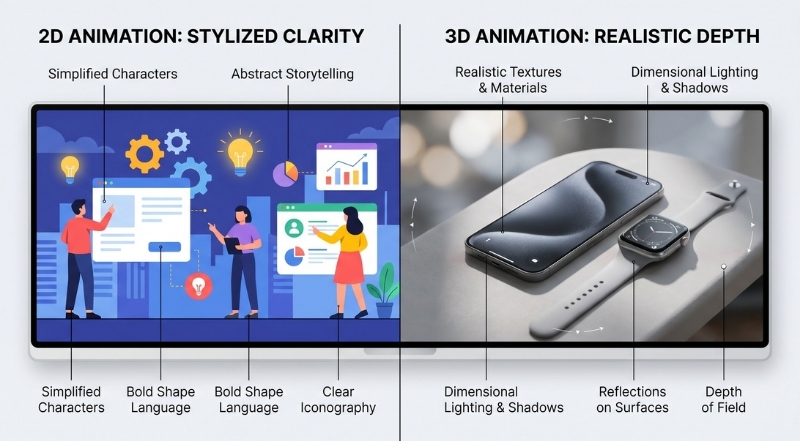
Both 2D and 3D animation accomplish these goals, but they do so in different ways. 2D animation uses flat, two-dimensional artwork and is often associated with illustrated, graphic, or stylized visuals. 3D animation creates depth and volume, allowing for realistic representations or dynamic spatial movement. The choice between them affects not only the visual style of your content but also the production timeline and budget.
Marketing campaigns use animation for explainer videos, product demonstrations, social media content, training materials, and brand storytelling. The style you choose should align with how your audience expects to receive information and how your brand presents itself in the market.
Pros and Cons of 2D vs 3D Animation
Understanding the advantages and limitations of each animation style helps you match the technique to your marketing objectives.
2D Animation: Pros
2D animation typically requires less production time than 3D, making it a practical choice when you’re working with tight deadlines. The workflow is more straightforward: artists create characters and environments in illustration software, then animate them frame by frame or using rigging techniques.
This style works well for abstract concepts, storytelling, and brand-focused content where stylization supports your message. 2D animation can be highly expressive and is particularly effective for explaining services, processes, or ideas that don’t require physical realism. It also tends to age well—a well-designed 2D animation doesn’t look outdated as quickly as 3D work that relies on rendering techniques that may become obsolete.
File sizes for 2D animation are generally smaller, which matters for web distribution and social media platforms where load times affect user experience. The style is also flexible for updates—if you need to change text, colors, or small elements, modifications are usually simpler than in 3D.
2D Animation: Cons
2D animation has limitations when you need to show physical products from multiple angles or demonstrate spatial relationships. If your marketing goal is to showcase a product’s design details, interior components, or how something moves in three-dimensional space, 2D may not provide the clarity you need.
While 2D can be highly artistic, it requires strong illustration and design skills to look professional. Poor execution is immediately noticeable and can undermine your brand credibility. Additionally, certain audiences in technical or industrial sectors may perceive 2D as less serious or less suited to their industry, though this varies by market and execution quality.
3D Animation: Pros
3D animation provides realism and spatial depth that’s difficult to achieve in 2D. When you need to show a product from every angle, demonstrate how parts fit together, or create a virtual environment that viewers can move through, 3D is the more effective tool.
Once a 3D model is built, it can be reused from different camera angles and in different scenes without rebuilding the asset from scratch. This makes 3D efficient for product visualization, architectural walkthroughs, medical illustrations, and technical demonstrations where accuracy matters.
3D animation also creates a perception of sophistication and investment, which can strengthen brand positioning in competitive markets. For industries like technology, healthcare, manufacturing, and real estate, 3D often aligns better with audience expectations and industry standards.
3D Animation: Cons
3D animation requires more specialized skills and software, which extends production timelines. Modeling, texturing, rigging, lighting, and rendering each add steps to the workflow. Changes late in production can be more complicated and time-consuming than in 2D projects.
Rendering time is a practical consideration—complex 3D scenes can take hours per frame to render, which affects turnaround time. File sizes are also larger, which can create challenges for certain distribution channels or platforms with file size restrictions.
Additionally, 3D animation can sometimes feel overused or generic if not executed with careful attention to style and design. Stock 3D assets and templates are common, which means your animation might unintentionally resemble other content in your market unless you invest in custom modeling and design.
Is 3D Cheaper than 2D?
This is one of the most common questions we hear, and the answer is: it depends on the project scope and complexity. The assumption that one style is universally cheaper than the other is misleading.
For simple projects, 2D animation is often more cost-effective because it requires fewer production steps. A straightforward explainer video with illustrated characters and minimal movement will typically cost less in 2D than creating 3D models, rigging them, and rendering scenes.
However, for projects requiring multiple angles of the same object or environment, 3D can become more economical. Once a 3D model exists, you can animate it from any perspective without creating new artwork. In 2D, showing the same object from different angles means drawing it multiple times, which increases labor costs.
Highly detailed 2D animation with complex character movement, hand-drawn frame-by-frame sequences, and intricate backgrounds can exceed the cost of mid-level 3D work. Similarly, basic 3D animation with simple models and minimal rendering requirements might cost less than elaborate 2D illustration work.
The real cost drivers are project complexity, duration, level of detail, and revisions. A 30-second 2D animation with simple shapes and motion graphics will cost less than a 30-second 3D product visualization with realistic materials and lighting. But a two-minute character-driven 2D narrative with custom illustration might cost more than a straightforward 3D logo animation.
When evaluating cost, consider the full scope: How many scenes do you need? How much detail is required? What’s the intended distribution platform? Will you need to reuse assets for future projects? These factors matter more than the general category of 2D versus 3D.

How to Choose Between 2D and 3D for Your Marketing Goals
Selecting the right animation style starts with clarifying what you’re trying to accomplish and who you’re trying to reach.
Consider Your Brand Identity
Your animation style should reflect your existing brand guidelines and market position. If your brand uses bold colors, flat design, and simplified graphics in your website and print materials, 2D animation will create visual consistency. If your brand emphasizes precision, realism, or technical sophistication, 3D may better support that perception.
Look at your competitors and industry standards, not to copy them, but to understand audience expectations. Some industries have established visual conventions—medical device marketing often uses 3D to demonstrate functionality, while consumer apps frequently use 2D for explainer content. You can choose to align with or deliberately contrast these norms, depending on your positioning strategy.
Think About Your Target Audience
Different audiences respond to different visual approaches. B2B audiences in technical fields often expect detailed, accurate representations that 3D provides. Consumer audiences may respond better to friendly, accessible 2D styles that feel approachable rather than clinical.
Consider where your audience will encounter the animation. Social media content often performs better with bright, simple 2D animation that reads clearly on small screens and captures attention quickly. Website product pages may benefit from 3D that lets viewers examine details. Trade show presentations might require 3D to demonstrate scale and spatial relationships.
Age demographics and cultural factors also play a role. Younger audiences are accustomed to diverse animation styles from social media and streaming content. Corporate decision-makers may have different expectations based on their industry experience.
Evaluate the Cost-Effectiveness
Cost-effectiveness isn’t just about the production budget—it’s about the return on investment. A more expensive animation that clearly demonstrates your product’s value and converts prospects may deliver better results than a cheaper alternative that doesn’t communicate effectively.
Think about longevity and reuse. If you’re creating a product demonstration that will be used for several years and across multiple platforms, the upfront investment in 3D modeling might be justified because you can repurpose those assets. If you’re creating time-sensitive campaign content that will be replaced in a few months, a faster 2D approach might make more sense.
Also consider production timeline as a cost factor. If you need content quickly to support a product launch or event, the style that can be delivered on time is the cost-effective choice, even if it’s not the cheapest option.
What 2D vs 3D Animation for Marketing Means for Buyers
When you’re purchasing animation services, understanding the practical implications of each style helps you communicate effectively with production teams and set realistic expectations.
Common Use Cases
2D animation is frequently used for explainer videos that simplify complex services, brand story videos, social media content, infographics, logo animations, and educational content. It works well when your message is conceptual rather than physical, and when visual style supports brand recognition.
3D animation is common for product demonstrations, architectural visualization, medical and scientific illustration, industrial equipment showcases, virtual tours, and technical training. It’s the better choice when spatial relationships, physical accuracy, or realistic representation support your marketing goals.
Some projects benefit from combining both styles. You might use 3D for product shots and 2D for supporting graphics and text. Hybrid approaches can provide the realism of 3D where it matters most while keeping costs manageable with 2D for simpler elements.
Who Typically Needs It
Companies launching new products often need animation to explain features before physical units are available for photography. Software and SaaS companies use animation to demonstrate interfaces and workflows. Manufacturing and industrial firms use it to show equipment operation or assembly processes. Healthcare organizations use it to explain procedures or medical devices. Real estate developers use it to visualize properties before construction.
Marketing teams working with limited budgets or tight timelines often choose 2D for its efficiency. Teams with complex spatial information to convey or products with important visual details typically choose 3D. Both styles serve professional marketing needs—the right choice depends on your specific situation.
Conclusion
Choosing between 2D and 3D animation for your marketing content isn’t about which style is objectively better—it’s about which one serves your specific goals, audience, and budget. 2D animation offers efficiency, stylization, and flexibility for conceptual messaging. 3D animation provides spatial depth, realism, and versatility for physical product representation. Both can deliver results when matched appropriately to your needs.
The most important factors in your decision are what you’re marketing, who you’re reaching, how the content will be used, and what resources you have available. Consider your brand identity, audience expectations, and the specific information you need to communicate. In many cases, the right answer becomes clear once you’ve defined these parameters.
Austin Visuals has produced both 2D and 3D animation projects for clients across industries since 2007. We can help you evaluate which approach fits your marketing strategy and budget, or whether a hybrid solution might serve you best.
Contact us at info@austinvisuals.com or call 512-591-8024 to discuss your project requirements and get a detailed proposal based on your specific needs.