
Mineral processing is difficult to explain well. The systems are large, the flow paths are layered, and much of the real value happens inside equipment that nobody can see during operation. Whether you are presenting a new plant design to investors, training operators on a grinding and flotation circuit, or marketing process equipment to mining clients, static diagrams usually fall short. That is where Austin Visuals can help. 3D animation for mineral processing plants gives engineering teams, sales teams, and stakeholders a clear way to see how ore moves, how equipment performs, and where the business value sits inside the process.
For mining companies, EPC firms, equipment manufacturers, and industrial technology providers, the goal is not simply to make something look impressive. The goal is to reduce confusion, speed up understanding, support better decisions, and present technical information in a format people will actually absorb. When done correctly, 3D animation becomes a practical business tool for training, safety communication, investor relations, project planning, and technical marketing.
Want help turning a complex mineral processing workflow into clear visual content?
Austin Visuals creates technical animation for mining operations, industrial systems, investor presentations, and plant training teams.
Email info@austinvisuals.com or call (512) 591-8024 to discuss your project.
What Is 3D Animation for Mineral Processing Plants?
3D animation for mineral processing plants is the use of detailed three-dimensional visuals to show how mining and beneficiation systems work. Instead of relying only on P&IDs, CAD screenshots, or still renderings, the animation shows motion, sequence, material flow, equipment interaction, and process logic in a way that is easy to follow.
That can include:
- Run-of-mine ore moving through crushers and conveyors
- Grinding circuits inside SAG and ball mills
- Classification, flotation, thickening, and filtration stages
- Chemical dosing and process reactions visualized at a simplified level
- Tailings handling, dewatering, and material recovery workflows
- Plant-wide flythroughs for layout, access, and process orientation
This type of animation can be fully photorealistic, more diagrammatic, or built as a hybrid of engineering visualization and marketing presentation. The right style depends on the audience. A board presentation, operator training module, trade show loop, and commissioning aid all need different levels of detail, pacing, and narration.
If your team already works with complex industrial visuals, you may also find value in our article on Enhancing Understanding Through Industrial Process Animation, which covers how animation improves comprehension across technical sectors.
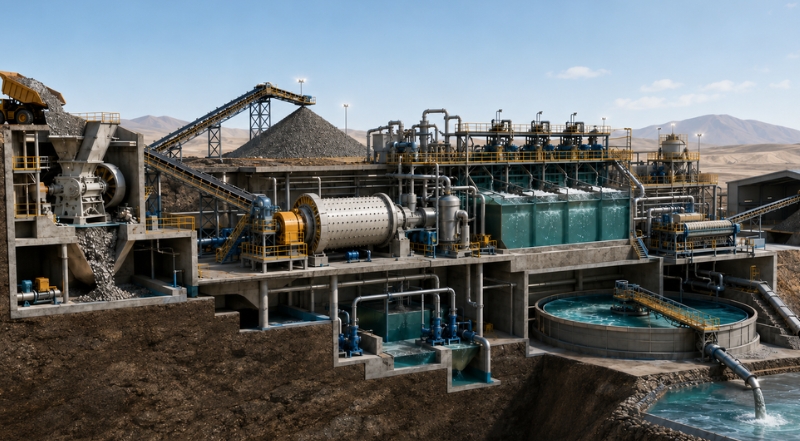
Mining Processing Plant 3D Cutaway Animation With Crushing Milling and Water treatment
Why Companies Invest in 3D Animation for Mineral Processing Plants
Most mineral processing teams do not commission animation because it looks modern. They commission it because the underlying process is hard to communicate and expensive to misunderstand.
In mining and mineral recovery, one misunderstanding can ripple across departments. Operations may train around the wrong assumption. Investors may miss the significance of the recovery method. Regulators or local stakeholders may not understand how water management or tailings systems function. Sales teams may struggle to explain why one equipment package outperforms another. A clear animation reduces those gaps.
Here are several common reasons companies invest in this kind of work:
- Faster technical understanding. Animation turns a dense explanation into a visual sequence that people can follow in minutes.
- Better stakeholder alignment. Engineering, operations, leadership, and marketing can all work from the same visual reference.
- Stronger investor presentations. Capital-intensive projects benefit when the process is presented clearly and professionally.
- Improved training retention. People remember moving visuals better than static manuals alone.
- More persuasive sales support. Equipment vendors and plant technology providers can demonstrate value instead of describing it abstractly.
This is part of a broader trend across industrial sectors. Our post on Why Technical Industries Need More 3D Animation Than Ever explains why technical companies are leaning harder into clear visual communication as systems become more specialized.
How 3D Animation Supports Training, Safety, Sales, and Investor Communication
One of the strongest arguments for 3D animation for mineral processing plants is that a single core asset can support multiple departments.
Training and onboarding
New operators and maintenance personnel often need to understand the overall process before they can perform specific tasks safely. A well-structured animation can show how crushing feeds grinding, how grinding affects flotation performance, and how downstream thickening or filtration ties into final recovery. That big-picture understanding matters. It helps teams see consequences, not just procedures.
Animation is especially useful when the process includes hazardous equipment, confined spaces, chemical handling, or costly downtime. You can show lockout points, access paths, maintenance sequences, and upset conditions without exposing trainees to live operational risk.
Safety communication
Safety teams can use animation to demonstrate material flow hazards, pinch points, dust control measures, slurry handling risks, reagent systems, and emergency response scenarios. Instead of telling workers what to expect, you can show them. That tends to make the message land harder and stay with them longer.
Sales and business development
For OEMs, EPC firms, and plant technology providers, sales conversations often break down because the client cannot easily picture the solution. A technical animation helps buyers understand what the equipment does, how it integrates into the circuit, and why the design matters. That is true whether you are selling screening systems, pumps, flotation technology, thickening systems, or digital monitoring tools.
We see a similar pattern in adjacent sectors. For example, 3D Technical Animation for Energy & Utilities Buyers shows how technical visuals help complex industrial buyers evaluate systems more confidently.
Investor and partner presentations
Mining projects compete for attention and capital. A serious animation can help management teams explain plant design, throughput logic, recovery strategy, infrastructure scope, and operational advantages in a format that feels credible and prepared. Investors do not need every engineering detail, but they do need confidence that the team understands the process and can communicate it clearly.
This is where visual storytelling and engineering accuracy need to work together. The animation should simplify the message without flattening the technical value.
Which Mineral Processing and Mining Operations Benefit Most?
Almost any operation with process complexity can benefit, but a few use cases stand out.
Crushing and conveying systems
Primary, secondary, and tertiary crushing sequences are easier to understand when viewers can see ore entering the circuit, changing size, and feeding the next stage. Animation is especially useful when the design includes multiple transfer points, dust suppression measures, surge bins, or complex conveying routes.
Grinding and classification
SAG mills, ball mills, cyclones, and circulating loads are difficult to explain with still images alone. Animation can simplify how the circuit operates while still preserving the logic of recirculation, particle size control, and throughput management.
Flotation and separation
Flotation is one of the best examples of where 3D animation for mineral processing plants adds real value. The process depends on particle behavior, chemistry, bubble attachment, froth management, and staged recovery. A strong visual can help operators, investors, and non-technical audiences understand what is happening without forcing them through textbook language.
Hydrometallurgy and chemical processing
Leaching, solvent extraction, electrowinning, and related processes often benefit from layered animation that shows tank flow, chemical movement, and staged recovery. This is particularly helpful when you need to explain a process improvement or demonstrate the difference between an existing system and a proposed one.
Tailings, water management, and environmental systems
Community stakeholders, environmental reviewers, and executive teams often need to understand how water is captured, recycled, thickened, stored, or treated. Animation can present those systems with far more clarity than technical diagrams alone, especially when the audience is mixed.
Teams focused on operational optimization may also want to review Elevating Manufacturing Process Efficiency Through 3D Animation, which explores how 3D visuals support process clarity and performance communication.
What Makes a Good Mineral Processing Animation Successful?
Good industrial animation is not just about detailed models. It is about choosing the right information, presenting it in the right order, and matching the depth of explanation to the audience.
A successful mineral processing animation usually has five traits:
- Technical accuracy. Equipment proportions, process sequences, and operational logic should reflect reality.
- Clear message hierarchy. Viewers should know what matters first, second, and third.
- Useful pacing. Too much speed creates confusion. Too much drag loses attention.
- Strong narration and labels. Voiceover, on-screen callouts, and captions help viewers retain technical information.
- Business relevance. The piece should connect the process to safety, output, reliability, cost, or market value.
It also helps to decide early whether the animation is primarily for training, marketing, internal communication, investor relations, or design review. Many projects can serve more than one function, but each version should still be edited for its main audience.
When source material begins in engineering files, the workflow matters. Our post From CAD to Cinema: Engineering 3D Animation Explained walks through how technical source assets become polished visuals that still respect the underlying design intent.
Production Steps, Timeline, and Planning Considerations
Every project is a little different, but the production pipeline for mining operations animation is usually straightforward when the inputs are organized.
1. Discovery and scope definition
First, define the audience, objective, and level of technical detail. Are you building a high-level investor piece, a plant training video, or a product marketing asset for an OEM? The answer shapes everything else.
2. Asset collection
This stage may include CAD models, plant layouts, process flow diagrams, P&IDs, equipment references, photos, brand guidelines, and subject matter expert interviews. If some assets are missing, the animation team can often reconstruct what is needed from the available documentation.
3. Script and storyboard
Before detailed animation begins, it helps to map the story. What should the viewer understand first? Where are the decision points? Which performance or safety details need emphasis? A strong script prevents expensive rework later.
4. Modeling, layout, and animation
The team builds or cleans the 3D environment, stages camera moves, animates material flow, and develops the visual treatment. Depending on the use case, this may also include section cuts, transparent equipment views, exploded assemblies, and process overlays.
5. Review and refinement
Industrial projects need real review cycles. Engineering, operations, safety, and marketing may all have input. The best projects keep those reviews structured so the content stays accurate without turning into a committee mess.
6. Final delivery and repurposing
Once approved, the animation can be delivered as a full video, short cutdowns, trade show loops, social clips, still frames, presentation inserts, or modular training chapters. That flexibility is one reason the asset tends to keep paying off after the initial project is done.
In most cases, a focused project can take six to ten weeks. A larger, highly detailed animation with multiple outputs may take longer. Cost depends on complexity, runtime, review scope, style, and how much source material already exists.

Why Work With Austin Visuals on Mineral Processing Animation?
Austin Visuals works with companies that need more than surface-level graphics. Our role is to help businesses turn technical systems into clear visual communication that supports real commercial and operational goals.
That may include:
- 3D animation for process plants and industrial systems
- 2D animation for procedural or conceptual explanations
- Engineering animation and technical visualization
- Industrial animation for training and safety communication
- Marketing videos for equipment, systems, and industrial services
- Corporate video production for presentations and stakeholder communication
- AI-enhanced video production workflows where speed and modular content matter
What matters most is that the visuals are accurate, understandable, and built with the audience in mind. Some clients need a polished investor asset. Others need a training tool that prevents confusion on the plant floor. Others need both. We build around the communication problem first, then choose the right production method.
If your team is comparing vendors, evaluating plant upgrades, or trying to present a difficult process more clearly, a custom mining operations animation can do a lot of heavy lifting.
Our clients include:

Conclusion
3D animation for mineral processing plants is not just a presentation upgrade. It is a practical way to improve understanding across training, safety, engineering, sales, and investor communication. When the process is complex, the stakes are high, and the audience is mixed, clear visuals help people move faster and make better decisions.
For mineral processing companies, equipment manufacturers, and industrial teams that need to explain how a system works and why it matters, animation creates a bridge between technical accuracy and business clarity. That is where Austin Visuals fits best: helping organizations turn difficult processes into communication tools people can actually use.
Ready to explain your mineral processing plant more clearly with 3D animation?
Austin Visuals helps mining, industrial, and engineering companies turn difficult systems, equipment, and workflows into visual content that supports training, safety, investor communication, and technical marketing. Whether you need a plant-wide overview, an equipment animation, or a more detailed operational walkthrough, we can help.
Contact us at info@austinvisuals.com or call (512) 591-8024.
FAQ
How is 3D animation used in mineral processing plants?
It is commonly used for operator training, maintenance orientation, investor presentations, plant overviews, trade show content, equipment sales support, and safety communication.
Can you build a mineral processing animation from CAD files?
Yes. CAD files are often the best starting point because they improve accuracy and reduce modeling time. If CAD is not available, an animation can still be developed from layouts, process documents, equipment references, and SME input.
Is 3D animation only useful for large mining companies?
No. Mid-sized mining firms, engineering consultancies, OEMs, and technology providers also benefit when they need to explain specialized systems clearly to buyers, partners, or internal teams.
What is the difference between a training animation and a marketing animation?
Training animation usually goes deeper into process steps, safety logic, and task flow. Marketing animation tends to focus more on value, differentiation, outcomes, and buyer understanding. Both can come from the same core 3D asset base.
How long does a mineral processing animation project take?
Many projects take six to ten weeks, depending on runtime, complexity, number of review rounds, and how complete the source materials are.
Can one animation be repurposed for multiple audiences?
Yes. A detailed master animation can often be edited into shorter versions for investors, operators, sales teams, and website visitors, which improves the return on the project.