
Oil and gas companies do not have the luxury of unclear training. When a field operator misunderstands a startup sequence, when a maintenance technician misses a lockout step, or when a contractor enters a site without fully grasping the equipment hazards, the consequences can be serious. Training has to do more than satisfy compliance. It has to build understanding that holds up under pressure.
That is where 3D animation for oil and gas equipment training stands out. Instead of relying only on manuals, toolbox talks, slide decks, or one-time demonstrations, companies can use animation to show how equipment works, where hazards exist, and what correct procedure looks like step by step. For technical teams dealing with compressors, pumps, separators, pipelines, valves, rigs, turbines, and process systems, that visual clarity matters.
Austin Visuals, based in Austin, Texas, works with industrial and technical clients to turn hard-to-explain systems into clear training and communication tools. This article breaks down why 3D animation for oil and gas equipment training has become so useful, where it creates real value, and what companies should consider when planning a project.
Why Oil and Gas Training Is Harder Than It Looks
Oil and gas environments are dense with risk, complexity, and interdependent systems. An operator is not just learning one task. They are learning how their task affects the rest of the process, how the equipment responds under normal and abnormal conditions, and where the line between routine work and a serious incident begins.
Traditional training methods still matter, but they have limits. Written SOPs are necessary, yet many procedures are easier to follow on paper than they are to visualize in real space. Live demonstrations are helpful, but they depend on timing, trainer quality, equipment availability, and site conditions. Static diagrams can clarify layout, but they rarely show sequence, internal movement, or cause and effect with enough precision for new personnel.
This is especially true in oil and gas, where teams may need to understand:
- startup and shutdown procedures for complex systems
- pressure flow through hidden piping and valve networks
- maintenance access points and service sequences
- emergency response steps under abnormal operating conditions
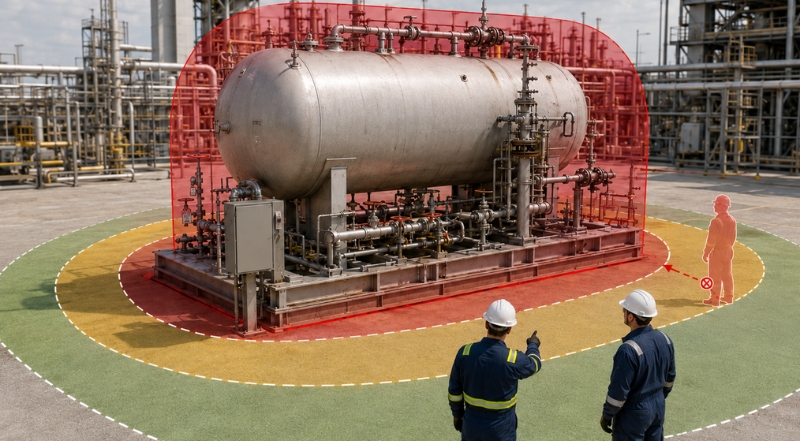
- site-specific hazard zones around rotating or pressurized equipment
In other words, the training challenge is not just information delivery. It is making invisible systems understandable before someone is expected to work around them.
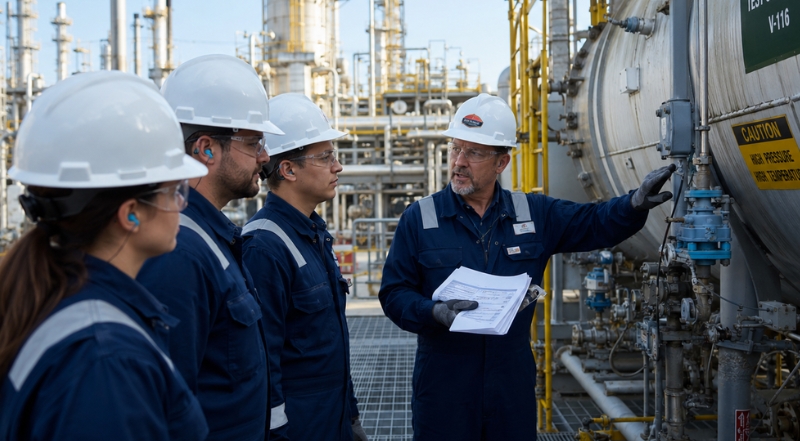
oil and gas safety training team inspecting industrial test separator equipment
How 3D Animation for Oil and Gas Equipment Training Solves the Visibility Problem
The biggest advantage of 3D animation is that it can show what real footage and printed documents usually cannot.
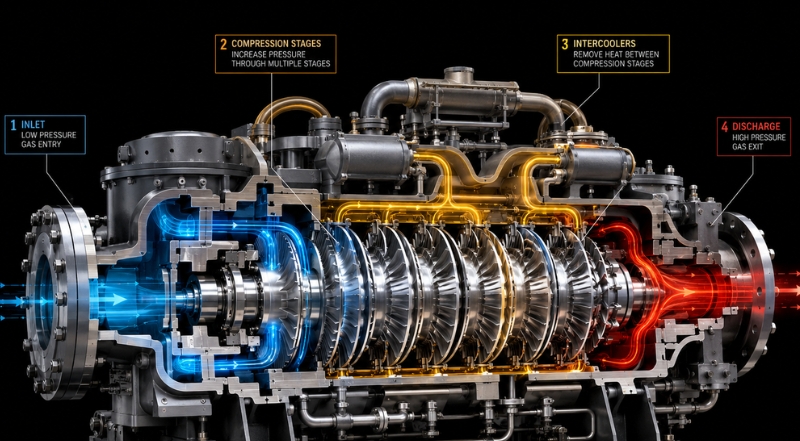
It makes hidden mechanics visible. A worker may operate a pump, inspect a valve assembly, or monitor a separator without ever seeing the internal movement that explains why the system behaves the way it does. A 3D animation can reveal those internals clearly, stripping away external housings, tracing product flow, and showing the mechanical sequence inside the equipment.
It explains process relationships. Oil and gas equipment rarely operates in isolation. A pressure change in one area affects another. A delayed step upstream may create risk downstream. Animation makes those relationships easier to understand by walking the viewer through the full process in order.
It shows procedure, not just theory. Good training requires more than describing a task. Workers need to see the exact order of actions, the location of controls, the timing of responses, and the warning signs that something is wrong. Animation can stage that clearly and consistently every time.
It improves retention. Technical training sticks better when the learner can match narration with a visual model. Instead of memorizing isolated rules, they understand the system itself. That leads to better recall when they are standing in front of the real equipment.
For a broader look at how visual communication supports technical buyers and industrial teams, Austin Visuals covers related applications in 3D technical animation for energy and utilities buyers.
Where This Helps Most: Equipment, Systems, and Field Operations
Oil and gas equipment training spans more than one environment. Upstream, midstream, downstream, and supporting energy infrastructure all involve systems that benefit from visual explanation.
Drilling and production equipment. Crews working around rigs, wellhead systems, pumps, and rotating equipment need a clear understanding of safe operating zones, inspection procedures, and failure risks. Animation helps train people before they encounter those conditions in person.
Pipeline and midstream systems. Pipeline operations often involve pump stations, valve arrays, metering systems, pigging operations, and safety procedures that are hard to explain with still diagrams alone. Animation can show product flow and valve logic in a way that helps operators understand the entire chain.
Refineries and process facilities. Refining and gas processing environments involve high temperatures, pressures, chemical exposure risks, and tightly sequenced procedures. A training animation can show system startup, shutdown, turnaround preparation, or emergency isolation steps without exposing trainees to live operational risk during the learning phase.
Maintenance and service operations. Maintenance training is often where 3D animation becomes especially practical. Instead of handing a technician a manual and expecting them to infer component relationships, animation can show disassembly order, access paths, isolation points, and reassembly logic with precision.
That same clarity also supports external-facing communication. Austin Visuals has already published related work on 3D animation for oil and gas equipment demonstrations, which overlaps naturally with training use cases.
Safety Training Is One of the Strongest Use Cases
Safety is where the value of oil and gas training animation becomes obvious. The industry deals with high-risk environments where mistakes can escalate quickly. Yet many safety lessons are still delivered in formats that are easy to skim and easy to forget.
Animation changes that because it can simulate scenarios that are too dangerous, too rare, or too impractical to recreate live. A company can train teams on what happens during a pressure release, a mis-sequenced startup, a leak response, or an equipment isolation failure without putting anyone in harm’s way.
That makes oil and gas safety animation especially effective for topics like:
- lockout and tagout on energized process equipment
- confined space entry around tanks and enclosed systems
- pipeline safety and shutdown response
- gas detection and emergency evacuation procedures
- maintenance hazards around rotating equipment
- contractor onboarding for site-specific safety expectations
What matters is not just that the topic gets covered, but that people can picture the consequence chain. When workers can actually see what a hazard looks like and how an incident develops, the lesson becomes more concrete.
Austin Visuals has explored adjacent applications in realistic 3D animation for pipeline safety presentations and workplace safety training videos.
Why Operators, HSE Teams, Engineers, and Managers All Benefit
A good training animation is not only useful for new hires. It can serve multiple audiences inside the same company.
Operators use it to understand procedures, equipment behavior, and safe responses.
HSE teams use it to reinforce site rules, hazard awareness, and incident prevention messaging in a way that is easier to absorb than text-heavy documentation.
Engineers and technical managers use it to explain system changes, new equipment rollouts, process modifications, and maintenance logic across teams that do not all share the same technical depth.
Leadership teams often use the same content to support broader operational consistency. When one training asset works across facilities or regions, it reduces the variation that comes from every site explaining the same system differently.
This multi-use value matters because many oil and gas companies are trying to reduce duplicated communication work. One well-planned animation asset can support training, internal alignment, vendor education, and in some cases even customer or investor communication. That overlap is one reason Austin Visuals has seen similar themes in how oil and gas companies will use engineering-grade animation.
What Makes Training Animation Effective in Oil and Gas
Not every animation project produces real training value. For oil and gas companies, effectiveness depends on technical discipline, not just visual polish.
Accuracy comes first. The animation needs to reflect the real system. That includes the actual equipment layout, mechanical relationships, safety zones, and procedural order. If the content looks generic or behaves unrealistically, experienced personnel will stop trusting it.
Planning has to start with the learning objective. Is the goal to reduce onboarding time for operators, improve contractor safety orientation, explain a maintenance procedure, or train teams on emergency response? The answer should shape the storyboard.
Pacing matters. Some parts of a process deserve more time than others. A good training animation slows down where errors are most likely, where risk is highest, or where comprehension normally breaks down.
Modular structure helps adoption. Oil and gas teams do not always need one long video. Short modules tied to specific equipment, procedures, or scenarios are usually easier to assign, update, and revisit later.
Voiceover and labels need to work together. Strong narration, clean onscreen callouts, and clear sequencing can make the difference between content that feels cinematic and content that is genuinely useful on the job.
Companies that already use industrial animation for marketing often discover that training requires a slightly different mindset. The visuals still need to look strong, but the real success metric is whether the viewer can perform better or safer after watching.
Cost, Timeline, and Planning Considerations
Companies evaluating 3D animation for oil and gas equipment training usually want to know what drives the budget and timeline. The answer depends on scope.
A short animation focused on one specific piece of equipment or one training procedure is much faster to produce than a multi-module training library covering a full facility workflow. The main variables are:
- how many pieces of equipment need to be modeled
- whether CAD or engineering references are available
- the level of detail needed for internals and cutaways
- how many scenarios or procedures are included
- whether voiceover, captions, and multiple language versions are needed
- whether the final deliverable is a simple video or part of a larger LMS package
In many cases, the smartest approach is to start with one high-value training asset. That lets the company test adoption, define the internal review process, and build a repeatable format for future modules. Once that structure is in place, it becomes easier to scale.
Animation can also be updated over time. If a valve arrangement changes, if a procedure is revised, or if new safety expectations need to be added, individual sections can often be refreshed without rebuilding everything from scratch. That long-term flexibility is part of what makes the investment practical.
Why Austin Visuals Is a Strong Fit for This Work

Austin Visuals is not just a creative studio making attractive visuals. The company’s value is in helping technical organizations explain systems that are difficult to communicate clearly. That includes industrial animation, engineering animation, training videos, product animation, safety videos, and AI-enhanced production support when a faster content pipeline makes sense.
For oil and gas clients in Texas and beyond, that means working from real technical references, building content around actual communication goals, and delivering assets that can serve more than one purpose. A training animation may begin as an operator education tool, then become useful for maintenance refreshers, contractor orientation, stakeholder presentations, or sales support.
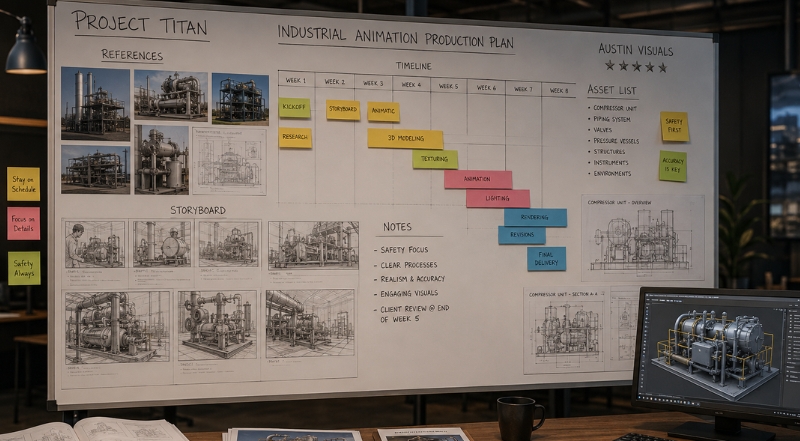
The production process usually includes discovery, scripting, storyboard planning, 3D modeling, animation, voiceover, review rounds, and final delivery in whatever format the client needs. That structure matters because industrial clients usually do not need guesswork. They need a predictable process with room for technical review.
If your team is trying to improve equipment onboarding, site safety instruction, operator readiness, or technical communication around energy systems, a well-planned training animation project can solve more than one problem at once.
Our Clients include:

Conclusion
3D animation for oil and gas equipment training works because it turns complex systems into something people can actually see, follow, and remember. It helps operators understand equipment behavior, gives HSE teams a stronger way to teach safety, supports maintenance and shutdown planning, and reduces the ambiguity that often leads to training failures.
In an industry where mistakes can be expensive or dangerous, clarity is not a luxury. It is part of the job. That is why more companies are using animation not only for marketing or investor presentations, but for internal training where comprehension matters most.
If your company needs better oil and gas equipment training, safety communication, or industrial animation support, Austin Visuals can help. Contact info@austinvisuals.com or call (512) 591-8024 to discuss your project.
Frequently Asked Questions
What is 3D animation for oil and gas equipment training used for?
It is commonly used to train operators, maintenance teams, contractors, and safety personnel on how equipment works, how procedures should be performed, and where hazards exist around industrial systems.
Why is animation better than manuals for complex equipment training?
Manuals are still useful, but animation can show sequence, internal movement, product flow, and hazard progression in a way that static pages cannot. It helps trainees build a clearer mental model of the equipment.
Can animation be used for oil and gas safety training?
Yes. Animation is especially effective for safety training because it can simulate dangerous scenarios without exposing people to real risk. It works well for lockout, emergency response, pipeline safety, and contractor orientation.
Do you need CAD files to create an oil and gas training animation?
No, although CAD files help. Austin Visuals can also work from engineering drawings, photos, videos, site references, and subject matter expert input.
How long does a training animation project usually take?
A small, focused animation may take several weeks, while a multi-module training package can take longer depending on the complexity of the equipment, review cycles, and number of deliverables.
Can one animation be reused across multiple teams or facilities?
Often yes. That is one of the major benefits. The same asset can be used for onboarding, refresher training, contractor orientation, and site-to-site standardization.
What types of oil and gas companies benefit most from this?
Upstream, midstream, downstream, energy infrastructure, and equipment manufacturers can all benefit, especially when they need to train people on systems that are difficult to explain with documents alone.
Need a clearer way to train teams on oil and gas equipment?
Austin Visuals creates industrial 3D animation, training videos, and technical visuals that help companies explain equipment, improve safety communication, and shorten the learning curve for complex operations.
Contact us at info@austinvisuals.com or call (512) 591-8024.