Training on the manufacturing floor has always carried real stakes. A worker who misunderstands a process does not just fall behind, they create bottlenecks, damage equipment, or worse, put themselves or coworkers at risk. Traditional training approaches like static manuals, 2D diagrams, classroom sessions, and verbal walkthroughs often fall short when the subject matter is a 50-ton press, a robotic assembly cell, or a multi-stage chemical process.
Austin Visuals, based in Austin, Texas, has worked with manufacturing and industrial clients for years to create animation and video content that explains exactly these kinds of complex systems. When training managers and plant directors ask how to help workers actually understand and retain what they are learning, the conversation increasingly turns to 3D animation. It is not just more visually interesting. It is more precise, more repeatable, and often far more useful than static training formats.
This article explains how 3D animation improves manufacturing training in practical business terms, including comprehension, onboarding speed, safety, consistency, and long-term training cost control.
The Real Problem With Traditional Manufacturing Training
Most manufacturing training materials were built around documentation and compliance. That usually means written SOPs, diagrams, PowerPoint sessions, and one-time demonstrations from supervisors or senior operators. Those materials may technically cover the process, but they do not always create understanding.
A new technician may be told how a machine works, but that does not mean they can visualize the internal sequence. A new operator may watch a demonstration once, but that does not mean they understand what causes a jam, what a normal cycle should look like, or how one step affects quality further down the line. On busy production floors, that gap between exposure and understanding becomes expensive.
Traditional training also depends heavily on who is delivering it. One trainer may be excellent. Another may skip steps, rush explanations, or assume too much prior knowledge. Over time, training quality can become inconsistent across plants, shifts, and teams. That inconsistency affects safety, quality control, and productivity.
Manufacturing companies do not just need documentation. They need technical training animation for manufacturing environments that turns complex physical processes into something workers can clearly see and remember.
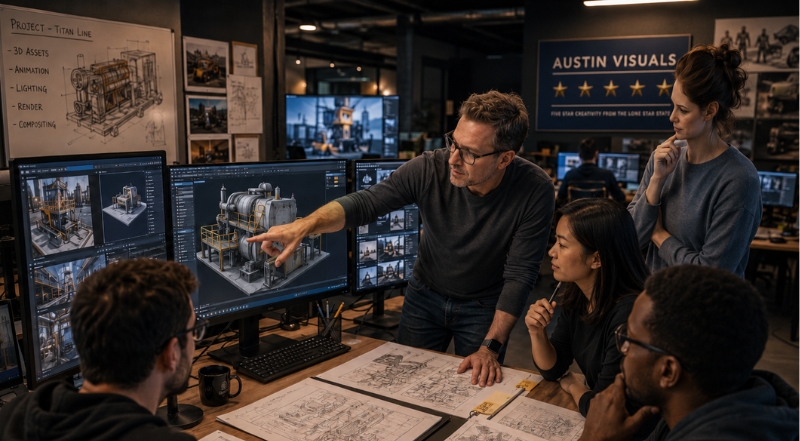
Engineering team reviewing industrial design plans manufacturing project
How 3D Animation Improves Manufacturing Training in Practice
The strength of 3D animation is simple. It shows what other training formats cannot.
It reveals internal mechanisms. Most equipment hides the very thing workers need to understand. Motors, gears, valves, fluid paths, sensors, and interlocks all operate behind covers and housings. A 3D animation can make those systems visible by stripping away surfaces and showing exactly what happens inside the machine during each stage of operation.
It makes process sequences easier to follow. Many manufacturing procedures depend on sequence. One missed step can affect quality, uptime, or safety. Animation can walk trainees through each stage in order, showing what happens first, what comes next, and what can go wrong if the sequence is broken.
It supports memory retention. Workers remember visual explanations better when they can connect narration to motion, part position, and process change. Instead of memorizing abstract instructions, they build a mental model of the process.
It creates safer exposure to dangerous scenarios. Some lessons are difficult or risky to demonstrate live. A training team cannot safely stage every possible failure mode on a real production line. Animation can simulate a jam, a pinch point, a hydraulic failure, or an improper lockout sequence without exposing anyone to real danger.
It helps multilingual teams. Many manufacturing facilities train teams with different language backgrounds. Animation communicates visually first. Voiceovers, subtitles, and translated labels can then reinforce the lesson, helping the same asset work across multiple teams and locations.
For manufacturers looking beyond training alone, Austin Visuals also covers the broader operational value of manufacturing process animation in a separate article.
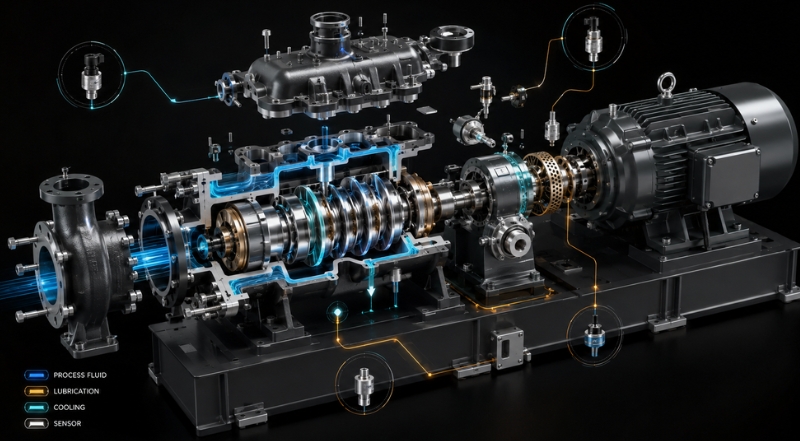
3D Industrial Pump Animation Exploded View Fluid Flow Visualization
Why 3D Animation Works So Well for Assembly Line Training
Assembly line environments are one of the clearest examples of how 3D animation improves manufacturing training. A line may look straightforward from a distance, but each station includes its own logic, timing, quality standards, tools, and handoff points. New hires often learn one task at a time without fully understanding how the entire line works.
That creates a common problem. Workers know their movement, but they do not understand the system around it. When the upstream or downstream condition changes, they struggle to adapt.
A 3D animation for assembly line optimization and training can solve that by showing the full line first, then zooming into each station. It can demonstrate:
- part orientation and correct positioning
- tool use and sequence timing
- quality checkpoints and inspection criteria
- common operator mistakes and their downstream effects
- startup, changeover, and shutdown procedures
This kind of structured view helps workers understand not just their immediate action, but the reason their action matters. That improves training quality and often reduces onboarding time. Workers arrive on the floor with visual familiarity before they touch the equipment.
If you want a side-by-side comparison of visual training and document-based training, Austin Visuals also explored that in explainer videos vs. training manuals.
Safety Training Becomes More Concrete With 3D Animation
Safety training is where 3D animation often creates the most immediate value. Many incidents happen because the correct procedure was not fully understood, or because the worker did not appreciate the seriousness of a shortcut. Written warnings are easy to skim. Static diagrams are easy to ignore. A strong animation is harder to forget.
When a training module shows the exact chain of events that follows a bypassed guard, an improper lockout, or an incorrect maintenance step, the lesson becomes specific. Workers can see where the hazard begins, how fast it escalates, and where intervention matters.
That makes 3D animation especially effective for:
- lockout/tagout procedures for real machines and real energy isolation points
- confined space entry with access paths, monitoring steps, and rescue procedures
- chemical handling and spill response with PPE, containment, and exposure scenarios
- machine guarding with motion zones, pinch points, and safe approach distances
- maintenance training where sequence errors can trigger injury or equipment damage
These are exactly the kinds of subjects that benefit from industrial process animation because the learner needs to understand movement, timing, position, and consequences in space, not just read a rule on paper.
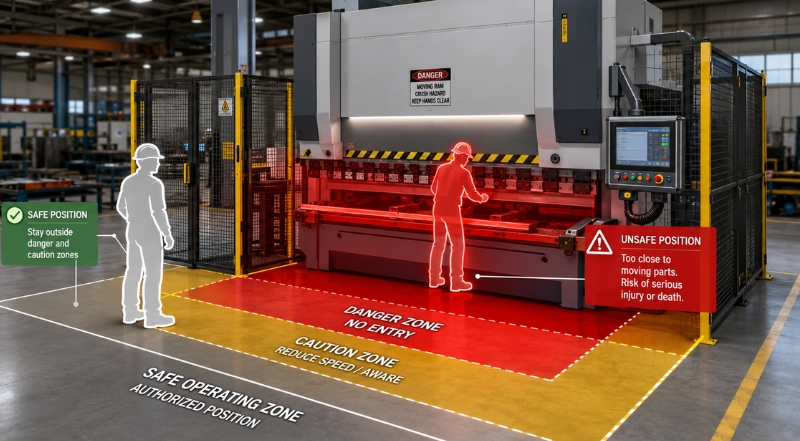
Industrial Press Brake Safety Animation Showing Safe and Unsafe Operator Zones
Reducing Onboarding Time and Training Costs
Manufacturers are under constant pressure to train faster without sacrificing quality. That is one reason how 3D animation improves manufacturing training has become a serious business question, not just a creative one.
When new hires require extended shadowing, repeated supervisor explanations, and hands-on correction for the same mistakes, training costs climb quickly. So do scrap rates, delays, and frustration on the floor. A reusable 3D training asset changes that math.
Once produced, the same animation can be used for:
- new hire onboarding
- cross-training existing staff
- refresher training after process changes
- contractor orientation
- training across multiple plants and shifts
Unlike live instructor-led sessions, the quality stays consistent every time it is viewed. Unlike manuals, the content is easier to absorb. Unlike live demonstrations, it does not depend on machine availability or trainer bandwidth.
For lean operations, this matters. A 3D animation for lean manufacturing training can support standard work by showing the ideal method clearly and repeatedly. That helps teams reduce variation, shorten ramp-up time, and maintain consistency across locations.
Austin Visuals has also written about the broader business case in how accurate 3D animation boosts ROI in technical industries.
What Makes a Manufacturing Training Animation Effective
Not every animation helps training. A polished visual still fails if it is vague, generic, or technically inaccurate. For manufacturing content, effectiveness depends on production discipline as much as visual quality.
Technical accuracy comes first. Good training animation reflects real equipment, real part geometry, and real process behavior. If CAD files are available, they help. If not, dimensional drawings, reference photos, videos, and SME interviews can still support an accurate build. The point is not to make something that merely looks industrial. The point is to show the real system clearly.
Pacing matters. Training content should slow down at the moments that matter most, especially around safety steps, decision points, and inspection criteria. If the animation moves too quickly, the learner misses the point. If it moves too slowly everywhere, it becomes tedious and ineffective.
Narration should guide, not distract. Strong voiceover explains what the viewer is seeing at the exact moment it matters. It reinforces the visual instead of competing with it.
Modular design improves usability. A single long training video is often less useful than a structured set of short modules. When workers can revisit the exact station, procedure, or hazard relevant to their role, the training asset becomes much more practical.
Planning should start from the business goal. Some projects are about faster onboarding. Others are about safety compliance, error reduction, or standardization across sites. The animation approach should match the operational goal.
Austin Visuals applies this production mindset to industrial process animation, where technical clarity matters as much as visual polish.
Which Manufacturing Sectors Benefit the Most
Almost any technical production environment can benefit from visual training, but a few categories consistently see strong returns.
Heavy equipment manufacturing. A 3D animation for heavy equipment manufacturing helps teams understand large assemblies, sequence dependencies, and inspection steps where mistakes are expensive.
Automotive and parts manufacturing. High-volume production benefits from consistent station-level training across shifts and plants.
Food and beverage processing. Changeovers, sanitation, contamination control, and line operation are all easier to standardize visually.
Chemical and pharmaceutical production. These environments rely on exact process adherence and clear hazard communication.
Aerospace manufacturing. Tight tolerances, regulated processes, and detailed inspection steps make advanced training assets especially useful. Austin Visuals has related experience in aerospace and defense animation.
Energy and process industries. Facilities with high-risk equipment and complex systems can use the same methods for operator and safety training. See Austin Visuals’ work in 3D technical animation for energy.
How Austin Visuals Approaches Manufacturing Training Projects

Austin Visuals is a professional animation and video production studio that helps companies turn complex systems into clear visual communication. For manufacturing clients, that often means building content that supports training, sales, technical explanation, and operational alignment at the same time.
A typical manufacturing training project includes:
- Discovery and planning, where the team reviews the equipment, audience, and training objective
- Script and storyboard development, where the lesson is structured before animation begins
- 3D modeling, using CAD or reference materials to create accurate digital assets
- Animation and rendering, with camera angles and motion designed for clarity
- Voiceover and sound, to reinforce the message and improve learner retention
- Delivery formatting, so the final content works in an LMS, on internal portals, or directly on the floor
The studio can also support related needs such as training videos, product animation, engineering animation, marketing videos, interactive media, and AI-enhanced production workflows. That matters because many manufacturers want one content partner who can support both internal communication and external messaging.
For companies evaluating vendors, the bigger issue is rarely whether animation looks good. It is whether the partner understands technical information well enough to turn it into useful training. That is where experience in industrial communication matters.
Our clients include:

Conclusion: How 3D Animation Improves Manufacturing Training Long Term
When manufacturers ask how 3D animation improves manufacturing training, the short answer is clarity. The longer answer is that it improves clarity in a way that affects real operations. Workers understand procedures faster. Training becomes more consistent. Hazards become easier to explain. Onboarding becomes more efficient. Standard work becomes easier to reinforce.
For complex equipment and high-stakes environments, 3D animation is not just a nicer way to present information. It is often the most practical way to build understanding before mistakes happen on the floor.
If your team needs better visual training for equipment, processes, safety procedures, or technical onboarding, Austin Visuals can help you plan and produce the right solution. Contact info@austinvisuals.com or call (512) 591-8024 to talk through your project.
Frequently Asked Questions
How does 3D animation differ from live-action video for manufacturing training?
Live-action video can show a procedure from the outside, but 3D animation can show internal mechanisms, hidden movement, unsafe scenarios, and cross-sections that are impossible or risky to film. That makes it more useful for explaining how systems really work.
How long does it take to produce a manufacturing training animation?
A focused animation for one machine or process may take around 6 to 10 weeks, while larger training programs can take longer depending on scope, approvals, and technical complexity.
Do you need CAD files to create training animation?
No. CAD files help, but they are not always required. Austin Visuals can work from drawings, photos, videos, and SME input when needed.
Can training animations be updated later?
Yes. One advantage of 3D animation is that it can often be updated by revising the affected scene or module instead of rebuilding everything from scratch.
What formats are these animations delivered in?
Most clients receive MP4 files for LMS or internal platform use, plus web-friendly deliverables when needed. Interactive formats can also be discussed for more advanced training scenarios.
Which industries use this type of animation most often?
Manufacturing, heavy equipment, aerospace, energy, food processing, chemical production, and pharmaceutical operations are common users because they rely on complex systems and repeatable training.
What is the typical budget for a manufacturing training animation?
Budgets vary based on length, modeling complexity, and how much technical detail is required. Austin Visuals usually recommends a short discovery conversation before quoting so the scope is defined correctly.
Ready to improve manufacturing training with 3D animation?
Austin Visuals helps industrial and manufacturing companies turn equipment, workflows, and safety procedures into clear visual training content that teams can actually use. Whether you need a single machine walkthrough or a larger training library, we can help.
Contact us at info@austinvisuals.com or call (512) 591-8024.