

VR-based healthcare training should start with a learning objective and an evaluation plan. Before investing, decide what learners need to do, whether a headset adds useful interaction, and who will approve the content. Austin Visuals can help develop medical animation and visual assets, while the healthcare organization defines clinical requirements and competency assessment. This checklist builds on the article’s original 2021 discussion and applies to training planning beyond COVID-19.
To discuss a visual communication project, contact Austin Visuals with your audience, approved source material and intended use.
VR-based healthcare training: 1. Why does this task need VR?
Choose VR when the proposed interaction addresses a real learning need. Spatial orientation or a rehearsable decision sequence may justify an interactive scene. A short video, instructor-led demonstration or physical model may suit other objectives.
Document the current problem before buying equipment. It might be limited access to a training site, inconsistent explanations, or a need to review a device before handling it. Define the expected improvement and compare feasible formats. Avoid treating the use of a headset as the project’s success metric.
Updated October 14, 2026.
2. What should learners be able to do?
Write an observable objective and identify the learners’ prerequisites. For example, a device orientation module might ask a learner to identify components and explain a sequence. This is an illustrative objective, not evidence that the learner can safely perform a clinical procedure.
A qualified educator should decide the assessment criteria and which tasks still require supervised practice. The 2019 review of VR education found evidence for some knowledge and skill outcomes, but limits remained. A course needs its own evaluation. Read the education review.
3. How will the program be delivered and maintained?
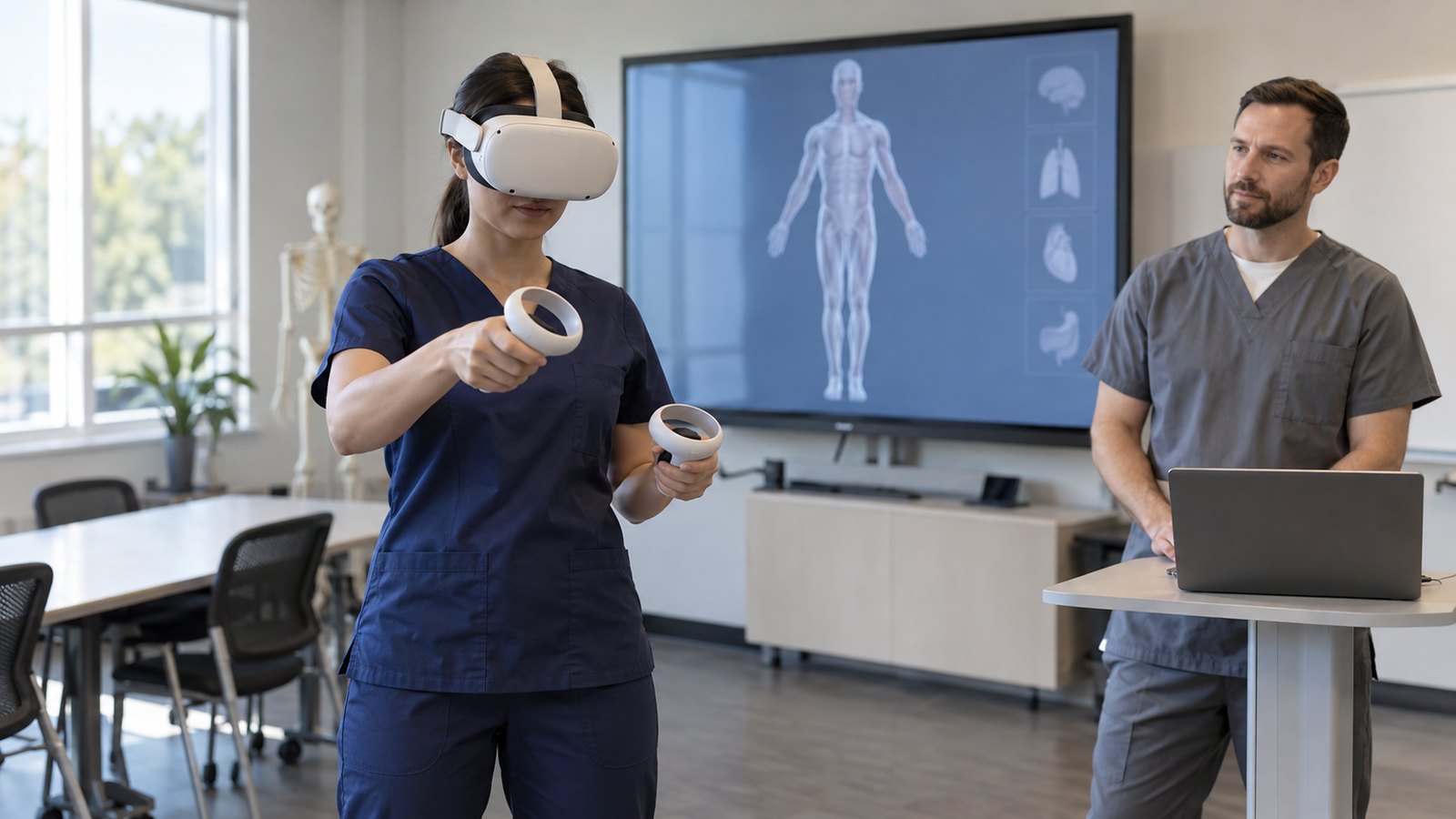
Plan hardware availability, support, account access and a usable alternative format. Decide whether learners work alone or join a facilitated session. Confirm the space and network requirements with the IT and education teams.
Assign ownership for updates when a device or procedure changes. Budget for content review, equipment maintenance and staff time. Consider comfort and accessibility during the pilot. FDA information on AR/VR devices identifies possible problems such as dizziness and fatigue. See the FDA AR/VR overview.
4. How will success be measured?
Use measures that match the stated objective. A completion rate shows participation, while a knowledge assessment or observed task score measures a different outcome. Satisfaction can help identify usability issues but does not establish competence.
| Question | Possible measure | Limit |
|---|---|---|
| Did learners attend? | Completion and access records. | Participation alone does not show learning. |
| Did learners understand? | Reviewed questions before and after the module. | Recall is different from procedural ability. |
| Did learning transfer? | Appropriate supervised assessment. | The method must fit the actual task. |
| Was delivery practical? | Support incidents, comfort and resource use. | Operational savings need a defined comparison. |
5. Who will produce and approve the content?
Assign an animation or software production lead and a qualified clinical content reviewer. Ask who approves references, anatomy, device actions and assessment logic. Keep those responsibilities visible in the project plan.
Request a testable scope: the scenes, interactions, delivery formats, source files and revision checkpoints. Discuss how changed scientific information will be handled after launch. A vendor’s portfolio can show visual capability, but it does not establish the clinical effectiveness of a new course.
Illustrative implementation scenarios
A manufacturer planning staff orientation could begin with a conventional device animation, then test whether component selection in VR adds useful learning. A medical school could use a facilitated anatomy session with a desktop alternative and reviewed questions. These are planning examples, not Austin Visuals deployment case studies.
Begin with one bounded module and a small, representative pilot group. Record the decisions needed before expansion: content corrections, learner support, assessment suitability and the continuing cost of maintenance. The COVID wording in the URL reflects the article’s history; the checklist is organized around current project decisions.
Compare the full delivery requirements
A purchase decision should include the content and the conditions needed to deliver it. List the hardware, support, facilitation, accessibility and maintenance requirements for each proposed format. A headset price alone is not the cost of a training program.
Ask whether existing equipment can support the intended audience and whether the module must work offline. Decide who helps a learner when an account or device fails. An accessible alternative should explain the same core content even if it cannot reproduce every immersive interaction.
Compare those requirements with a conventional animation, a desktop interactive model and instructor-led teaching. The purpose is to choose a practical combination for the learning objective. The comparison should not assume that the most immersive or visually elaborate option offers the best educational result.
Write a pilot decision record
Before a pilot, state what the team needs to learn from it. The decision record can identify the learning objective, representative participants, assessment method and operational problems to observe. It should also say who decides whether the program is ready to expand.
Record results against the original criteria rather than changing the goal after the session. If learners enjoy the experience but struggle with the task, that finding may call for a content or interaction revision. If they understand the material but cannot access the hardware easily, delivery needs attention.
A pilot may lead to a smaller scope, a blended format or a decision to keep a conventional video. Those are useful planning outcomes. They should be documented without turning a positive satisfaction score into proof of clinical effectiveness or an automatic financial return.
Plan updates before commissioning the module
Training content has a version life cycle. Ask what happens when device information, terminology or institutional practice changes. The project should specify access to source files, the owner of the references and the approval process for revisions.
Keep a record linking each released version to its script, source documents and review decisions. That makes it easier to identify which learners received which explanation and which scenes need updating. A revised voiceover should trigger a check of matching labels and actions.
Also decide how the program will be retired or replaced if it no longer fits the curriculum. An older module should not remain available merely because it still plays correctly. Reviewing scientific content and delivery suitability is part of maintenance, and the ongoing work belongs in the investment plan.
Give the pilot team a clear route for reporting confusing content and access problems. Someone should own the response to those reports and decide whether a revision needs another review. Closing that feedback loop is part of running a maintained program, rather than treating delivery of the initial module as the end of the investment.
Published medical animation examples from Austin Visuals
These published medical animation samples illustrate ways to explain anatomy and products visually. Their portfolio entries do not establish outcomes for a VR training program.
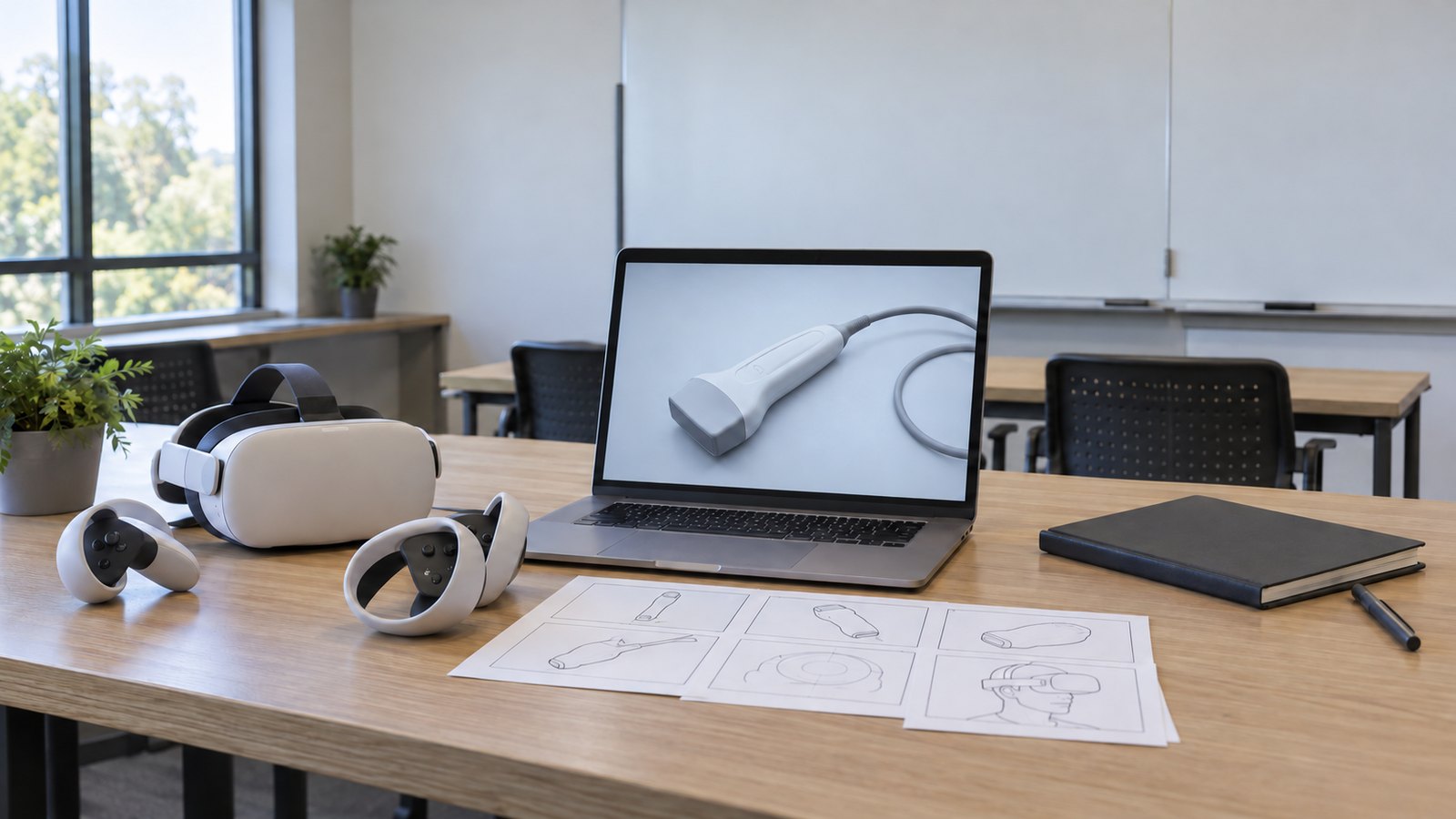
Ultrasound-device explainer animation
Austin Visuals publishes an ultrasound-device explainer in its portfolio. It provides a relevant product-communication example. The entry is not used here to claim a validated training result, device effectiveness or increased sales. View the published ultrasound-device explainer animation work sample.
Plastic surgery animation
The published plastic-surgery animation shows a related medical visualization format. Use the sample to discuss presentation detail and audience needs; it does not establish fewer complications or predict an individual surgical result. View the published plastic surgery animation work sample.
Scoping a training visualization with Austin Visuals
Austin Visuals can help scope the visual portion of a healthcare training project through medical animation production. Bring one learning objective and a clear account of the content the pilot needs to explain.
The production discussion should cover source references, learner prerequisites, the desired interaction and delivery formats. The healthcare education team should define assessment criteria and appoint the clinical reviewer. Agree on a storyboard or rough-motion checkpoint before building detailed scenes, and identify which assets can support an accessible alternative. The pilot plan should also record who will update the references and visual files after the first release.
Conclusion
VR-based healthcare training should begin with one learning objective and a manageable pilot. Test the content, delivery requirements and assessment method before expanding the program.
Austin Visuals can help turn your approved material into a clear visual explanation. Email info@austinvisuals.com or call (512) 591-8024 to discuss your audience and production requirements.
Frequently asked questions
Should every healthcare training program use VR?
No. Choose the format that fits the learning objective, learners and resources.
How should we calculate ROI?
Define costs and a relevant comparison before evaluating savings or other benefits. Course completion alone does not establish financial return.
Who should approve a clinical scenario?
A qualified clinical educator or relevant specialist should approve the clinical content and assessment criteria.
Can the program replace supervised practice?
That decision belongs to the responsible education team. A visualization alone does not establish competency.
What should a healthcare team test before expanding a VR pilot?
Test whether learners meet the stated learning objective, can use the equipment comfortably and can access the required support. Review technical problems, assessment results and maintenance requirements before expanding.
What should the first pilot include?
Include a defined objective, reviewed content, representative learners, an assessment plan and a record of usability issues.