
Heavy equipment manufacturing is difficult to communicate well. The products are large, the systems are technical, the assembly steps are layered, and the audience often includes people with very different needs. One viewer may need to understand how a machine is built. Another may care about how it operates in the field. Another may be focused on safety, maintenance access, or what makes one design different from a competitor’s.
That is where 3D animation becomes useful. It helps manufacturers explain complicated machinery and production workflows in a format that is easier to understand than static diagrams, product sheets, or verbal explanation alone. When built correctly, animation can show internal systems, assembly sequences, component interactions, safety procedures, and process improvements in a way that supports sales, training, engineering communication, and operational alignment.
Austin Visuals creates technical and industrial animation for companies that need to explain complex equipment clearly. For heavy equipment manufacturers, that can mean visual content for marketing, workforce training, investor communication, dealer enablement, or product education. Instead of expecting every audience to mentally assemble a machine from CAD screenshots and bullet points, animation gives them a way to see the system in motion.
Want a clearer way to present your heavy equipment manufacturing process? Email info@austinvisuals.com or call (512) 591-8024 to talk with Austin Visuals about a 3D animation built for manufacturing communication, training, and sales support.
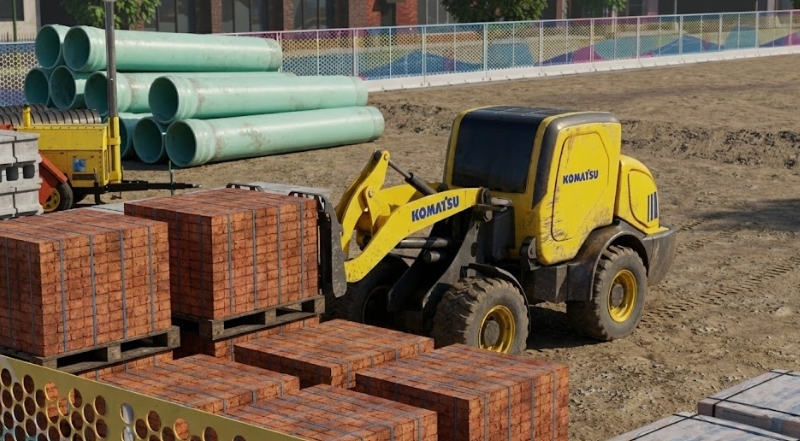
Construction wheel loader animation moving brick pallets on jobsite
What 3D Animation for Heavy Equipment Manufacturing Actually Shows
3D animation for heavy equipment manufacturing is not just a polished product demo. At its best, it is a communication tool designed to make a complicated manufacturing process easier to understand. That may include the machine itself, the way it is assembled, the way its internal systems interact, or the workflow required to produce it consistently.
Depending on the goal, an animation might show:
- Major component assembly sequences
- How hydraulic, electrical, and mechanical systems fit together
- Fabrication steps across a production line
- Operator or maintenance access points
- Safety procedures during assembly or operation
- Quality-control checkpoints
- Differences between product models or configurations
- How a machine performs in a real-world jobsite environment
This is one reason manufacturers use animation across multiple departments. Engineering wants accuracy. Sales wants clarity. Training teams want repeatability. Leadership wants a faster way to explain the value of a process or a machine. Animation can serve all of those goals when it is scoped correctly.
For companies already using industrial visual content more broadly, this overlaps naturally with industrial process animation and engineering-grade 3D visualization. The common thread is turning technical complexity into shared understanding.
Why Heavy Equipment Manufacturers Use Animation
Heavy equipment companies usually do not invest in animation because they want something flashy. They invest in it because they need people to understand something that is difficult to explain quickly.
1. Sales teams need to show more than they can carry
A sales rep can bring brochures, spec sheets, and maybe a short live demo. They usually cannot bring a disassembled earthmover, drilling rig subsystem, loader drivetrain, or large fabrication process into a meeting. Animation lets a rep show internal mechanisms, assembly quality, and key differentiators without needing the physical machine present.
2. Training teams need consistency
Manufacturing environments often depend on repeatable training. New hires, line leads, technicians, and dealers all benefit when they can see the same process explained the same way every time. Animation supports that consistency better than informal coaching alone. This is closely related to the communication advantages discussed in How 3D Animation Improves Manufacturing Training Effectiveness.
3. Engineering communication needs clarity
Sometimes the audience is internal. A plant expansion, a new assembly workflow, or a redesigned component path may need buy-in from people across operations, production, quality, and management. Animation can reduce confusion early by showing the process instead of leaving every stakeholder to interpret static drawings differently.
4. Marketing teams need better storytelling
Heavy equipment is often technically impressive but visually hard to explain in plain language. Animation helps marketers show the machine’s function, durability, efficiency, and differentiators in a format that works well online, at trade shows, in sales decks, and in launch campaigns. Austin Visuals explores this more in Industrial Advertising Animation: How Manufacturers Use 3D Video.
5. Buyers need confidence
Procurement teams, dealers, and end users want to know how a machine is built, why it performs reliably, and what operational advantage it offers. Animation can build that confidence by making the manufacturing logic and machine design easier to evaluate.
Where Animation Helps Most in the Manufacturing Process
Not every manufacturing step needs animation. The strongest opportunities are usually the places where misunderstanding slows decisions, increases training time, or weakens product communication.
Assembly and build sequence
When a machine includes multiple subsystems, animation can show the order of installation and how each part fits into the whole. This helps with onboarding, work instruction support, and executive understanding of the production process.
Safety and maintenance communication
Large equipment often includes pinch points, heavy lifts, pressurized systems, rotating assemblies, and service-access considerations. Animation helps teams explain safe procedures and maintenance logic before a person is standing next to the machine. That is especially useful when combined with broader training initiatives such as 3D Animation for Safety Training Videos.
Dealer and distributor education
Manufacturers with dealer networks need fast, repeatable ways to teach external partners what makes a product line different. Animation can shorten that ramp-up by giving dealers a visual asset they can revisit without depending only on product manuals.
Factory workflow and process improvement
Animation is also useful before a new process is implemented. If leadership is evaluating a line change, a robotics cell update, or a new plant layout, visualizing the process ahead of time can help teams spot friction before it becomes expensive.
Launches and trade shows
A new product line may need launch content that explains features and manufacturing quality in a short time. Animation is effective in trade-show booths, sales presentations, landing pages, and investor-facing materials because it compresses a large amount of technical information into a format that is easier to absorb.
How 3D Animation Supports Sales, Training, and Operations at the Same Time
One of the best reasons to invest in manufacturing animation is that the same core asset can often support more than one function.
A single animation project may begin as a sales tool, but the underlying 3D assets can also support:
- Technician training modules
- Dealer onboarding content
- Product launch reels
- Website explainer sections
- Service and maintenance overviews
- Internal engineering presentations
That does not mean one video should try to do everything. Usually the smarter approach is to build a core visual asset library and then create versions for specific audiences. A sales cut may be shorter and more benefit-focused. A training cut may include labels, callouts, and slower pacing. An executive version may focus on manufacturing capability and product differentiation.
This modular approach tends to improve ROI because the same foundation can serve multiple business needs. It is similar to how technical buyers use 3D technical animation for energy and utilities, where one accurate visual system supports both field understanding and stakeholder communication.
What Makes a Good Heavy Equipment Manufacturing Animation
The strongest industrial animations are not defined by glossy visuals alone. They work because the content is organized around the viewer’s actual questions.
Accuracy comes first
If the animation shows a manufacturing step, part relationship, or operating principle incorrectly, technical viewers will notice immediately. That weakens trust. The goal is not to include every engineering detail on screen. The goal is to simplify without becoming wrong.
Audience focus matters
A plant manager, a dealer, a prospect, and a technician all care about different things. A good animation is structured around the intended audience rather than trying to cover every possible angle at once.
Visual hierarchy improves comprehension
Good industrial animation guides attention. Camera movement, labels, cutaways, exploded views, and color coding help viewers follow the logic. Without that structure, even accurate content can feel crowded or confusing.
Strong scripting is as important as modeling
Many industrial companies have excellent CAD. That does not automatically create a good animation. The message has to be organized so the viewer understands why a sequence matters, not just what the parts look like.
Reuse should be planned early
If a manufacturer may want training edits, short social clips, trade-show loops, or dealer modules later, that should be considered during the initial production plan. It is easier and more cost-effective to build for reuse from the start.
Production Planning, Timeline, and Cost Considerations
The timeline and cost of a heavy equipment manufacturing animation depend on the scope, the source material, and the number of audiences the piece needs to serve.
Typical planning factors include:
- Whether usable CAD or engineering models already exist
- How many machines, assemblies, or process steps need to be shown
- Whether the animation is for one audience or several
- How much scripting, voiceover, and labeling is required
- How many stakeholder review cycles are involved
- Whether the output needs multiple aspect ratios or versions
If a manufacturer has clean source files and a narrowly defined scope, production moves faster. If the project requires model cleanup, custom rebuilding, or a multi-version rollout across sales and training teams, the schedule naturally expands.
The best first step is to define the communication objective clearly. Are you trying to help dealers sell the product, help operators understand the machine, help plant teams understand a workflow, or support a launch campaign? Once that is clear, the production plan becomes more realistic. Austin Visuals goes deeper into this planning logic in What an Animation Studio Needs From You Before Production Starts and How Long Does Animation Production Take for a Real B2B Project?.
Why Work with Austin Visuals

Austin Visuals helps companies explain complex products, services, and processes through clear visual storytelling. That includes 2D animation, 3D animation, industrial animation, engineering visualization, training videos, corporate video production, product animation, SaaS explainers, architectural visualization, and AI-assisted production workflows when those tools improve speed or flexibility.
For heavy equipment manufacturers, the real advantage is not just that we can animate machinery. It is that we understand why the content needs to exist in the first place. A manufacturing animation should help someone understand a process, compare a machine, learn a procedure, or gain confidence in a product. If it looks polished but fails at that job, it is not doing enough.
Clients come to Austin Visuals when they need a studio that can bridge technical accuracy and communication clarity. We work with engineering-driven businesses that need their message to hold up in front of buyers, operators, plant teams, and leadership. That combination matters in heavy equipment manufacturing because the audience is rarely just one audience.
Our Clients include:

Frequently Asked Questions
Can 3D animation help sell heavy equipment to technical buyers?
Yes. It helps technical buyers understand internal systems, manufacturing quality, and machine function in a way that is easier to absorb than brochures or still imagery alone. It is especially useful when the machine cannot be demonstrated in person.
Is animation only useful for marketing?
No. Manufacturers also use it for training, dealer education, factory workflow explanation, maintenance overviews, and stakeholder presentations.
What if our CAD files are too heavy or messy for animation?
That is common. Production teams often need to clean, simplify, or rebuild models so they work well for communication. Raw engineering files rarely go straight into a polished animation without preparation.
How long does a manufacturing animation project usually take?
A focused piece may take a few weeks, while larger projects with multiple machines, versions, and stakeholder reviews take longer. The exact timeline depends on scope, source materials, and revision cycles.
Can one animation support both training and sales?
Often yes, but usually through multiple edits based on the same core asset library. The best approach is to plan the reuse strategy up front instead of forcing one version to do every job.
What is the best way to start a project?
Start by identifying the audience, the main communication problem, and the materials you already have. That makes it easier to define scope, estimate timeline, and decide what type of animation will be most useful.
Conclusion
3D animation for heavy equipment manufacturing processes gives companies a clearer way to explain machines, workflows, and technical decisions that are hard to communicate through text and still images alone. Whether the goal is sales support, workforce training, dealer education, or internal alignment, the value comes from making complex information easier to understand and easier to act on.
For manufacturers building large, technical products, that clarity matters. It improves how teams train, how products are presented, how buyers evaluate options, and how stakeholders understand what makes a machine or process worth the investment. Austin Visuals helps companies build that kind of content with the right balance of technical accuracy, structure, and business communication.
Ready to improve heavy equipment manufacturing communication with 3D animation?Austin Visuals helps manufacturers turn machinery, assembly workflows, safety procedures, and technical product details into clear visual content that teams, buyers, and partners can actually use. Whether you need a single product overview or a broader training and sales library, we can help.
Contact us at info@austinvisuals.com or call (512) 591-8024.
Related Blog Posts
- How 3D Animation Improves Manufacturing Training Effectiveness
- Industrial Advertising Animation: How Manufacturers Use 3D Video
- 3D Technical Animation for Energy & Utilities Buyers
- The Importance of Engineering-Grade 3D Visualization in Modern Industry
- What an Animation Studio Needs From You Before Production Starts