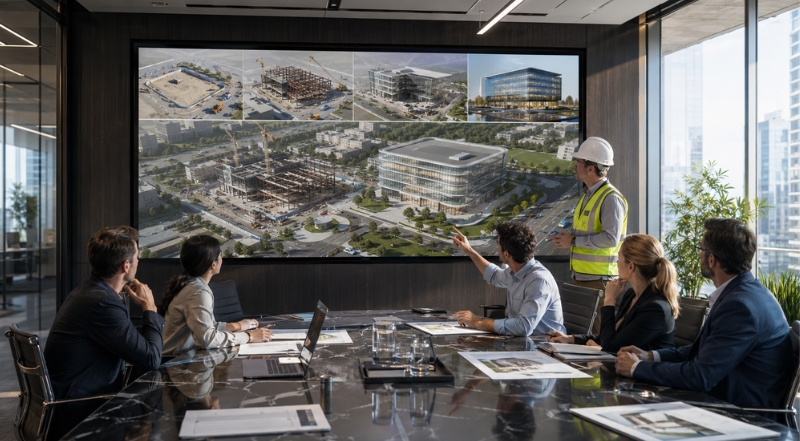
Large construction projects are hard to explain with drawings alone. Owners, developers, engineers, contractors, investors, and public stakeholders may all be looking at the same plans, yet each group is trying to answer a different question. One team wants to understand sequencing. Another wants to see how a new structure fits the site. Another is focused on access, safety, public disruption, or construction risk.
That is where engineering animation for construction projects becomes useful. Instead of asking people to mentally translate plans, schedules, and technical drawings, animation turns the project into a clear visual story. You can show how a structure will be built, how crews move through phases, how equipment will operate on site, and what the finished result will look like long before work is complete.
Austin Visuals, based in Austin, Texas, helps companies turn technical information into visuals that are easier to understand and easier to present. For construction teams, that can mean stronger approvals, better stakeholder alignment, more effective safety communication, and more persuasive project marketing.
Need a construction animation that helps your team win approval, communicate clearly, or support a bid? Email info@austinvisuals.com or call (512) 591-8024 to talk with Austin Visuals.

What Engineering Animation for Construction Projects Actually Means
Engineering animation for construction projects is a technical visualization service that uses motion, timing, and 3D space to explain how a project is designed, built, staged, or operated. It goes beyond a static rendering. Rather than showing a single finished view, it can show sequence, interaction, movement, access, and cause-and-effect.
In practical terms, this type of animation may include:
- Construction phasing and sequencing
- Structural assembly or erection steps
- Crane picks and equipment movement
- Traffic detours and public access changes
- Site logistics and laydown areas
- MEP coordination or underground utility relationships
- Safety procedures and hazard awareness
- Before-and-after views for stakeholder presentations
It often overlaps with architectural and construction animation, but the emphasis is usually more technical. The goal is not only to make the project look attractive. The goal is to make the project understandable.
For some teams, the animation is mainly a preconstruction communication tool. For others, it becomes part of a bid package, public hearing, investor presentation, leasing effort, or field orientation workflow. On especially complex builds, it can do all of those jobs with different edits made from the same source assets.
This is also why many firms pair animation with engineering-grade 3D visualization. Accuracy matters. If the purpose is to support a real construction conversation, the visuals need to reflect actual design intent, not a vague marketing approximation.
Why Companies Use Engineering Animation for Construction Projects
Large-scale construction is full of technical decisions that affect schedule, cost, risk, and confidence. The more moving parts a project has, the more valuable it becomes to show those parts visually.
Companies use engineering animation for construction projects because it helps solve communication problems that drawings and spreadsheets alone do not solve well.
1. It reduces confusion among mixed audiences
Construction teams are used to reading plans. Many clients, board members, neighborhood groups, and funding partners are not. Animation gives non-technical audiences a way to understand the same project without needing to interpret technical documents first.
2. It helps projects get internal buy-in faster
When executives or owners can see the sequence, footprint, and operational impact of a project, conversations become more productive. Instead of debating abstract assumptions, teams can react to a shared visual reference.
3. It makes phasing easier to explain
Phasing is one of the hardest parts of construction communication. A good animation can show what remains active, what gets closed off, when access routes change, and how the work progresses over time. That is especially valuable for hospitals, campuses, infrastructure upgrades, and occupied facilities.
4. It strengthens business development and proposal materials
In competitive pursuits, clarity matters. A short, well-structured animation can help a contractor or engineering team communicate approach, methodology, and risk awareness more clearly than a text-heavy deck.
5. It supports marketing after the job is won
Construction visuals are not just for preconstruction. Developers, real estate teams, and corporate communications groups also use them for public-facing storytelling, tenant attraction, investor relations, and milestone announcements. This is where animation and architectural visualization often work together.
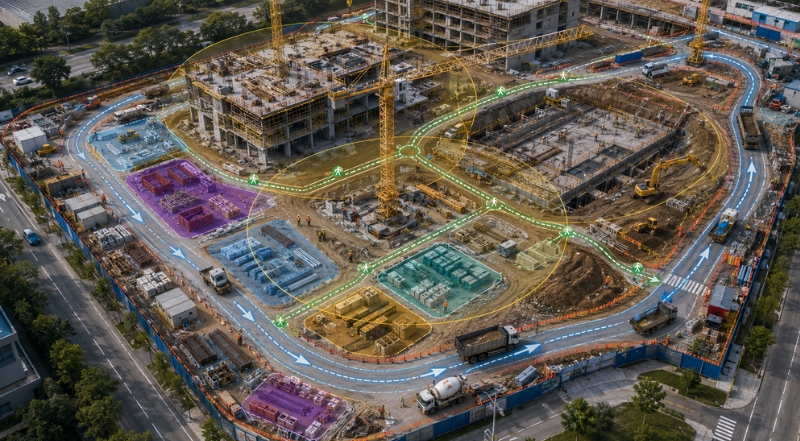
Construction Site Logistics 3D Animation Showing Pedestrian Routes and Material Zones
How Engineering Animation Supports Bids, Approvals, Safety, and Stakeholder Communication
The strongest construction animations are built around a business purpose. They are not just visual assets. They are decision-support tools.
Bids and proposal interviews
During a pursuit, animation can help show how your team plans to manage the project, protect adjacent operations, and stage work responsibly. This is especially useful when several bidders are competing on similar qualifications and price bands. The team that explains the job more clearly often appears more prepared.
Owner and board presentations
When owners need to approve budgets, design direction, or sequencing plans, animation makes the discussion easier to follow. It can show not only what is being built, but why a certain sequence or logistics plan makes sense.
Municipal and public outreach
For civil and infrastructure work, construction often affects roads, sidewalks, utilities, and neighborhoods. A visual walkthrough can help the public understand temporary impacts and the long-term value of the project. That lowers friction and improves confidence during meetings.
Safety and field training
Engineering animation can also support site orientation and safety communication. Teams can use it to explain equipment paths, exclusion zones, step-by-step procedures, and special hazards before crews enter a complex environment. That communication role has a lot in common with industrial process animation, where technical clarity directly supports safer execution.
Investor, leasing, and public marketing
Some construction projects need more than technical approval. They also need market confidence. Mixed-use developments, industrial facilities, energy upgrades, and civic projects often benefit from visuals that help outside audiences see both the plan and the value behind it.
That is why many firms create multiple versions from one core animation package. One version may be technical and sequence-driven for engineering review. Another may be shorter and more polished for investors, public websites, or leasing teams.
Which Projects Benefit Most from Engineering Animation for Construction Projects
Almost any project with complexity, phasing, public exposure, or technical risk can benefit from animation. The biggest gains usually show up where a lot of people need to understand the same project from different angles.
High-rise, mixed-use, and commercial development
Developers and project teams use animation to show site context, structural sequence, access planning, tenant appeal, and final design vision. These visuals are helpful when presenting to investors, city boards, and future occupants.
Hospitals, labs, and occupied facilities
Projects in active environments require careful sequencing. Animation helps explain what stays online, how crews move, and how disruption is minimized. This matters when the cost of confusion is high.
Industrial plants, utilities, and process facilities
Construction in industrial settings often involves shutdowns, tie-ins, heavy equipment, and multi-discipline coordination. Animation can clarify work windows, system relationships, and safety constraints. Teams that also work in utilities or process environments often benefit from the same kind of technical storytelling described in 3D technical animation for energy and utilities buyers.
Transportation and civil infrastructure
Roadway changes, bridge replacements, rail improvements, and drainage or utility work are ideal candidates for animation because the public impact is so visible. If a project changes how people move through a space, it is usually easier to explain with motion than with plan sheets.
Campus renovations and phased expansions
Schools, airports, business campuses, and healthcare systems often need to build while continuing daily operations. Animation helps show how construction phases protect access, maintain circulation, and reduce confusion over time.
What Makes a Construction Animation Successful
A successful animation is not defined by visual polish alone. It succeeds when the right audience understands the right message without extra explanation.
That usually starts with four questions:
- Who needs to watch this?
- What decision or action should it support?
- How accurate does the model need to be?
- Where will the animation be used?
From there, the production process typically includes:
Source material review
Plans, CAD files, BIM or Revit models, schedules, site photos, drone footage, and reference boards help define scope. Clean source files reduce rework and improve accuracy.
Audience-first scripting
The message should be shaped around the viewer, not just the model. An owner presentation needs different emphasis than a superintendent safety briefing or a public website video.
Storyboarding and camera planning
Good engineering animation chooses what to show and in what order. That sounds obvious, but it is the difference between an animation that informs and one that simply moves around a model.
Model prep and technical cleanup
Construction data is rarely presentation-ready on day one. Files often need optimization, relabeling, simplification, or conversion before animation starts. This is one reason the path from engineering files to polished motion content matters, and why posts like From CAD to Cinema: Engineering 3D Animation Explained resonate with technical buyers.
Animation, annotation, and versioning
Once the project is animated, labels, callouts, overlays, narration, and branded edits can turn one asset into multiple deliverables. A single core build may produce a boardroom version, a sales version, a website cutdown, and a loop for trade shows or stakeholder events.
Review with technical stakeholders
For engineering animation, review cycles are about more than aesthetics. They are where sequence logic, geometry assumptions, and messaging accuracy get confirmed before the piece is shared externally.

Commercial building construction progress animation from foundation to completion
Cost, Timeline, and Planning Considerations
The cost of engineering animation for construction projects depends on scope, source material quality, and how many communication goals the animation is expected to cover.
In general, the main pricing and schedule drivers are:
- Whether clean CAD or BIM files already exist
- How detailed the environment and equipment must be
- How much sequencing logic needs to be visualized
- Animation length and number of deliverable versions
- Need for voiceover, captions, graphics, or bilingual edits
- How many review stakeholders are involved
- Whether the project is conceptual, in design development, or nearing issue for construction
A short animation built from organized models may move quickly. A multi-minute piece with several phases, custom environments, and multiple audiences will naturally take longer. The smartest approach is usually to define the primary use case first, then decide what secondary versions can be built from the same asset package.
That approach protects budget. It also helps marketing, operations, and technical teams share the cost of a visual asset that serves more than one purpose.
At Austin Visuals, that is often where experience matters most. A team that understands both communication strategy and technical production can help clients scope the animation correctly from the beginning. Sometimes that means a full 3D construction sequence. Sometimes it means a hybrid package using 3D animation, motion graphics, labels, still frames, and AI-enhanced post workflows to deliver more value without overbuilding the asset.
Why Work with Austin Visuals

Austin Visuals helps companies turn technical information into visuals people can actually use. That matters in construction because the audience is rarely just one audience. The same project may need to make sense to engineers, ownership, public stakeholders, tenants, procurement teams, and field crews.
Our role is to translate complexity into clear communication without stripping away the technical substance that makes the project credible. Depending on the need, that may involve 3D animation, 2D animation overlays, architectural visualization, industrial animation, training videos, marketing videos, corporate video production, or interactive media support.
For construction and engineering teams, we focus on a few things that consistently matter:
- Clear storytelling built around business goals
- Visuals grounded in real project information
- Production quality that works for both technical and public-facing uses
- Flexible deliverables for proposals, meetings, websites, and presentations
- A process that respects review cycles and technical accuracy
If your team needs to explain a sequence, reduce stakeholder confusion, support a pursuit, or package a development story more effectively, engineering animation can do more than make a project look impressive. It can make the project easier to approve, easier to present, and easier to understand.
Our Clients include:
FAQ: Engineering Animation for Construction Projects
How is engineering animation different from architectural visualization?
Architectural visualization often focuses on the finished appearance of a project. Engineering animation is more likely to focus on process, sequencing, systems, logistics, and technical relationships. Many projects use both.
Can Austin Visuals work from CAD, BIM, or Revit files?
Yes. Engineering animation projects often begin with CAD drawings, BIM data, Revit models, schedules, and site references. The exact workflow depends on how clean and complete the files are.
Is engineering animation useful before the design is final?
Absolutely. Many teams use animation during concept development, preconstruction, or early stakeholder alignment. The level of detail can be adjusted to match the stage of the project.
Can one animation be used for both technical and marketing purposes?
Often, yes. A core animation can usually be repurposed into different edits for owners, public meetings, websites, leasing teams, or internal training. Planning for versioning early saves time and budget.
How long does a construction animation project usually take?
That depends on scope. A shorter piece built from organized source material may move quickly, while a large multi-phase animation with several review groups will take longer. Timeline is usually driven by model readiness, complexity, and approval cycles.
What should I send before requesting a quote?
The most helpful starting materials are plans, CAD or BIM files, project schedule, intended audience, target runtime, examples you like, and a note about where the animation will be used. Even if the package is incomplete, that information helps define the right production path.
Austin Visuals creates engineering animation, architectural visualization, industrial animation, and technical video content that helps construction teams explain complex projects clearly. Contact info@austinvisuals.com or call (512) 591-8024 to discuss your project.
Conclusion
Engineering animation for construction projects gives teams a practical way to communicate complexity before it becomes confusion. It helps explain phasing, logistics, safety, and design intent in a format that more people can understand quickly. For large-scale construction, that clarity supports better presentations, smoother approvals, stronger marketing, and more aligned project conversations from early planning through execution.
When the project carries high visibility, technical complexity, or multiple stakeholder groups, good visuals are not just a nice extra. They are part of how the work gets understood. Austin Visuals helps construction, engineering, development, and industrial teams build those visuals with the right balance of accuracy, strategy, and presentation value.
Ready to explain a construction project more clearly with engineering animation?Austin Visuals helps construction, engineering, and development teams turn schedules, site logistics, phasing plans, and technical systems into clear visual content that stakeholders can understand. Whether you need a pursuit animation, a public presentation piece, or a technical sequence for internal review, we can help.
Contact us at info@austinvisuals.com or call (512) 591-8024.
Related Blog Posts
- Architectural & Construction Animation: Visualizing Projects Before the First Brick
- The Importance of Engineering-Grade 3D Visualization in Modern Industry
- From CAD to Cinema: Engineering 3D Animation Explained
- Architectural Visualization: Bridging the Gap Between Ideas and Reality
- Enhancing Understanding Through Industrial Process Animation