
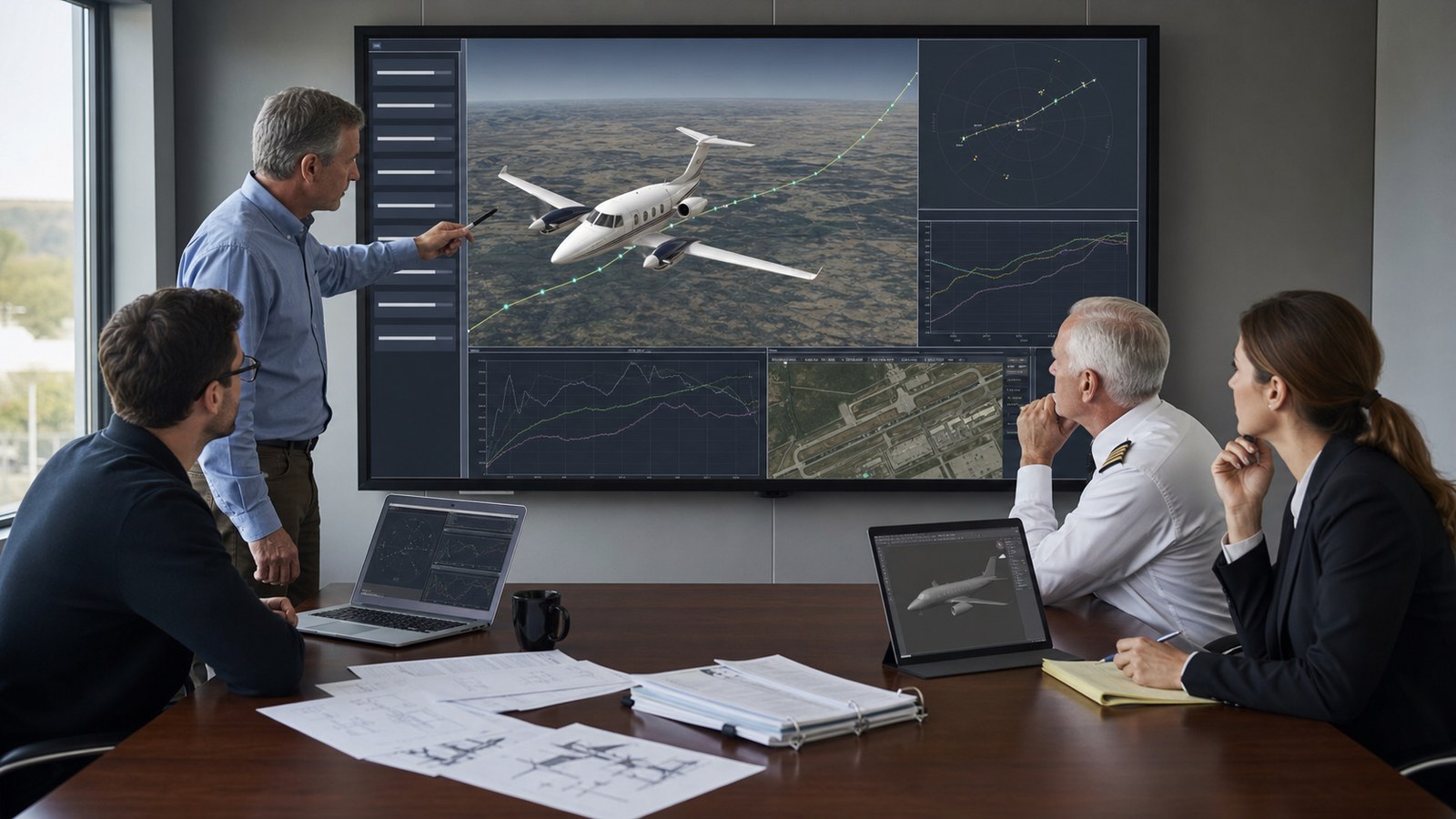
Forensic animation for aviation accident cases organizes flight data, radar, air traffic communications, weather, aircraft geometry, wreckage evidence, and expert analysis into a visual sequence that helps viewers understand how a flight developed. It can show attitude, altitude, speed, configuration, flight path, cockpit indications, airport geometry, visibility, or impact relationships without asking a judge, mediator, or jury to assemble the entire event from disconnected technical exhibits.
The animation is not a recovered recording of the accident. A defensible production identifies which elements are measured, which are calculated, which are representative, and which express a qualified expert’s opinion. Counsel and the responsible experts determine the theory, legal purpose, and evidentiary foundation; the animation team translates approved information into a controlled visual explanation.
Need to explain a complex aviation sequence clearly?Austin Visuals can help legal teams and designated aviation experts scope, storyboard, model, review, and deliver an evidence-linked 2D or 3D demonstrative for mediation, deposition, arbitration, or trial.
Contact us at info@austinvisuals.com or call (512) 591-8024.
What Is Forensic Animation for Aviation Accident Cases?
Forensic aviation animation is a litigation-support visual built from records and analysis relevant to an aircraft accident or incident. It may depict a complete flight segment, one disputed maneuver, an approach and runway environment, aircraft-system operation, component failure, occupant movement, or the spatial relationship between wreckage and terrain.
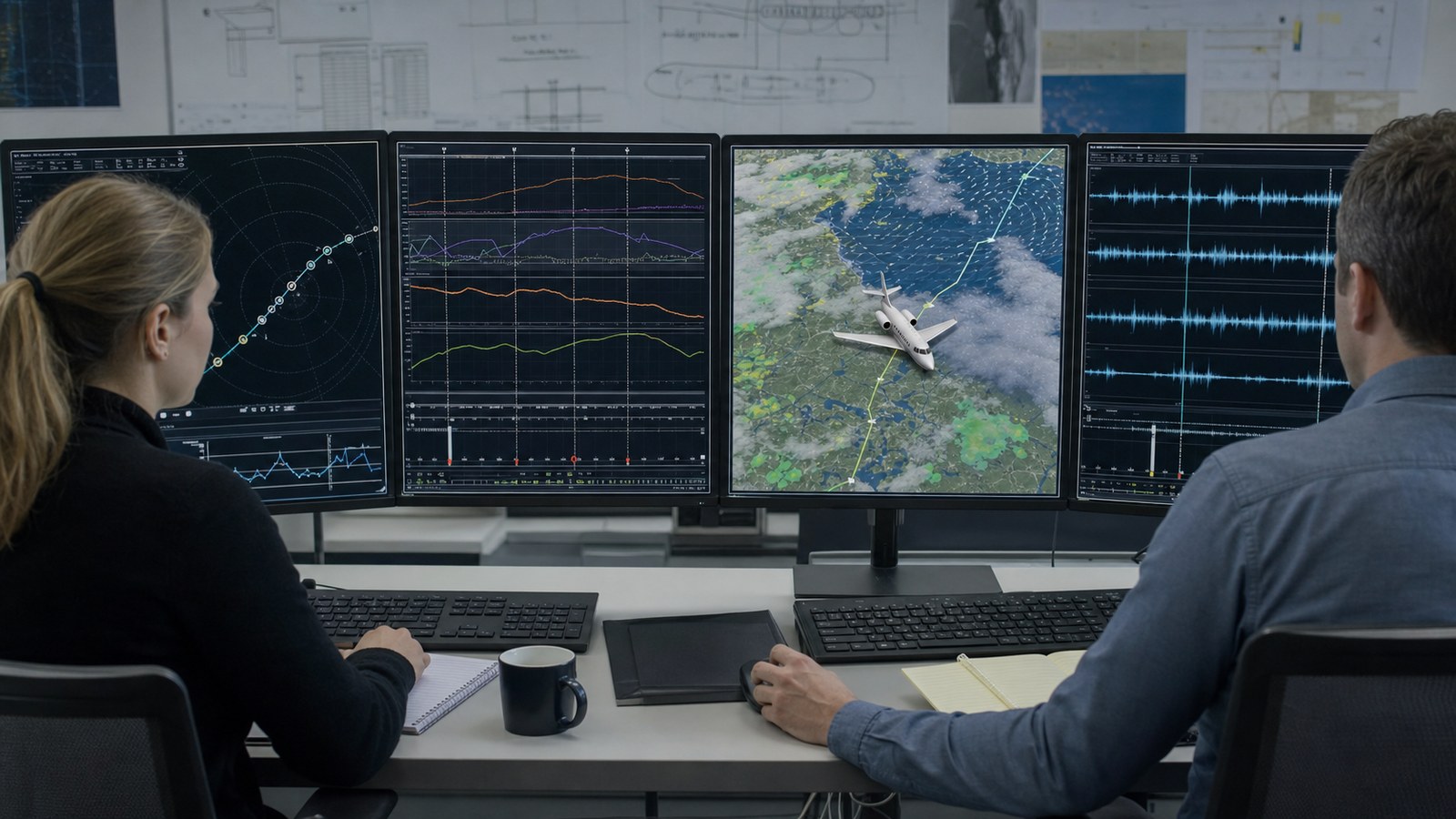
An aviation accident reconstruction animation may combine several synchronized sources. Flight data recorder parameters can describe altitude, airspeed, heading, attitude, control inputs, system states, and other recorded conditions. Radar or ADS-B can establish positions over time. Air traffic control communications and cockpit voice recorder transcripts can anchor events to a shared clock. Airport surveys, photographs, laser scans, maps, weather records, and maintenance materials add different layers of context.
The useful question is not how realistic the finished video can look. It is whether every important visual statement has an appropriate source, a defined degree of certainty, and a qualified reviewer who can explain it.
Which Aviation Disputes Benefit From Animation?
Flight Path, Approach, and Runway Events
Approach and runway cases often involve altitude, descent rate, groundspeed, heading, glide path, localizer alignment, runway geometry, lighting, weather, braking, and crew or controller communications. A synchronized visual can move between a plan view, profile view, cockpit perspective, and instrument display while preserving one event clock.
An aircraft crash animation should avoid smoothing away the gaps in the record. Radar intervals, sensor tolerances, estimated positions, and disputed sight lines can be shown as ranges or separate scenarios. Camera views should be selected to answer a technical question, not to create drama.
Aircraft Performance and Loss of Control
Performance issues may concern attitude, energy state, stall development, control inputs, engine response, configuration changes, loading, center of gravity, or aerodynamic effects. The visual can coordinate aircraft motion with plots or instrument indications so viewers see how the values relate without confusing a calculated model with a directly recorded parameter.
The retained aeronautical or performance expert should define the equations, inputs, assumptions, and limits. The animator should not infer a control movement, pilot perception, or aerodynamic state merely because it makes the sequence appear complete.
Mechanical, Structural, and Maintenance Claims
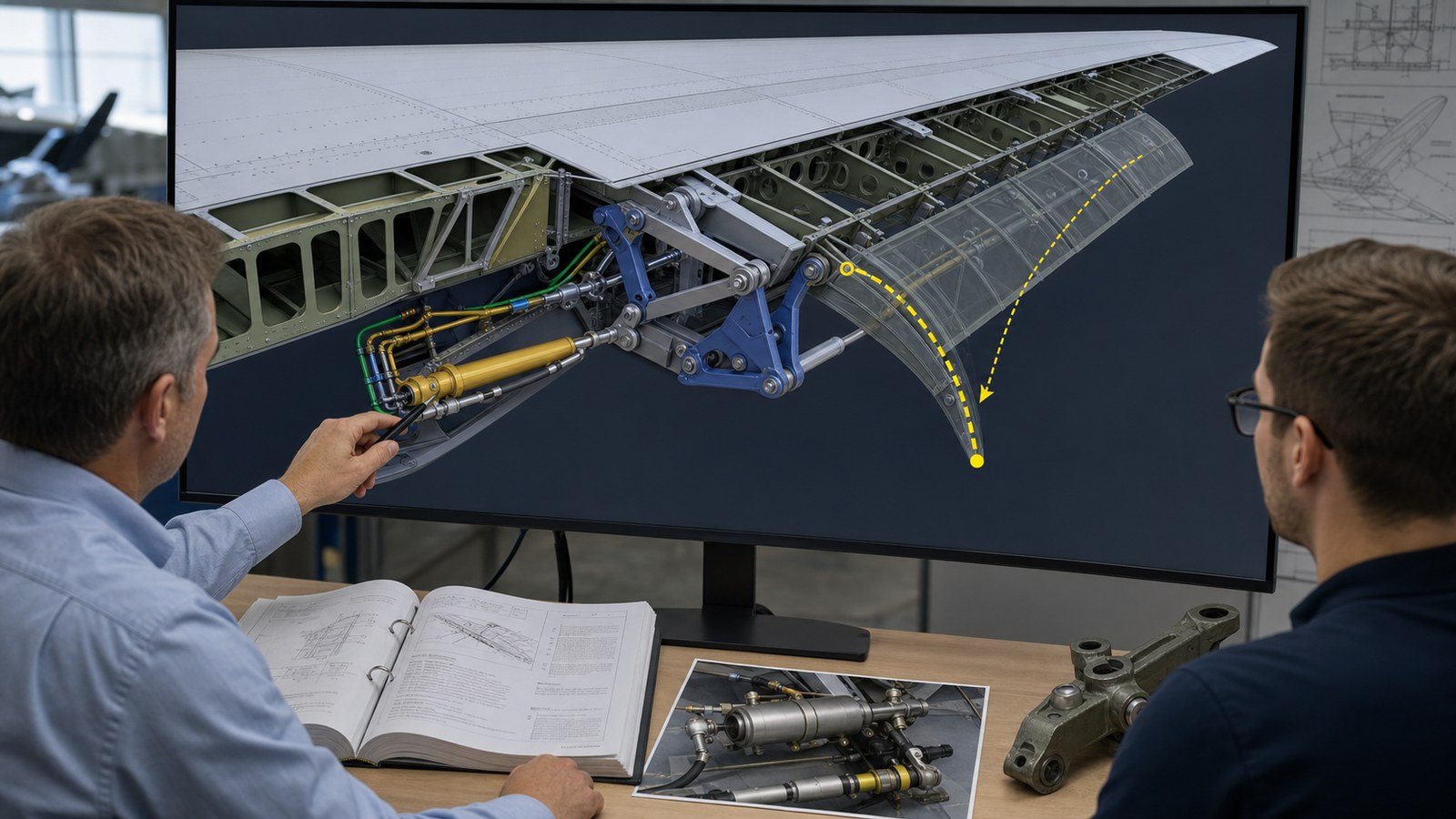
Some cases turn on an assembly hidden inside the aircraft: a flight-control linkage, engine component, fuel pathway, electrical system, landing gear, fastener, structural joint, or maintenance access area. A reviewed 3D cutaway can isolate the component, show its relationship to surrounding systems, and compare normal operation with the failure sequence offered by an expert.
Maintenance manuals, illustrated parts catalogs, engineering drawings, photographs, inspection records, service difficulty reports, exemplar scans, and teardown findings may all inform the model. Representative geometry should be labeled when exact accident-aircraft dimensions are unavailable.
Midair Collisions and Airspace Conflicts
Two-aircraft events can be difficult to understand because each aircraft has its own path, speed, altitude, field of view, and communication timeline. Animation can display both tracks from a neutral overhead view, then examine selected sight lines without claiming that a pilot saw what the camera sees.
Useful layers may include radar coverage, transponder data, traffic-alert indications, sun position, cloud layers, terrain, cockpit geometry, and published procedures. Human-factors opinions about detection, attention, or reaction remain with qualified experts.
Helicopter and Unmanned Aircraft Cases
Rotorcraft and unmanned systems introduce different visual questions, including rotor-disc clearance, tail-rotor relationships, low-altitude obstacles, downwash, payloads, remote-pilot interfaces, command links, battery state, and automated flight modes. The production plan should be tailored to the aircraft rather than applying a fixed-wing template.
What Evidence Can Support an Aviation Animation?
The National Transportation Safety Board explains that flight data recorders can capture parameters such as altitude, airspeed, heading, attitude, configuration, and system status. Modern recorders may contain hundreds or more than a thousand parameters. The agency also uses recorder data to generate computer animation that helps investigators visualize a flight sequence.
That does not mean every civil case has complete recorder data. General aviation aircraft may have different onboard sources, including engine monitors, GPS units, avionics logs, electronic flight bags, cameras, phones, or other personal devices. Ground sources may include radar, ADS-B, airport surveillance, security video, dispatch systems, weather observations, and air traffic recordings.
A practical source inventory may include:
- Flight data recorder information and cockpit voice recorder transcripts available for authorized use
- Radar, ADS-B, GPS, avionics, engine-monitor, and airport-surface data
- Air traffic control audio, transcripts, clearances, and facility records
- Aircraft manuals, maintenance records, component drawings, and service information
- Wreckage photographs, drone imagery, surveys, laser scans, and recovery diagrams
- Airport geometry, terrain, obstacle, lighting, and navigational information
- Weather observations, forecasts, satellite imagery, radar, and lighting conditions
- Witness testimony, exemplar inspections, tests, and qualified expert analyses
The strongest flight data visualization preserves source identity. It should be possible to determine where a parameter came from, how it was synchronized, whether it was filtered or interpolated, and which visual element it controls.
How Is the Evidence Turned Into a Reviewable Sequence?
1. Define the Visual Proposition
Begin with one sentence describing what the animation must help the audience understand. Examples include the relationship between a flight path and terrain, the timing of configuration changes, the operation of a failed component, or the spatial opportunity for two aircraft to detect one another. A narrow proposition controls scope and prevents decorative modeling from overtaking the evidence.
2. Build a Source and Assumption Ledger
Each material element should be linked to a record, calculation, expert instruction, or purposeful simplification. The ledger can identify timestamps, units, coordinate systems, revisions, uncertainty, and reviewer ownership. It also records what is intentionally absent, such as unsupported weather detail, facial expressions, or cockpit actions.
3. Normalize Time, Position, and Coordinate Systems
Aviation sources may use UTC, local time, recorder elapsed time, radar time, video timecode, latitude and longitude, airport coordinates, pressure altitude, geometric altitude, indicated airspeed, groundspeed, or other frames of reference. The reconstruction expert decides how these are reconciled. The visual team implements that approved mapping and keeps transformations traceable.
4. Approve Geometry Before Motion
Aircraft dimensions, control surfaces, cockpit viewpoints, airport layouts, terrain, structures, and component assemblies should be reviewed at a low-detail stage. A visually polished model with the wrong geometry is expensive to correct and can undermine trust.
5. Review an Animatic
The animatic establishes sequence, camera, pacing, labels, data displays, and narration before final rendering. Counsel can evaluate whether the visual matches the intended legal use, while experts verify that movement and timing remain within their opinions.
6. Preserve Version History and Deliverables
Production records should identify source revisions, review notes, approvals, and exported versions. Final delivery may include a master video, silent version, still frames, chaptered segments, captions, presentation files, and a lower-bandwidth backup for courtroom systems.
Our Work samples:
3D Accident Reconstruction Animation
Medical Animation Showreel
SEAGATE Commercial 3D Animation
How Should Uncertainty Be Shown?
Aviation evidence rarely has one uniform level of precision. An FDR parameter may update frequently, radar points may be separated by seconds, a witness estimate may cover a broad range, and wreckage may establish one physical relationship with high confidence. Combining them into one smooth sequence can falsely suggest that every frame was observed.
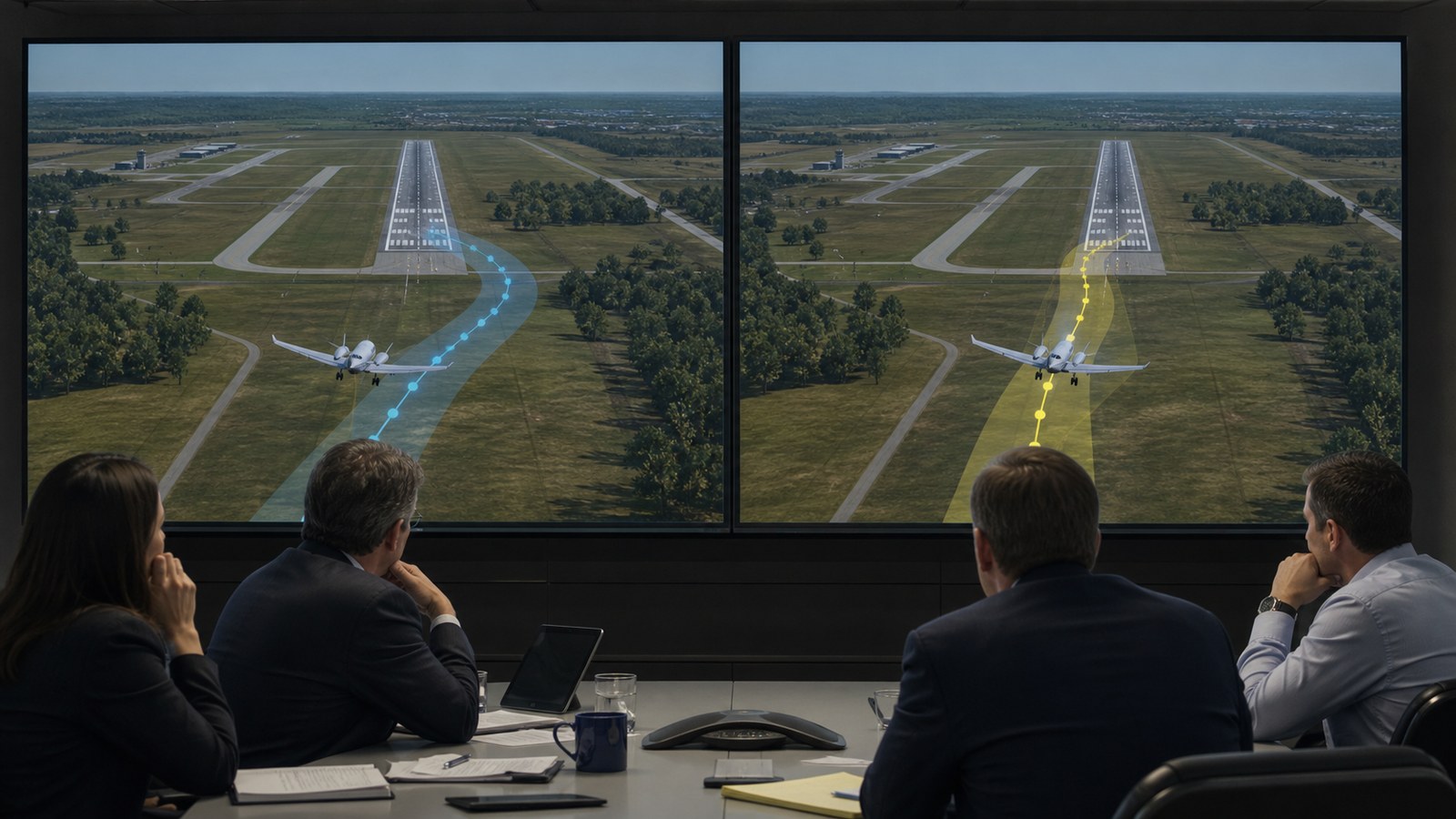
Uncertainty can be represented through position envelopes, error bands, dashed paths, alternate sequences, restrained labels, or a hold on the last recorded value. Interpolation should be disclosed when it materially affects the movement. If competing experts use different inputs, matched views can show both theories with the same scale, clock, aircraft model, and visual treatment.
Good 3D aviation litigation graphics also avoid unsupported sensory claims. A cockpit camera can illustrate geometry, but it does not establish what a pilot noticed. A sound may identify an event when supported by the record, but added cinematic audio can confuse the purpose of the demonstrative.
What Evidence Rules Affect Aviation Legal Animation?
Federal Rule of Evidence 702 addresses qualified expert testimony and requires sufficient facts or data, reliable principles and methods, and reliable application to the case. Rule 901 concerns authentication and includes evidence about a process or system that produces an accurate result. State rules and case law may differ.
Federal Rule 107, effective since December 2024, specifically governs illustrative aids used to help the factfinder understand evidence or argument. It asks courts to balance assistance to comprehension against risks such as unfair prejudice, confusion, misleading the jury, delay, or wasted time. The rule distinguishes an illustrative aid from substantive evidence.
Those categories affect production. An animation illustrating an expert’s disclosed opinion has a different purpose from a computer simulation that generates a conclusion. Counsel should identify the intended use, sponsoring witness, disclosure schedule, foundation, and local requirements before the final render. This article is general information, not legal advice.
How Much Does Aviation Accident Animation Cost?
Cost depends on the number and condition of source files, aircraft and airport modeling, data synchronization, runtime, system complexity, expert-review cycles, alternate scenarios, visual realism, narration, deadlines, and delivery requirements. A focused 2D timeline or flight-path module may require less work than a detailed 3D sequence combining cockpit instruments, terrain, weather, multiple aircraft, and internal components.
A useful proposal separates evidence intake, technical planning, data preparation, modeling, storyboard, animatic, expert review, final rendering, revisions, and presentation support. Early agreement on the decisive question can reduce cost by avoiding geometry and scenes that do not contribute to the explanation.
Why Choose Austin Visuals to Work With?

Austin Visuals brings more than 18 years of custom animation production to cases where technical information must remain understandable without losing its source boundaries. The team can coordinate aircraft models, airport and terrain environments, system cutaways, timelines, instrument graphics, labels, narration, and multiple camera views within one controlled project.
The workflow is built around review. Counsel defines the legal objective. Aviation, reconstruction, engineering, human-factors, weather, maintenance, and medical experts approve the material within their disciplines. Austin Visuals tracks decisions across storyboards, model checks, animatics, and final frames so a late correction does not quietly create inconsistencies elsewhere.
The studio can work on a single decisive sequence or create modular assets for deposition, mediation, trial, and settlement presentations. Learn more about Austin Visuals’ forensic animation services and technical 3D animation workflow.
Our Clients include:

Conclusion
Forensic animation for aviation accident cases is most effective when it converts a complicated record into a visible chain of evidence without pretending to eliminate uncertainty. Recorder parameters, radar, communications, weather, aircraft systems, wreckage, and expert analysis can share one sequence while remaining identifiable as different kinds of information.
The result should be easier to inspect than a cinematic recreation. A narrow visual proposition, synchronized sources, documented assumptions, low-detail reviews, matched comparisons, and disciplined final rendering give counsel and experts a visual that can be understood, challenged, revised, and presented for its intended purpose.
Ready to build an evidence-led aviation demonstrative?Austin Visuals helps legal and expert teams turn flight records, aircraft systems, airport environments, and technical opinions into a clear, reviewable animation while preserving the distinction between measured data, analysis, and visual simplification.
Contact us at info@austinvisuals.com or call (512) 591-8024.
Frequently Asked Questions
What is forensic animation for an aviation accident case?
It is a 2D or 3D litigation-support visual that organizes aviation records and qualified expert analysis into a clear explanation of a flight path, aircraft system, accident sequence, or disputed technical issue.
What data can be used in an aviation accident animation?
Inputs may include flight-recorder parameters, radar, ADS-B, GPS, avionics logs, air traffic communications, weather, airport data, manuals, maintenance records, wreckage documentation, scans, photographs, witness testimony, and expert calculations.
Is a forensic aviation animation the same as a simulation?
No. An animation may illustrate an expert’s existing opinion, while a simulation may apply a computational method to generate a conclusion. The intended use and methodology affect review, disclosure, foundation, and legal treatment.
Can an aviation animation show missing or uncertain data?
Yes. Position envelopes, ranges, dashed paths, labels, alternate scenarios, or disclosed interpolation can communicate uncertainty without presenting estimated movement as directly recorded fact.
How is technical accuracy reviewed?
Counsel and designated experts review the source ledger, geometry, synchronized timeline, storyboard, animatic, data displays, camera views, labels, and final sequence within defined approval stages.
How long does an aviation forensic animation take?
A focused visual may take several weeks. A multi-source sequence with detailed aircraft, airport, terrain, cockpit, system, or competing-scenario work may require eight to sixteen weeks or more.
Does Austin Visuals determine the cause of an aviation accident?
No. Austin Visuals produces the visual under the direction of counsel and qualified experts. Accident-cause opinions, engineering analyses, human-factors conclusions, and evidentiary decisions remain with the responsible professionals and court.