
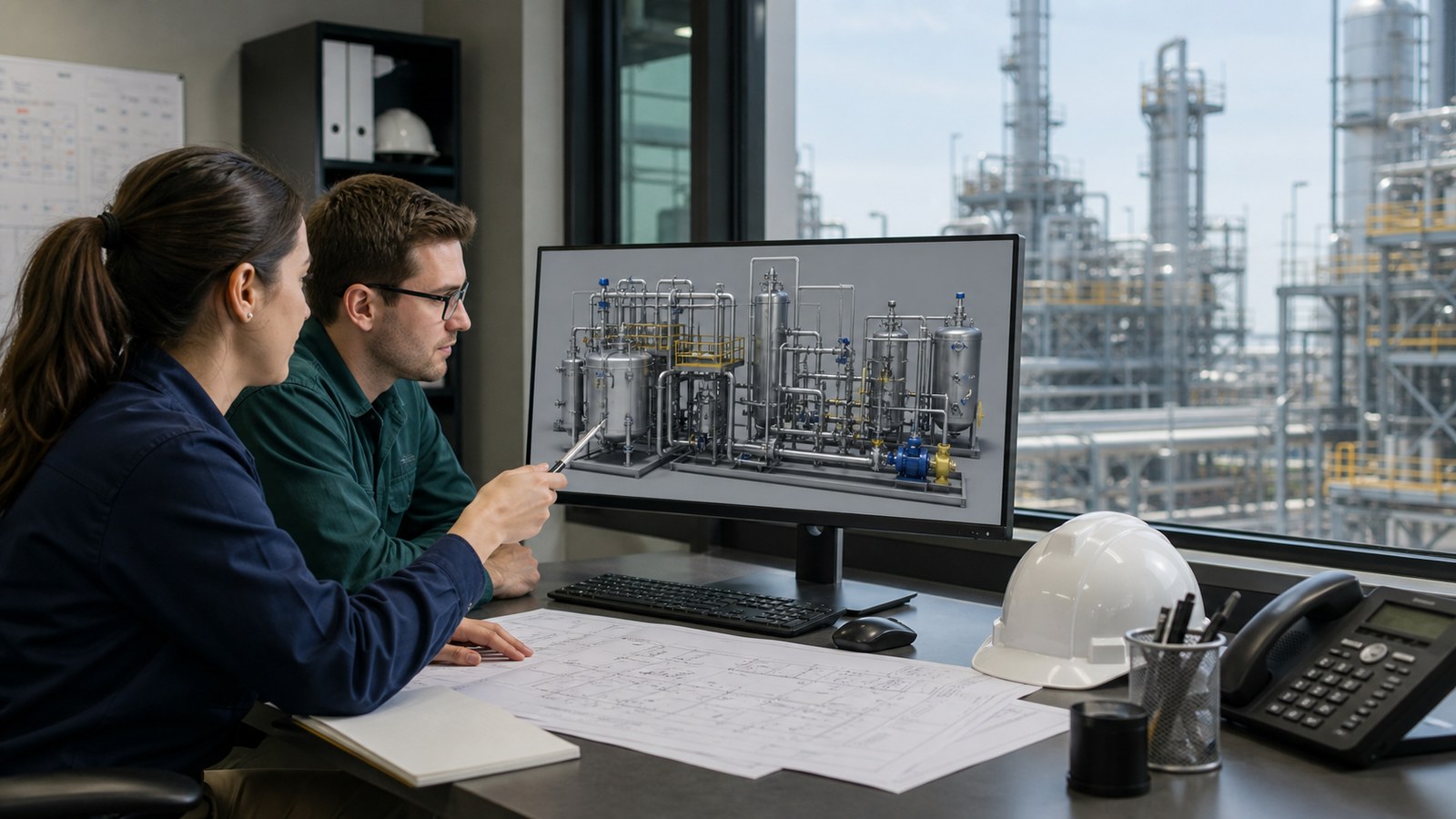
Technical animation for chemical manufacturing directly explains equipment, material flow, operating sequences, controls, and safety concepts that are difficult or unsafe to observe inside a working plant.
Austin Visuals turns approved process information into realistic 3D visuals for engineering communication, training, commissioning, maintenance, and business development. To discuss a project, call (512) 591-8024 or email info@austinvisuals.com.
A chemical process combines physical equipment with chemistry, heat transfer, pressure, flow, control logic, procedures, and human decisions. A useful animation does not simplify those relationships into spectacle. It selects the details an audience needs, records assumptions, and uses staged review so the finished sequence stays aligned with the approved technical basis.
What Is Technical Animation for Chemical Manufacturing?
Technical animation for chemical manufacturing is a structured 2D or 3D representation of a plant, process unit, piece of equipment, or operating event over time. It can establish the complete process train, reveal hidden internals, trace material movement, slow a sequence, compare operating states, or show an approved procedure from a consistent viewpoint.
The format can support batch and continuous manufacturing, specialty chemicals, polymers, coatings, industrial gases, water treatment, petrochemicals, fertilizers, cleaning products, and other process industries. The subject may be one reactor or an integrated line of tanks, pumps, heat exchangers, columns, filters, separators, instruments, utilities, and controls.
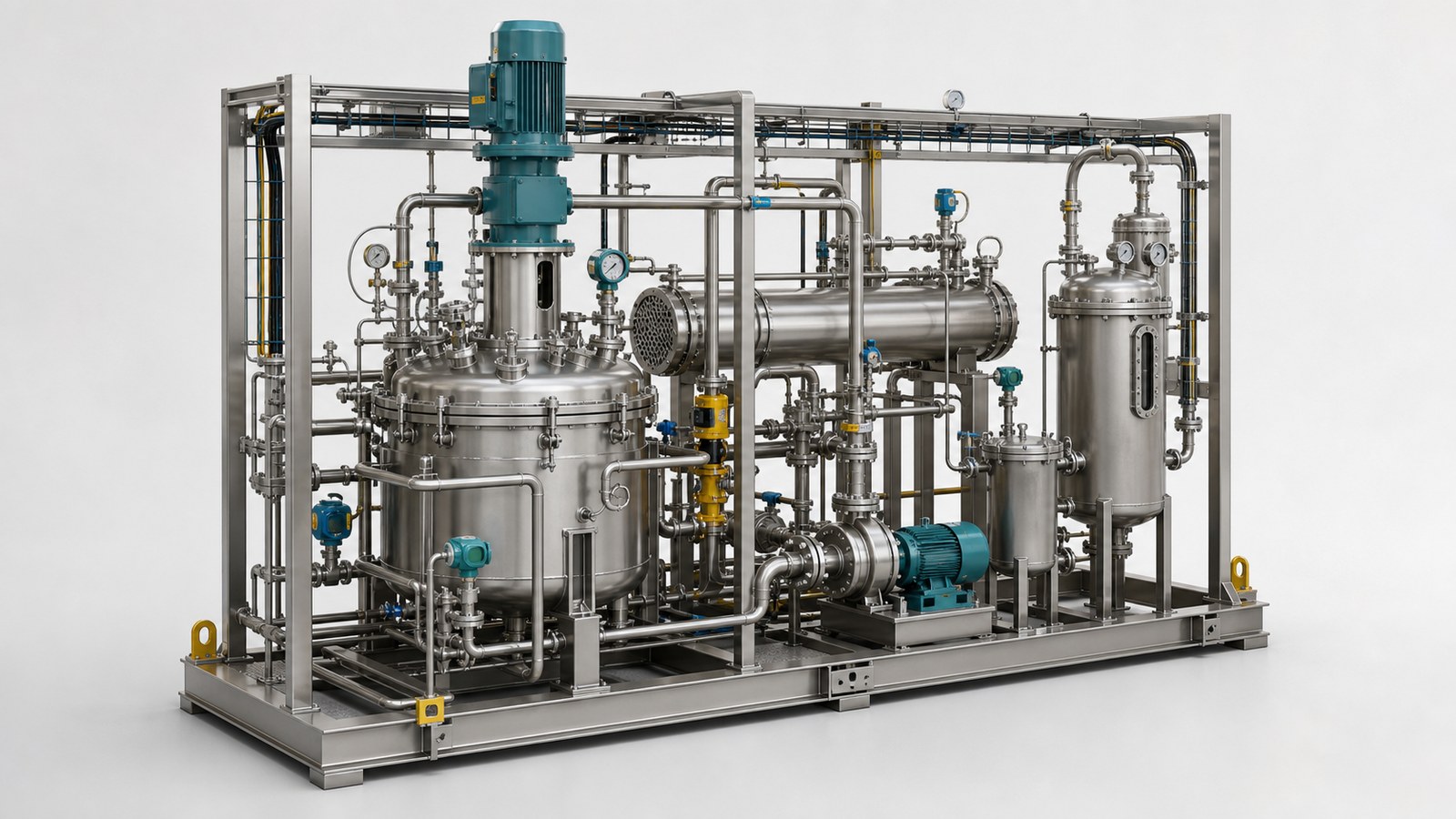
A strong chemical manufacturing visualization gives each audience the right level of information. A new operator may need orientation and sequence. An engineer may need interfaces and process relationships. Maintenance personnel may need isolation boundaries and access. A customer or stakeholder may need a concise explanation of what the system produces and why the design matters.
Why Chemical Processes Are Difficult to Communicate
Most of the important activity is hidden. Liquids and gases move inside opaque piping. Mixing occurs inside closed vessels. Heat crosses jackets and exchanger surfaces. Separation happens within columns, settlers, membranes, filters, or centrifuges. Instruments send signals that are not visible in the physical equipment.
Direct filming has limits as well. The process may be hazardous, confidential, unavailable during production, too large for one camera view, or too slow for a practical explanation. Guards, insulation, enclosures, elevation, and restricted access can prevent a camera from showing the relationship the audience needs.
Industrial process visualization addresses these constraints by controlling viewpoint, timing, opacity, scale, and emphasis. The animator can remove visual clutter, section a vessel, isolate one line, and move between plant-level and equipment-level views. Those choices remain communication devices and require review against the real process.
Map the Complete Process Before Showing Details
The audience should understand where a sequence begins, where it ends, and which equipment performs each major function. A useful overview may establish raw-material receiving, storage, dosing, reaction, heat exchange, separation, purification, filtration, drying, finishing, packaging, recycle, utilities, emissions controls, wastewater handling, and final storage as applicable.
The animation does not need to display every line on a P&ID. It should preserve the relationships required for the communication goal. Major feeds, transfers, recycles, vents, drains, utility connections, and control points should remain accurate when they affect the explanation.
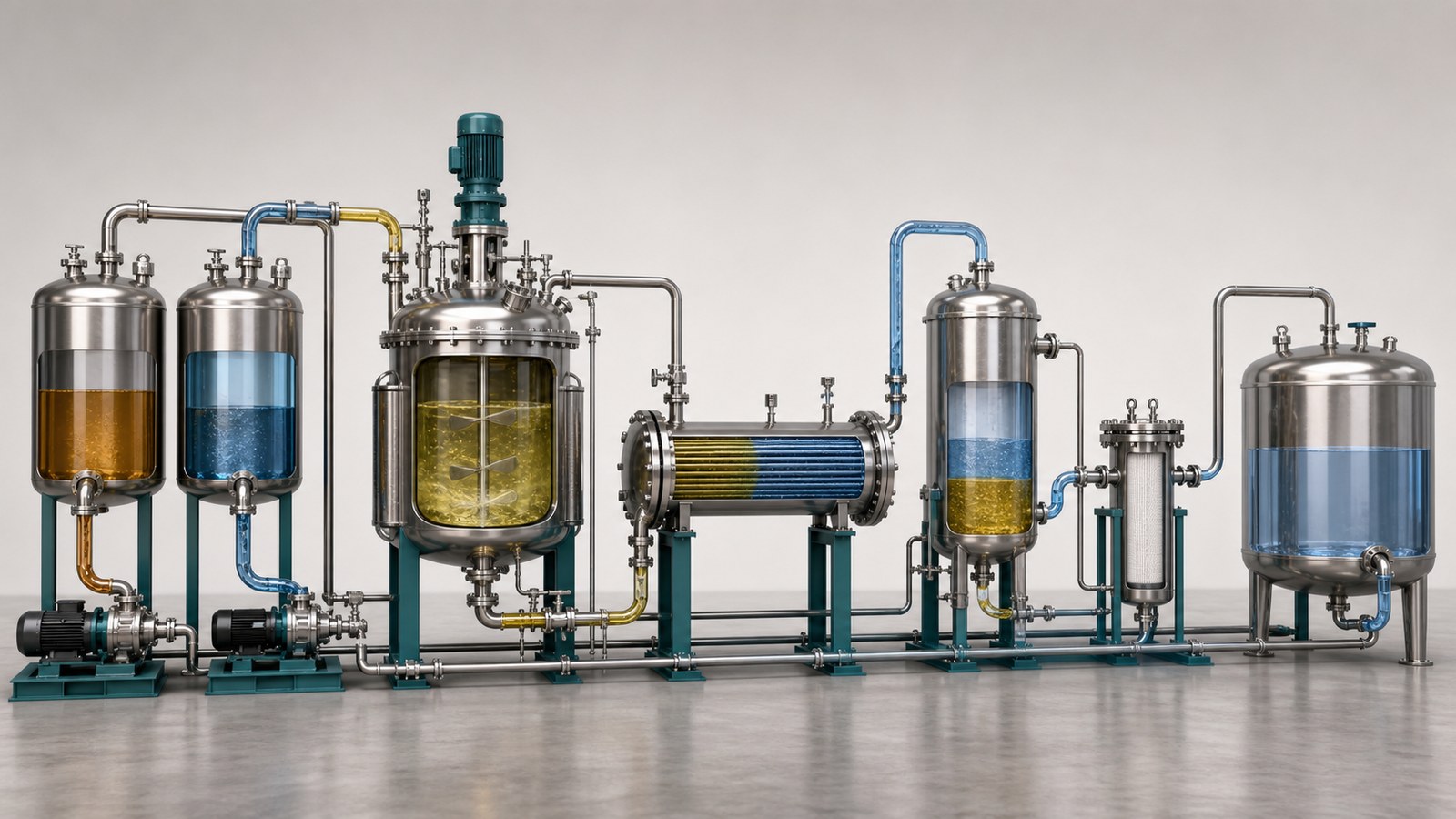
A 3D chemical plant animation can then move from the process overview to a specific reactor, exchanger, filter, or control loop. This hierarchy helps a viewer retain context when the housing becomes transparent or the camera follows material into equipment.
Show Material Flow Without Inventing Chemistry
Color is one of the clearest ways to distinguish feeds, intermediates, product, recycle, utilities, and waste streams. Transparency can show material inside piping. Particles can suggest mixing or dispersion. A time-compressed sequence can make a long batch cycle understandable within minutes.
These methods need boundaries. Color does not establish chemical composition. Particle motion does not prove molecular behavior. A glowing reaction front does not demonstrate kinetics. The animation should use process data, operating narratives, mass and energy balances, test information, or approved subject-matter input to define what happens and when.
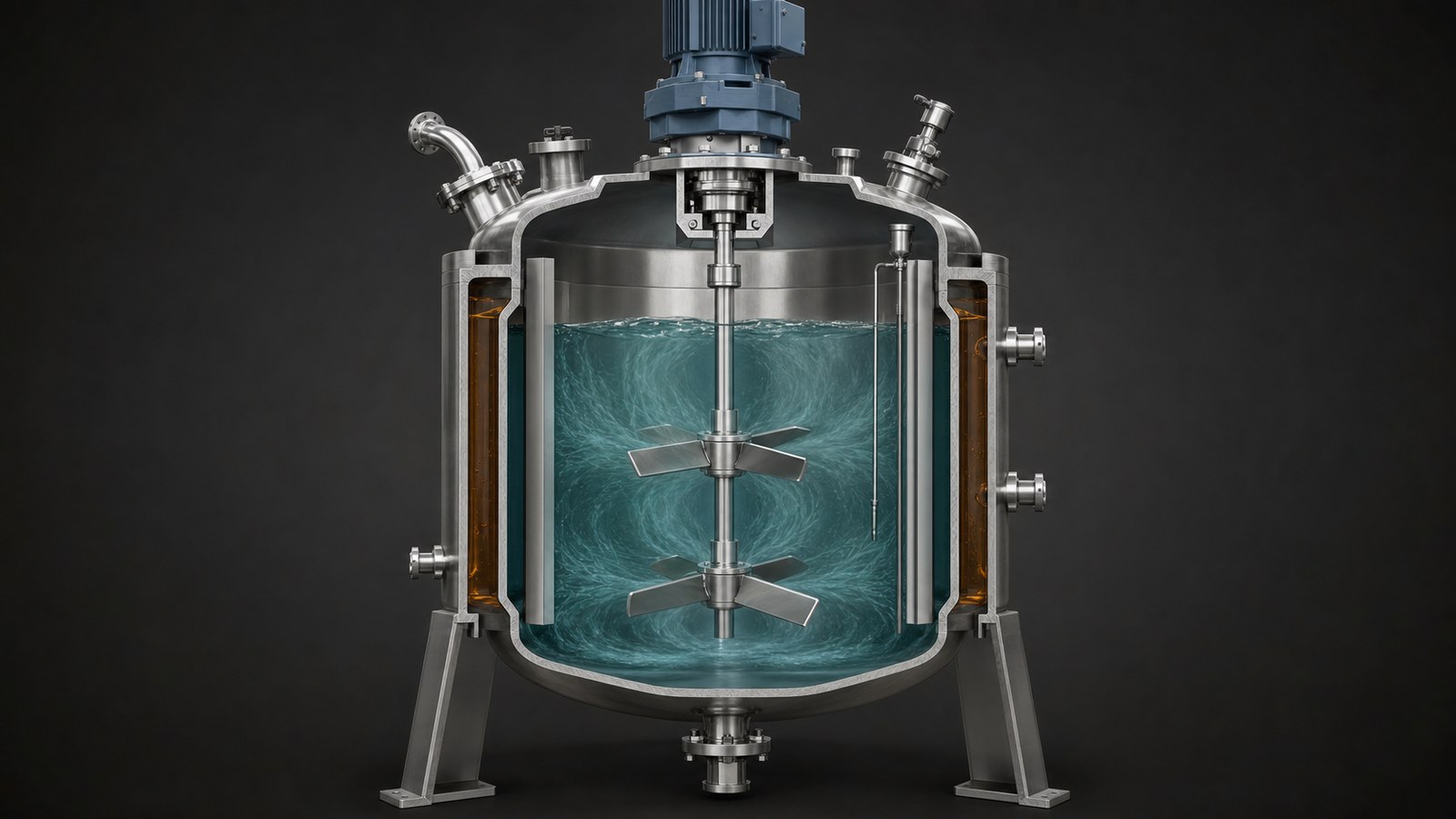
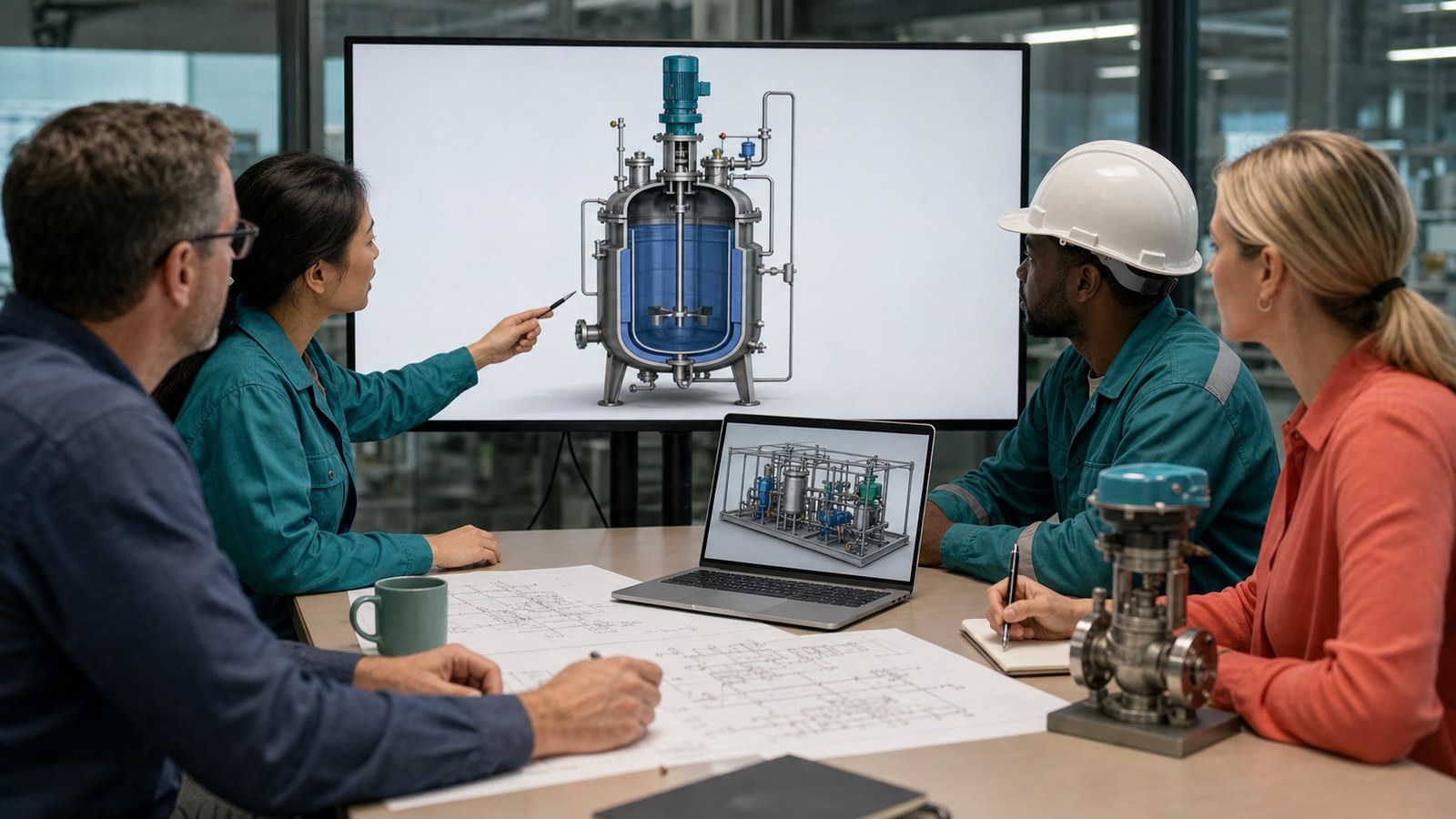
A reactor animation might show charging, agitation, jacket heating or cooling, a controlled addition, hold time, sampling, and transfer. It can reveal impellers, baffles, probes, liquid level, headspace, and the jacket. If temperature, pressure, concentration, phase, or reaction progress appears on screen, the client should approve the value, unit, time basis, and source.
Represent Reaction, Heat Transfer, and Separation Carefully
Animation can explain cause and effect without claiming to calculate it. For example, the sequence can show two feeds entering an agitated vessel, heat leaving through a jacket, product moving through an exchanger, and phases separating in a downstream vessel. That is a communication model of an approved process narrative.
When the client supplies validated CFD, process simulation, residence-time, temperature, pressure, concentration, or other analysis results, those results can be incorporated. The visual should preserve legends, units, ranges, geometry, time scale, and stated assumptions. Representative color fields should not be presented as calculated output.

The same discipline applies to filtration, distillation, absorption, extraction, crystallization, evaporation, drying, and other unit operations. A section view may reveal where material enters and leaves, but the separation mechanism and operating condition must match the specific equipment and process.
Use the Right Engineering and Operating Sources
Accuracy begins with source control. Useful inputs may include process flow diagrams, P&IDs, equipment data sheets, 3D CAD or plant models, general arrangements, line lists, valve and instrument information, mass and energy balances, control narratives, operating procedures, maintenance instructions, material references, safety information, photographs, and approved process descriptions.
Each source has a different purpose. A PFD establishes major equipment and process streams. A P&ID provides piping, valves, instruments, and control relationships. CAD defines geometry and layout. Procedures establish sequence and responsibility. Safety information identifies hazards and required controls. None should be treated as a substitute for another.
Revision status matters. The team should record drawing numbers, model versions, equipment configuration, operating mode, and the date of the process basis. Confidential or trade-secret information should be handled according to the client’s approved security and access requirements.
Support Process Safety Training Without Replacing It
A process safety training animation can give workers a consistent view of equipment relationships, normal operating sequence, isolation boundaries, and approved responses. It can slow fast events, repeat a decision point, and reveal hidden paths without placing learners near an active process.
OSHA’s Process Safety Management framework addresses hazards associated with processes involving highly hazardous chemicals. Its guidance emphasizes complete and accurate process safety information, operating procedures, training, mechanical integrity, management of change, incident investigation, and emergency planning among other elements. Animation can support communication within those programs, but it does not create compliance by itself.
The U.S. Chemical Safety Board has also used computer animation to explain the sequence of events in chemical incidents, including a runaway reaction at T2 Laboratories. That example shows the value of a reviewed visual timeline, not permission to dramatize an event. Incident animation should distinguish evidence, calculations, witness information, assumptions, and illustrative transitions.
Training visuals must follow the employer’s approved procedures and safe state. They should not invent valve lineups, bypasses, emergency actions, lockout/tagout steps, PPE, or alarm responses. Competency evaluation and hands-on instruction remain part of the training system.
Separate Animation from Process Simulation
Chemical process animation and process simulation can look similar on screen, but their purposes differ. Simulation calculates process behavior using models, properties, equations, inputs, and boundary conditions. Animation controls visual objects over time to explain a supplied sequence or dataset.
An animation can accurately reproduce a simulated result when the team receives the approved output and understands how it should be interpreted. Without that data, the visual should be labeled or described as representative. This distinction protects technical credibility and prevents a polished rendering from implying unsupported precision.
The same rule applies to CFD, finite-element analysis, dispersion modeling, dynamic simulation, and digital twins. Animation can make results easier to understand, but it does not independently validate the model, inputs, solver, or engineering conclusion.
Apply Animation Across the Chemical Manufacturing Lifecycle
One approved model can support several communication needs when each output is adapted and reviewed:
Well-planned technical animation for chemical plants can follow the same approved visual foundation across design, operations, training, maintenance, and external communication while changing the detail and narration for each audience.
- Design and layout review: explain equipment relationships, access, sequencing, and interfaces before construction or modification.
- Commissioning and startup communication: orient teams to systems and approved sequence while preserving the authority of current procedures.
- Operator and contractor training: show process context, normal operation, hazards, boundaries, and role-specific information.
- Maintenance planning: reveal internals, isolation, access, removal paths, and approved service sequence.
- Management of change: communicate an approved change and the affected equipment, sequence, or procedure.
- Business development: explain proprietary equipment or process value at a level authorized for customers and stakeholders.
- Incident communication: present a sourced sequence while clearly separating established facts, analysis, and illustrative content.
Teams that need a broader introduction can also review Austin Visuals’ guide to technical animation for complex concepts. The link fits this topic cluster because chemical manufacturing is one example of a complex technical subject that benefits from a structured visual explanation.
Build an Accuracy-First Production Workflow
The project begins by defining the audience, main question, permitted information, intended use, runtime, outputs, and approval team. Source files are inventoried and assigned revision status. Missing information becomes an assumption list rather than an invitation to guess.
The script states what the viewer should understand and identifies the source for each technical statement. Storyboards establish process scope, camera position, cutaways, material colors, labels, units, sequence, and explanatory conventions. A low-resolution animatic then lets reviewers evaluate logic and timing before final rendering.
A practical review sequence includes:
- Process review: confirm equipment, streams, operating mode, sequence, recycle, utilities, and boundaries.
- Equipment review: confirm geometry, internals, nozzles, supports, valves, instruments, and service access.
- Safety review: confirm hazards, safe state, PPE, isolation, guards, alarms, and approved responses shown.
- Communication review: confirm audience level, terminology, labels, legends, narration, and representative conventions.
- Delivery review: approve the master before creating training, presentation, web, trade-show, or social versions.
Cross-functional review may involve process engineers, operators, maintenance personnel, process safety specialists, environmental teams, product owners, legal reviewers, and communication stakeholders. The required group depends on the subject and use.
Why Choose Austin Visuals for Chemical Manufacturing Animation?

Austin Visuals helps chemical manufacturers, technology providers, engineering firms, training teams, and industrial organizations turn complex systems into clear visual communication. Our team can support discovery, script development, storyboarding, CAD preparation, equipment modeling, process animation, motion graphics, voiceover, editing, and multi-format delivery.
We organize production around staged review with client-designated experts. Equipment, piping, process sequence, material paths, operating states, safety context, labels, and claims can be approved before final rendering. We also document representative conventions and avoid presenting illustrative effects as new simulation results.
A shared asset can support design communication, operator orientation, maintenance modules, management-of-change communication, customer presentations, trade-show media, and still graphics when each version is reviewed for its purpose. Contact Austin Visuals at (512) 591-8024 or info@austinvisuals.com to discuss your process, source files, security requirements, audience, and schedule.
Our Clients include:

Conclusion
Technical animation for chemical manufacturing makes closed equipment, hidden material paths, operating sequences, and safety context easier to understand. Its value depends on current source information, explicit assumptions, disciplined visual conventions, and review by the people who understand the real process. Used that way, one approved visual foundation can support technical, training, and business communication without replacing engineering analysis or plant procedures.
Make your chemical manufacturing process easier to understand.
Austin Visuals creates realistic plant overviews, equipment cutaways, material-flow animation, operator-training visuals, and technical presentation assets with staged expert review.
Call (512) 591-8024 or email info@austinvisuals.com to discuss your project.
Frequently Asked Questions
What is technical animation for chemical manufacturing?
Technical animation for chemical manufacturing is a 2D or 3D visualization that explains process equipment, material movement, operating sequences, controls, maintenance, or safety concepts. It turns approved engineering and operating information into a visual sequence without replacing formal design documents or training requirements.
How is 3D animation used in chemical plants?
3D animation is used in chemical plants for process orientation, operator and maintenance training, design communication, commissioning support, management-of-change communication, stakeholder presentations, and equipment marketing. Each use requires an edit and review appropriate to its audience.
Can animation show chemical reactions inside process equipment?
Yes, animation can represent mixing, reaction stages, heat transfer, phase behavior, or material conversion when those visuals are based on approved process knowledge. Colors, particles, transparency, and time compression must be identified as explanatory conventions rather than literal molecular simulation unless validated analysis data is supplied.
What files are needed for chemical process animation?
Useful inputs include process flow diagrams, P&IDs, equipment data sheets, 3D CAD or plant models, general arrangements, mass and energy balances, control narratives, operating procedures, safety information, product references, and a list of authorized technical reviewers.
Can chemical process animation support operator safety training?
Yes, chemical process animation can support training by showing normal sequences, equipment relationships, isolation boundaries, and approved responses from a consistent viewpoint. It should supplement the employer’s procedures, hazard communication, process safety program, hands-on instruction, and competency evaluation rather than replace them.
Is chemical process animation the same as process simulation or CFD?
No, chemical process animation is not automatically process simulation or CFD. Simulation calculates behavior from defined models and inputs, while animation communicates prescribed motion, approved process logic, measured data, or supplied analysis results in a visual form.
How long does a technical animation for a chemical plant take?
Production time depends on runtime, source-file readiness, plant complexity, modeling requirements, process detail, review availability, rendering, narration, and delivery formats. A reliable schedule is created after the team defines the communication goal, technical basis, reviewers, and approval stages.