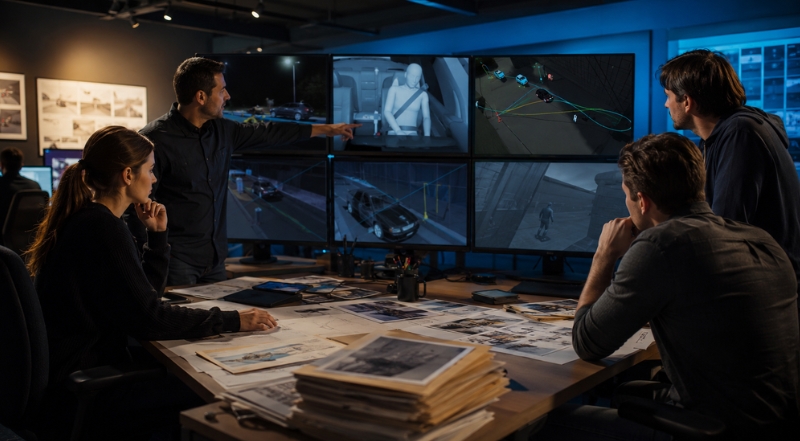
Product liability cases often hinge on events that happened in seconds and mechanisms that are difficult to describe in words. When a plaintiff or defendant needs to show exactly how a product failed, how a design choice led to injury, or why a safety system did not prevent harm, forensic animation in product liability law becomes one of the most effective tools available.
Austin Visuals has produced forensic animations for legal teams handling mechanical failures, consumer product defects, industrial equipment accidents, and medical device cases. These animations translate engineering data, expert reports, and physical evidence into clear visual sequences that courts can admit and juries can understand.
Forensic animation in product liability law is not general illustration. It is a reconstruction built from the evidentiary record. Every dimension, movement, and failure sequence must be traceable to documents, measurements, or expert analysis already in the case file.
What Forensic Animation Shows in Product Liability Cases
In product liability litigation, the central questions usually involve design, manufacturing, warnings, or causation. Attorneys need to answer:
- How did the product behave under normal use?
- What changed in the moments before failure?
- Could an alternative design have prevented the injury?
Forensic animation answers these questions by showing the internal mechanics that witnesses can only describe. A 3D model of a hydraulic press, a consumer appliance, or a vehicle component can demonstrate exactly where forces concentrated, where a guard was absent, or how a material deformed under load.
The animation does not replace expert testimony. It visualizes the expert’s conclusions so the jury can see the sequence rather than imagine it from spoken description alone.
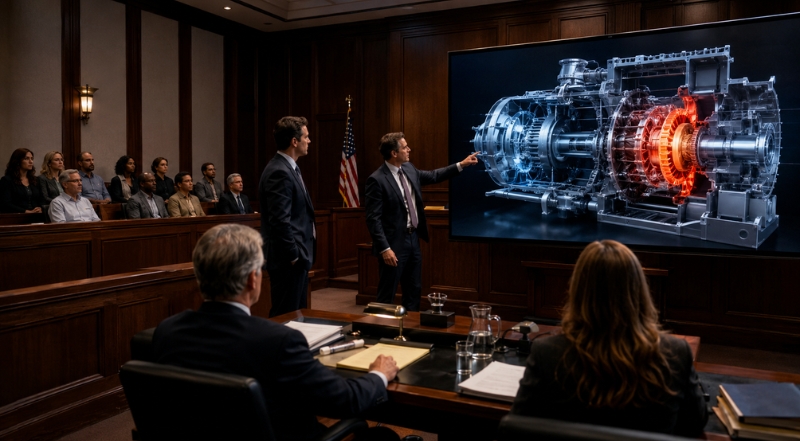
Courtroom technical animation showing industrial machinery failure for legal litigation
Why Product Liability Cases Need Visual Reconstruction
Jurors are not engineers. They do not spend their days reading stress-strain curves or failure analysis reports. When an expert describes a fatigue crack propagating through a metal component or a pressure relief valve that did not open in time, the technical detail can be lost.
Research on juror comprehension consistently shows that visual presentation improves retention and understanding compared with verbal testimony only. Forensic animation in product liability law gives the jury a reference point they can watch, pause, and review during deliberations.
For plaintiffs, the animation can connect a specific design decision or manufacturing defect directly to the injury. For defendants, it can demonstrate that the product performed within specifications and that misuse or external factors caused the harm. Either side can use the same tool to present its technical narrative clearly and credibly.
Industries That Rely on Forensic Animation for Product Liability
Certain product categories appear more frequently in litigation because the consequences of failure are severe or the technical explanation is genuinely complex. These include:
- Automotive and heavy equipment components
- Industrial machinery and presses
- Consumer appliances and power tools
- Medical devices and implants
- Pressure vessels, valves, and piping systems
- Construction and agricultural equipment
Each of these categories involves moving parts, material properties, or control systems that are difficult to convey without visual support. Forensic animation in product liability law has become a standard part of discovery and trial preparation across these industries.
Legal teams working on personal injury cases involving product defects frequently commission animations at the expert disclosure phase so the sequence can be reviewed, refined, and ready before depositions begin.
How a Court-Admissible Forensic Animation Is Produced
The production process for litigation work differs significantly from commercial animation. Accuracy and documentation take priority over visual style. A beautiful render that misrepresents the physics of the failure does more harm than good in court.
The workflow typically follows these steps:
- Evidence review and technical brief — The animation team receives all relevant materials: CAD files, engineering drawings, maintenance records, expert reports, deposition transcripts, and photographs. A written brief outlines the exact sequence to be shown and the data sources supporting each element.
- Expert validation — The qualified expert who will sponsor the animation reviews and approves the brief before modeling begins. This step is critical for admissibility.
- 3D modeling and animation — Models are built to scale using the provided measurements and CAD data. Movements and failure sequences follow the parameters established in the approved brief.
- Review and revision — The expert and legal team review drafts for technical accuracy. Changes are documented with version control so the revision history is available if challenged.
- Final deliverable and authentication package — The finished animation is exported in the required format with supporting documentation the expert can use to authenticate the work during testimony.
This process usually takes four to ten weeks depending on complexity and the number of revision cycles required by the expert and legal team.
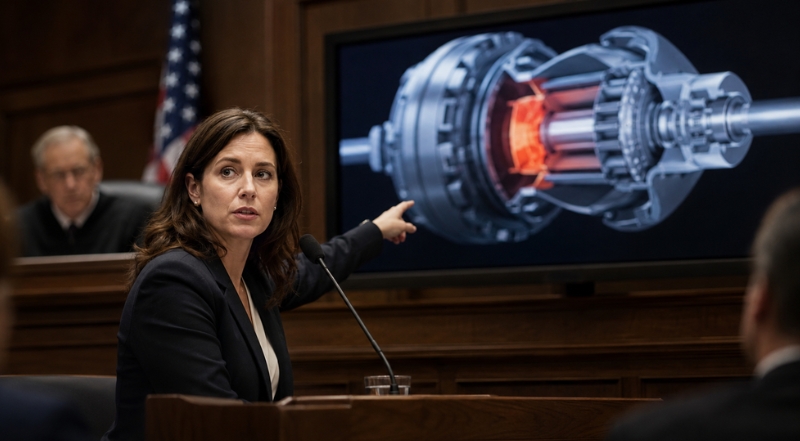
Courtroom Technical Animation Industrial Machinery Cutaway Legal Expert Testimony
Admissibility Standards for Forensic Animation
Courts evaluate forensic animations under the same standards that govern demonstrative evidence and expert testimony generally. The animation must be relevant, based on sufficient facts or data, and the product of reliable principles and methods applied correctly to the facts of the case.
Key requirements include:
- The animation must fairly and accurately reflect the evidence already in the record.
- It must be sponsored by a qualified expert who can explain and defend the methodology.
- It must not mislead the jury or create unfair prejudice by dramatizing events beyond what the evidence supports.
Studios that produce forensic animation in product liability law work closely with counsel and experts to meet these standards at every stage. The animation is a visual aid that strengthens expert testimony — not a standalone dramatization designed to provoke an emotional response.
Attorneys preparing for trial should also consider how trial graphics and legal visuals support juror comprehension more broadly, especially in cases where the animation is one part of a larger visual evidence package.
Forensic Animation vs. Legal Illustration: Knowing the Difference
Not every visual aid used in product liability litigation is a forensic animation. Courts and counsel often distinguish between forensic animation — which reconstructs a specific event based on evidence — and demonstrative illustration, which explains a general concept or mechanism without purporting to recreate what actually happened.
The distinction matters for admissibility. An animation labeled as a reconstruction of the incident carries a higher evidentiary burden than a diagram that explains how a valve is supposed to work under normal conditions. Legal teams need to be clear about which type of visual aid they are commissioning and how it will be characterized at trial.
Austin Visuals can produce both types of visuals and advises counsel on the appropriate framing for each. Sometimes a combination works best: a general mechanism animation to establish context, followed by a reconstruction sequence showing how the specific product deviated from expected behavior.
Planning and Budget Considerations for Legal Animation
Forensic animation for product liability cases is not a commodity purchase. The cost reflects the complexity of the mechanical systems involved, the availability and quality of technical data, the number of expert review cycles required, and the resolution needed for courtroom display.
Simpler cases involving a single mechanical component with clear CAD data available may be completed for less than more complex multi-system reconstructions involving fluid dynamics, structural deformation, or controlled burn sequences. Legal teams should plan for expert involvement throughout the production process, not just at final review.
Budget discussions should start early. Waiting until thirty days before trial to commission a forensic animation is a common mistake. The process requires time to do correctly, and rushed production increases the risk of technical errors that opposing counsel will exploit on cross-examination.
Why Legal Teams Choose Austin Visuals for Forensic Work
Austin Visuals has produced animations used in depositions, mediations, and trials across multiple jurisdictions. The studio’s approach emphasizes technical accuracy over visual flair. Every project begins with the question: “What does the expert need the jury to see, and what evidence supports it?”
The team is experienced in working under attorney-client privilege, maintaining strict version control, and delivering files in formats that integrate with modern courtroom presentation systems. When opposing counsel presents their own animation, Austin Visuals can also prepare rebuttal sequences that address specific claims point by point.
The studio’s background in legal and forensic animation spans personal injury, wrongful death, patent disputes, and product liability cases involving medical devices, industrial equipment, and consumer products. That breadth of technical experience matters when the subject matter is outside the typical range of commercial animation work.
For cases involving medical devices specifically, the studio’s experience with medical device animation provides additional depth in modeling biological interactions and implant mechanics that general forensic studios may not have.
Our Clients include:

Conclusion
Forensic animation in product liability law gives legal teams a direct path from technical complexity to jury comprehension. When the case depends on showing how a product failed — not just describing it — a well-produced animation built from the evidentiary record can be the difference between a verdict based on confusion and one based on genuine understanding.
The tools and production methodology exist to do this work accurately and defensibly. What matters is starting early, keeping the expert central to every decision, and working with a studio that treats precision as a non-negotiable requirement rather than an optional feature.
Frequently Asked Questions
How is forensic animation different from regular 3D animation?
Forensic animation in product liability law is built exclusively from case evidence and expert analysis. Every dimension, timing, and mechanical interaction must be traceable to documents already in the record. Commercial animation has no such constraint.
Will a forensic animation be admissible in court?
Admissibility depends on accuracy, methodology, and proper sponsorship by a qualified expert. Austin Visuals structures every litigation project to meet these requirements from the first brief through final delivery.
How long does it take to produce a forensic animation?
Most projects require four to ten weeks, depending on complexity and the number of expert review cycles needed.
Can the same animation be used for settlement negotiations?
Yes. Many cases resolve after both parties review the visual evidence during mediation. A clear animation often narrows the gap between positions before the matter reaches trial.
What materials are needed to begin production?
CAD files, engineering drawings, expert reports, photographs of the product and scene, and any measurements or test data already produced in discovery. The more complete the technical record, the faster and more accurate the production process.
Do you work with both plaintiff and defense teams?
Austin Visuals works with counsel on either side of a case, provided the project meets professional and ethical standards for demonstrative evidence.
Can you create a counter-animation if the opposing party presents one?
Yes. The studio regularly prepares rebuttal sequences that address specific technical claims in opposing animations, often with side-by-side comparison sequences that highlight discrepancies.
Related Posts
- Legal & Forensic Animation: Turning Complex Evidence into Jury-Friendly Visuals
- Legal Graphics & Trial Graphics: The Growing Role of Visuals in the Courtroom
- 3D Forensic Animation Services for Personal Injury Cases
- Legal Animation Company for Courtroom Presentations
- Legal Animation in Intellectual Property and Patent Cases
Need forensic animation for a product liability case? Contact Austin Visuals to discuss your project. Our team works directly with attorneys and experts to build technically accurate, court-ready visual reconstructions that hold up under cross-examination.